Follow us on Facebook @FHofDW
2 St. George’s Road
(formerly number 1)
&
The Men & Women Who Lived There
1803-1955
Town Hall St. George’s Road
In 1741 the pipemaker, Thomas Kipps, sold his ‘messuage and appurtenances’, that is his house, land and outbuildings, known as the ‘Bear Pump’ to Sarah Gilbert who, at her death in 1748, bequeathed it to her daughter, Sarah Friend, who in 1781 sold it to John Friend, a brewer from Hythe. By this time a Deal bricklayer, William Wilds, was leasing the said ‘messuage and appurtenances’, which he then purchased from John Friend in 1782. It then remained in William’s possession until he sold it to the Mayor, ‘Jurats and Commonalty of Deal’ in 1802 on which to build the new Town Hall and Gaol.
In 1810 Barrodal Robert Dodds surveyed the Borough of Deal and surrounding area, in order to find a way of bringing fresh water into the town. The map he produced clearly shows that St. George’s Road, from West Street to High Street, was laid out and had a number of buildings sitting on it. Thirty or so years later, when the 1843 Tithe Map was produced, not much had changed. From 1843 the few remaining former market gardens, fronting St. George’s Road, were sold off as building plots.
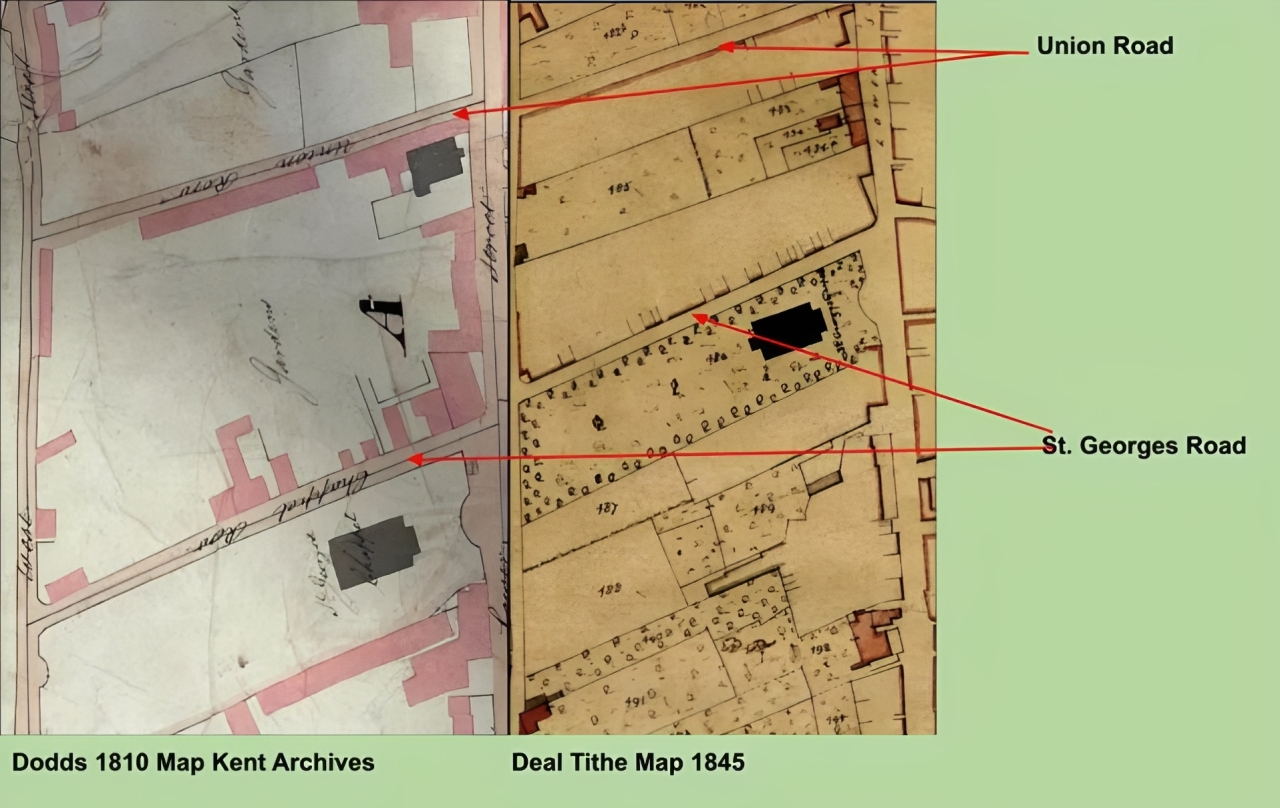
As mentioned in The History of St. George’s Road: High Street to West Street, the name of the road changed several times before it settled into today’s St. George’s Road. Then, in 1952, the road was renumbered so that all the properties from High Street to West Street were given even numbers and those from West Street to St. Patrick’s Road odd numbers.
2 St. George’s Road, (formerly number 1)
Thomas Langley
When the new Town Hall was built in 1803 a tied residence for the Town Gaoler was included. So, when the former messuage, owned by William Wilds, was demolished and the Town Hall foundations laid in 1803, the foundations for that residence, today’s 2 St. George’s Road, were also laid. When built, its first occupants were Constable and Gaoler, Thomas Langley and his second wife Frances Woodcock.
When Thomas Langley married his first wife, Catherine Pettet, in 1801, he may already have been a parish constable. He certainly was in 1803 when he is recorded on the Deal Lieutenancy Papers and as such was exempt from being called to serve in the event of a French invasion. After Catherine’s death in 1804, Thomas, in 1805, married Frances Woodcock, and the couple went on to have nine children, all of whom grew up in the house attached to the police station and town gaol.
It seems strange to us today, to live in such close quarters with not only a police station but also a town gaol, also referred to as a lock-up, where sometimes dangerous criminals were held until their transfer to a more secure facility, and, maybe more worryingly, from where some prisoners were able to escape.
Three such escapees were Henry Baily, Thomas Lake and John Splicewell, who in 1807 broke out of the new Town Gaol “….all dressed in sailor’s wearing-apparell…” Ten guineas were put up as a reward for their apprehension. What crime they had committed, and if they were caught, returned to gaol and sentenced, is lost in time.
In 1823 and 1824 Thomas was involved in two murder cases. The first was of a father shot by his nineteen-year-old son in April 1823. The son, Joseph Bell, had obtained a gun and bought a penny-worth of gunpowder from the local grocer and, on the evening of 19th April, he stood outside his home and looked through the closed window to see his father sitting by the fire, whereupon he took aim and shot his father. In giving evidence, Thomas Langley explained how he had seen a footprint in the freshly turned soil of the flower bed below the window through which Mr. Bell had been shot. On comparing it with Joseph’s shoes, it was a match. Joseph Bell was convicted of murder and hanged on Penenden Heath.
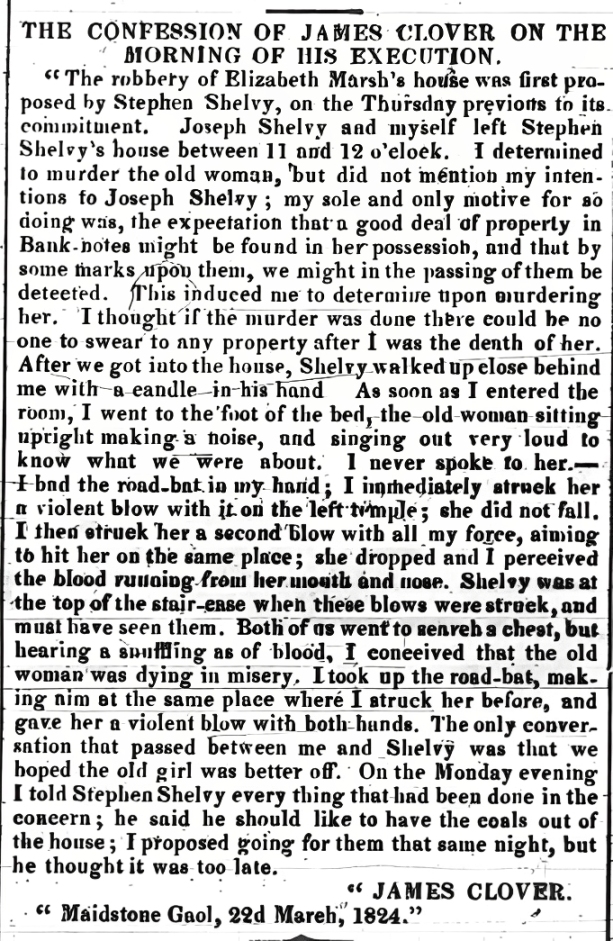
Maidstone Journal and Kentish 23 March 1824
The second murder, that of Elizabeth Marsh, a somewhat eccentric woman who lived alone, took place in Sholden. Her murder occurred during a planned robbery by four people, three of whom were siblings. The outcome of the robbery left the defenceless Elizabeth Marsh brutally murdered by James Clover. Following their arrest by “…Langley the indefatigable Constable of Deal…” Joseph, Stephen and Hester Shelvey and John Clover were all committed to Maidstone Gaol and put on trial. Stephen Shelvey was transported for life; with no evidence against Joseph and Hester, they were both discharged. James Clover was sentenced to death and hanged on Penenden Heath.
In 1825 the gaol was deemed “insufficient and inconvenient”, and it was recommended that it be enlarged with the purchase of property immediately behind and adjoining the gaol and the Town Hall.
Thomas held the position of Town Gaoler until around 1848, when it became the responsibility of the town’s new Inspector of Police, Joseph Boyd. That being so, it seems likely that it was then that Thomas moved out of 2, St. George’s Road. Joseph Boyd’s tenure in Deal was to be short. By 1850, after a Government Inspector had raised concerns over his “slackness” he was dismissed and given two months’ pay as compensation and the town’s police were once again reorganised.
Throughout his long career, Thomas dealt with many crimes including drunkenness, sheep stealing and a riot at Deal Workhouse. As well as holding the positions of Constable and Gaoler, he was elected Town Sergeant in around 1813, a position he held until his death in 1860 when former Mayor, Samuel Wellard West, said “…We believe him to have been one of the most efficient and best town sergeants ever possessed by any town, and we now express our warmest sympathies with the surviving family for the loss they have sustained…” It was proposed and unanimously carried that his salary be paid to his wife until 9 May.
The Watch Committee
As elsewhere, Deal had parish constables and nightwatchmen to help keep order. These men were usually unpaid but, in 1835 when the Municipal Corporations Act came into force, Deal became one of the 178 new Boroughs required to establish Watch Committees whose role was to supervise the new paid night-time police force of the town. Deal’s Watch Committee was founded in January 1836 with the appointment of Mayor Comfort Kingsmill, an alderman and five councillors who appointed butcher George Hoile as the Inspector of Watchmen, at 15s a week, with 5 watchmen each earning 10s 6d.
So successful did this night force prove that by March the Committee had decided to bring in a day watch. This was to be led by Thomas Langley, who by then was the Town Sergeant, and two men. However, Thomas declined to act as a watchman for this new police force, being fully occupied as the gaoler, parish constable and Town Sergeant.
As this new night-time and daytime police force settled into their roles, some men were found drinking on duty which was, then as now, against the rules. Resignations followed in response to being disciplined and fined. Some later applied to be reinstated but were refused. However, in 1842 when Queen Victoria stayed at Walmer Castle, two men were reinstated, one of whom was Sergeant Henry Edward Redsull.
Henry Edward Redsull
Sergeant Henry Redsull, his wife Louisa, and their family must have moved into number 2 soon after Joseph Boyd’s departure. By 1851 Henry was earning 17s 6d a week, living rent-free and receiving two tons of coal per year. The Station House was modernised in 1852 when the Watch Committee approved the installation of gas lighting.
Louisa, according to W. H. Gillespie’s research titled ‘An Old Force’, was employed by the Watch Committee as the matron of the lock-up, for which she earned £2 a year.
As matron, Louisa would have been called upon to search and supervise women prisoners and children held in the station gaol or lock-up. No doubt this included Mary Murphy, a twenty-two-year-old from Ireland, who is listed as being held in the lock-up when the 1851 Census was taken.
Louisa would also have been involved in searching Hannah Mary Griggs and Ann Rogers in 1856, when these young women were accused of stealing a watch and named as prostitutes by Henry in court.
In 1857 Henry, and the then Constable Thomas Parker, arrested Samuel Baker, the publican of the Ship Inn. He was accused of murdering a lieutenant of the 44th Regiment, then stationed at Walmer Barracks. Lieutenant Edward McCarroll had apparently tried to get a drink, on tick, from Mrs Baker of the Ship Inn. When he was refused, an exchange of words took place and he eventually left. A few minutes later, though, Samuel Baker was observed leaving the pub and following the lieutenant, who was later found with a severe head wound on the beach. Suspicion soon fell on Samuel Baker and he was arrested by Henry Redsull and taken to the police station. Here he was questioned and stripped to see if he had any marks on him, which he did not. He admitted to hitting the lieutenant, saying that he had hurt his wife by “…shoving a stick in her mouth…” With evidence given by both Henry Redsull and Thomas Parker and other witnesses, Samuel Baker was convicted of manslaughter and sentenced to five years’ penal servitude.
Henry Redsull died of tubercular meningitis in December 1858 and Thomas Parker was interviewed, and then selected to take over from his former commanding officer. It was agreed that Louisa could stay in the Station House for one month while she sought a new home and as “…as an act of justice…” Henry’s funeral should be paid for by the council as “…his death, in a certain measure, having been attributed to injuries received in pursuance of his duty as a public officer…”
No mention of her service as matron was given, so she not only lost her home but her occupation too.
Thomas Parker and Ann Parker
Thomas Parker had joined the police some time after his marriage to Ann Goldsack Hogbin in 1837. In 1858, when he took over from Henry Redsull, it was with the rank of Superintendent. Ann too was employed as the Matron of the lock-up and female searcher. So she would have made initial searches of the local prostitutes who fell under the Contagious Diseases Act of 1869. Though no cases are reported in the local press during Thomas and Ann’s time, one poor unfortunate who would later face the full force of the Act and the indignity of an intimate search was Mary Jane Orrick.
Another was Elizabeth Ellis who in May 1869 was brought before the magistrates for stealing nine sovereigns from a 70-year-old labourer named Daniel Ratcliffe. Daniel had entered the Lord Nelson in Short Street where Elizabeth was scrubbing the floor. He ordered some beer for them both, and at 10.30 pm they went upstairs. He was later woken by Henry Blythe, the landlord, at which point Daniel realised his money had been taken. On leaving the pub he bumped into Superintendent Parker and told him of his loss and of Elizabeth Ellis. When PC Pain finally apprehended her she was “…very drunk and violent…” At the Station House Elizabeth was put in the women’s ward and Ann Parker was called to search her; whilst the search was carried out she admitted she had got a sovereign from the ‘dust hole’ , a local name given to the Lord Nelson, and that the landlord had got the remaining money.
Henry Blythe was cautioned and bailed for his part but Elizabeth, having no one to offer sureties, was sent to Sandwich Gaol until a trial could be held at the next Quarter Sessions, at which the case against Blythe was thrown out. Elizabeth was accused of “gross debauchery” but, on this occasion, she was acquitted.
In 1870 James Freer, a twenty-year-old marine, was being held in the cells while Thomas Parker was at the Barracks investigating a series of thefts made in the town. Ann and their son were alone at the Station House. At around 7pm they heard loud banging from the cell. Ann went to see what the noise was about and, getting no reply from the marine, opened the ‘wicket gate in the door’ to find the prisoner was hanging, by his braces, from the bars over the door. Help was sent for and he was quickly cut down, survived, and taken to the Marines’ Hospital only to try again the next day. In court it was found that James had a record of not only thieving but also of trying to commit suicide. After reviewing all the evidence, James Freer was committed to an asylum.
Tragically, four years after this case, Thomas Parker died and, perhaps hoping that his son William would continue the good work of his father, he was appointed as the new Superintendent.
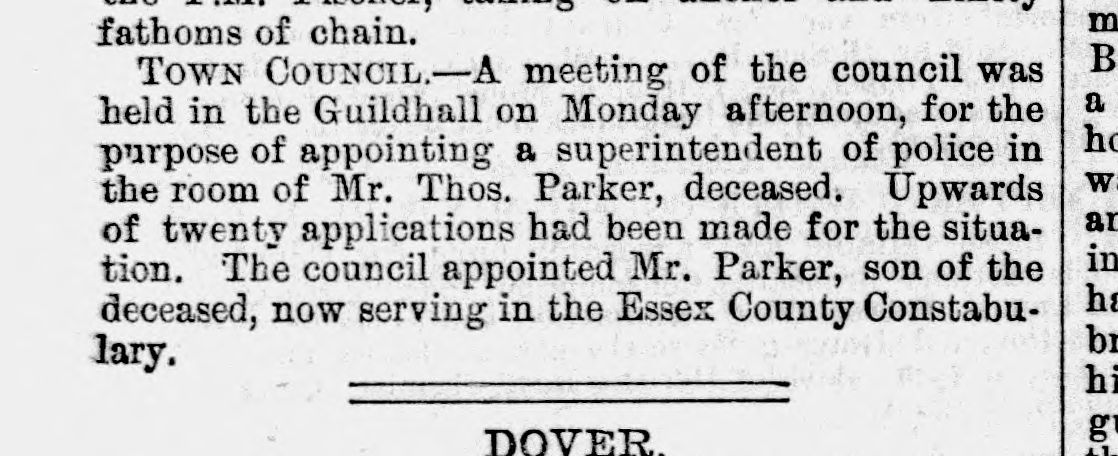
Isle of Thanet Gazette 2 January 1875
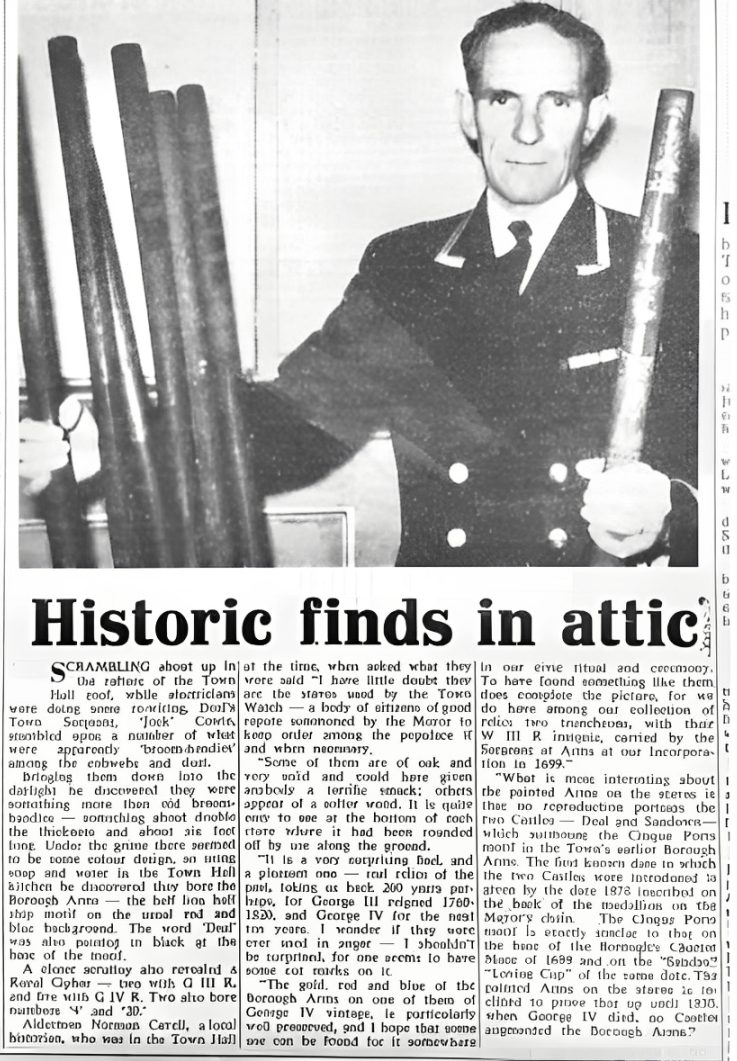
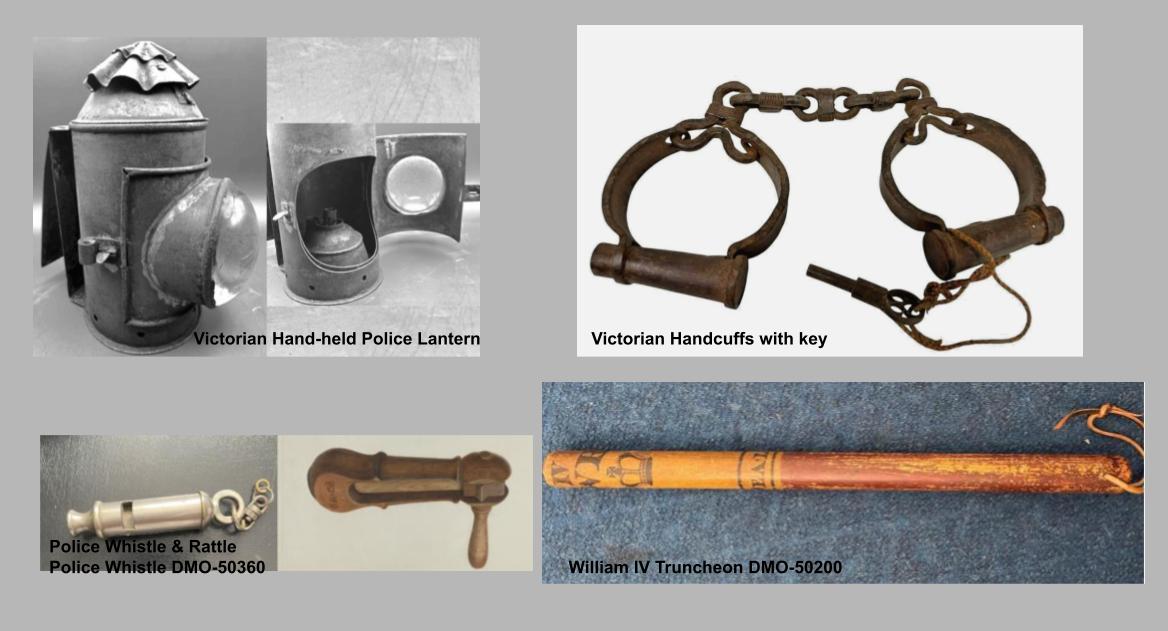
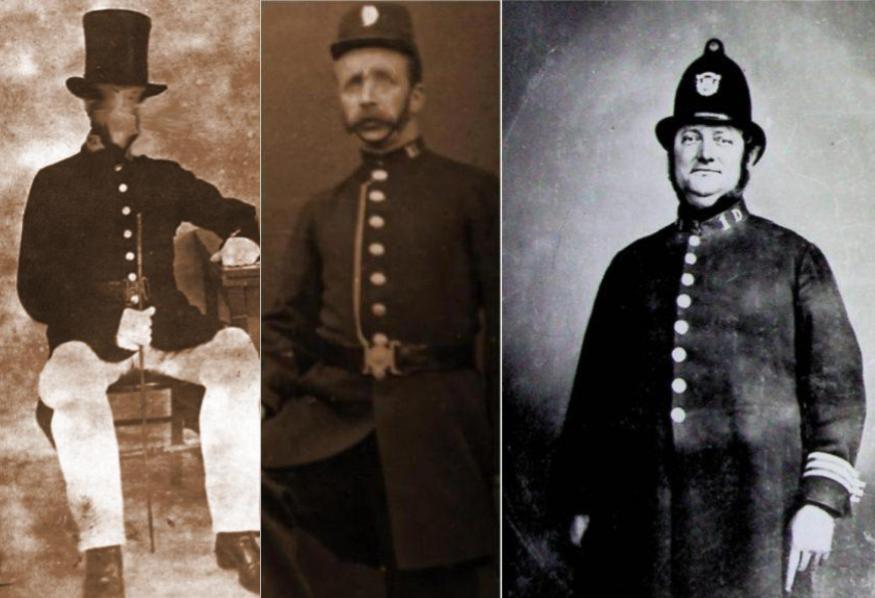
Police Uniforms & Equipment This late 19th century oak measuring stick, at 6 ‘9 “, is believed to have been used by Deal Police for measuring the height of prisoners. Measuring stick Police DMO-2764 In 1835 it was decided to base the New Deal Watchmen’s uniforms on the London ‘peelers’. These were all ordered and made locally, with the commission spread across the town’s tailors, enabling them all to have a share of two or three articles each. In 1858, a new Inspector of Constabularies was established. When the report for Deal was presented, it showed the force consisted of four full-time officers: a sergeant, three constables, and two part-time constables. The latter may have assisted with night duties, which enabled them to carry on with their daytime employment. By 1885, the force consisted of a superintendent, two sergeants, and six constables. The police station itself included three large cells with beds and fireplaces; in 1883, the station was extended, giving it a charge office, and the cells were improved. In their uniforms of blue coats, white trousers, belts, capes, tall hats and armed with lanterns, truncheons and staves, the Deal Night Watchmen patrolled the town from 10 pm until 5 am. In 1968, one hundred and thirty-three years later, a collection of staves was found in the roof of the Town Hall. Deal, Walmer Sandwich Mercury 1968 An original William IV truncheon is also to be found in Deal Museum. It was still in the Borough’s ownership in the mid-twentieth century when it was given to a council employee for his protection when taking out the workmen’s wage packets. Deal Police were eventually issued with whistles. They were in use by the city police forces from around the 1820s. By the 1860s other forces recognised their use, but before their introduction, rattles were issued. By 1860, white trousers were no longer worn and, in that year, white cotton gloves were issued for summer wear. The long overcoat or cape was altered in style and the tall hats replaced by the shako style and, a few years later, the now-familiar police helmet was introduced. A Peeler, A Constable in Shako Hat, Deal Police Constable James Shelvey Cox circa 1880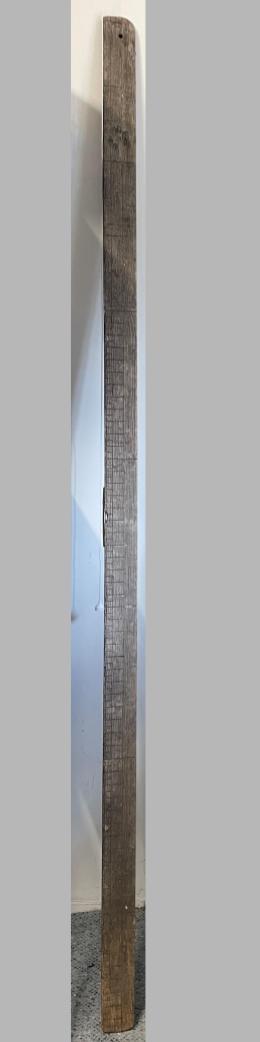
William Parker
William’s appointment, however, proved to be a bad choice and caused friction between himself and Sergeant Philpott, who had also applied for the post. On one occasion the sergeant was suspended, following a Watch Committee meeting, after he had travelled toDover to make enquiries about, and to make an arrest, without the superintendent’s knowledge. At the same meeting William was reprimanded for his slackness in the supervision of public houses. Things came to a head in 1877 and William resigned.
Hilder B Capps
Hilder Ben Capps and his wife Emma moved into the Station House in August 1877 with their three young daughters. Five more children would be born over the next nine years.
Like his predecessors, he would be faced with the usual minor and not-so-minor offences. These included cases such as when young Alfred Roberts in 1881 was charged with “…wantonly knocking on the door of Mrs Heather in Brewer Street…” He was caught tying string to the handles of her door late at night and pulling the knocker. For this, he could have gone to prison, but a fine of 1s 6d was paid along with 8s 6d costs. One evening, in the same year, Hilder had just finished work and was getting changed when he was called to assist in giving chase to a man who had escaped from his gaol cell. Constable Chapman was caught by a momentary distraction whilst putting the prisoner, William James Hill, into a cell. William was the landlord of The Globe, had been arrested for stealing a gelding and took the opportunity to not only exit the cell but to lock it with the unfortunate Constable still inside. Hilder, hearing the shouting and banging of the Constable, soon released him and both gave chase. William Hill was soon apprehended and in handcuffs returned to the cell he had recently escaped from. Hilder no doubt returned home to fully change his clothes and to soak his feet as he had given chase in only his shirt and trousers.
Hilder also helped investigate the more serious case of an alleged child murder. In 1888 Ellen Jane Webb left her mother’s home at Kingsdown and headed for Deal, with her eleven-month-old illegitimate daughter, Florrie. When Ellen returned home it was without her; she said that she had “…put the child out to nurse…” The next day she was seen leaving the house with some of Florrie’s clothes. Suspicion was raised by her brother-in-law PC Mercer when he met Ellen in High Street and naturally asked the whereabouts of Florrie. To his surprise, her reply was that her daughter had choked on a marble and was buried behind the house where she had recently taken rooms. PC Mercer then took her into custody and to the police station where she admitted to him that she had buried Florrie in the Sandhills. A search was made and poor Florrie’s body was found “…tightly fixed in a rabbit-hole…” An inquest was held at the Chequers Inn where, following a post-mortem, Doctor Payne gave his opinion that Florrie had not choked and that her death was by suffocation after being placed alive, head down, in the rabbit hole. Ellen had been present during the inquest and heard the verdict of wilful murder given against her. She returned to Deal in a fly and to the station gaol. The next day, accompanied by Mrs Emma Capps, she was taken by coach to the Magistrates’ Court in Queen Street where she was committed for trial at the next County Assizes. Ellen pleaded not guilty and stuck to her story of her daughter choking on a marble. Her solicitor argued that it was grief and fear that had made her hide the body and with no evidence to the contrary, the jury had no choice but to find Ellen not guilty. Understandably, Ellen left Kent and found employment as a maid in Surrey.
By mid-1889, changes in how Deal was policed came into force when the Local Government Act of 1888 placed borough police forces under the control of Chief Constables, with Deal falling in the Wingham Division. After thirteen years of service to Deal, Hilder was awarded a “…handsome marble clock and a purse of money…” to mark the respect felt for him by the Borough and the men under his command. Mrs Capp was given a Bible “… as a small token of their respect towards her…”
George Lacy
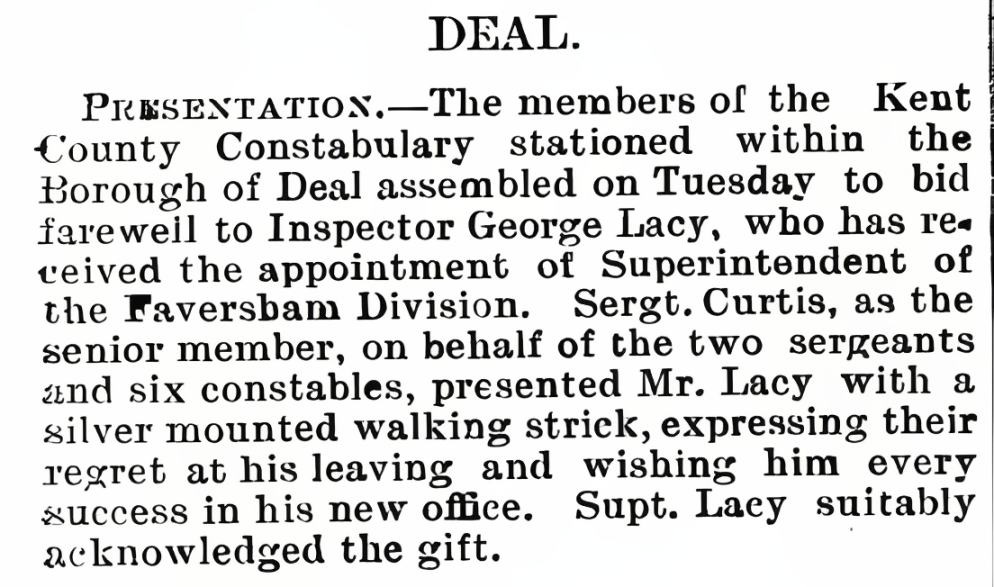
Kentish Gazette 26 January 1892
Inspector George Lacy now took up residence with his family at Deal’s Station House. His tenure at Deal was to be just three years as, in 1892, he accepted a promotion to Superintendent in the Faversham Division. Before taking up his duties, he was presented with a silver-mounted walking stick.
His successor was Superintendent John Chaney who was followed by Superintendent Amos Stone, both of whom were stationed in Sandwich.
Thomas Walter Fowle
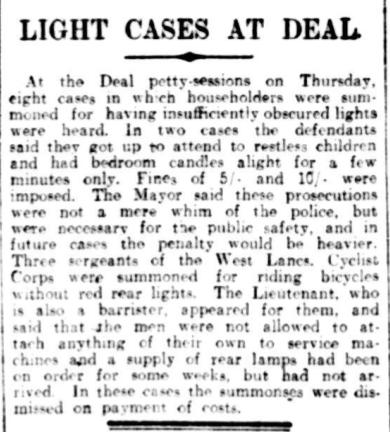
Thomas Walter Fowle, who succeeded Amos Stone, came from a family of Kent policemen. In 1909 he was promoted to Inspector and took up his post in Deal, where he remained until 1919. Serving during WWI, he would have been responsible for enforcing the Aliens Restriction Act, so he and his men early in the war would have been severely stretched having to deal with the sudden influx of Belgian refugees. The enforcement of the Defence of the Realm Act, known as DORA, would also have been his responsibility; this included making sure that the lighting restrictions were adhered to.
Kentish Express 26 June 1915
Horace Thomas Russell
Police Inspector Horace Thomas Russell was born in Malling in 1876, marrying his wife Frances Pemberly there in 1899. He joined Kent Constabulary in 1897, working his way up the ranks and being appointed Inspector at Dartford in 1917. He transferred to Deal in February 1919, where he remained until he was again promoted in 1921 to Superintendent of the Cranbrook Division. It seems that he occasionally worked with his predecessor, Thomas Walter Fowle, in administering the Aliens Restriction Act during the war.
One of the first cases Inspector Russell had to deal with was a tragic case of infanticide. Nineteen-year-old Emily Frances Andrews from Folkestone was employed as a clerk at Walmer Post Office. She was lodging at 118 Blenheim Road, where she secretly gave birth to a full-term baby girl. Realising that something was wrong with Emily, when asked, she told her landladies that she’d miscarried at four months. The next day, however, they found the carving knife they’d missed the day before had been returned blunt and with blood on it, and that the outside toilet was in such a mess they were extremely suspicious. On searching the room, they found a dismembered baby. The police and doctor were called and, after arresting Emily, Inspector Russell and Constable Lane escorted Emily and the baby to the police station, from where Emily was sent to Victoria Hospital to be cared for. In July, Emily was sentenced to two years without labour, where she would be observed for signs of insanity and given the necessary treatment. What happened to Emily between her detention and release is not known; the 1921 census indicates that she may have been released early and was working as a useful maid in London. She appears to have returned to Folkestone by 1922, where she married Edwin Skrivens and had a daughter in 1923.
Dover Express February 22 1929
Deal Borough Fire Brigade
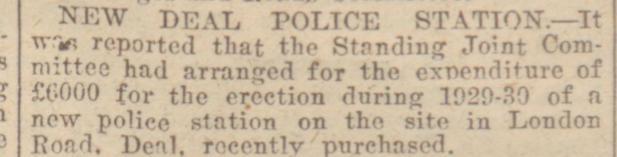
By 1929 it had been decided that Deal needed a new police station, which left the Station House open for a new occupation. In August 1930 the town’s fire brigade had taken over 2 St. George’s Road for its permanent fire officer and the Town Hall’s undercroft to house the two fire engines.
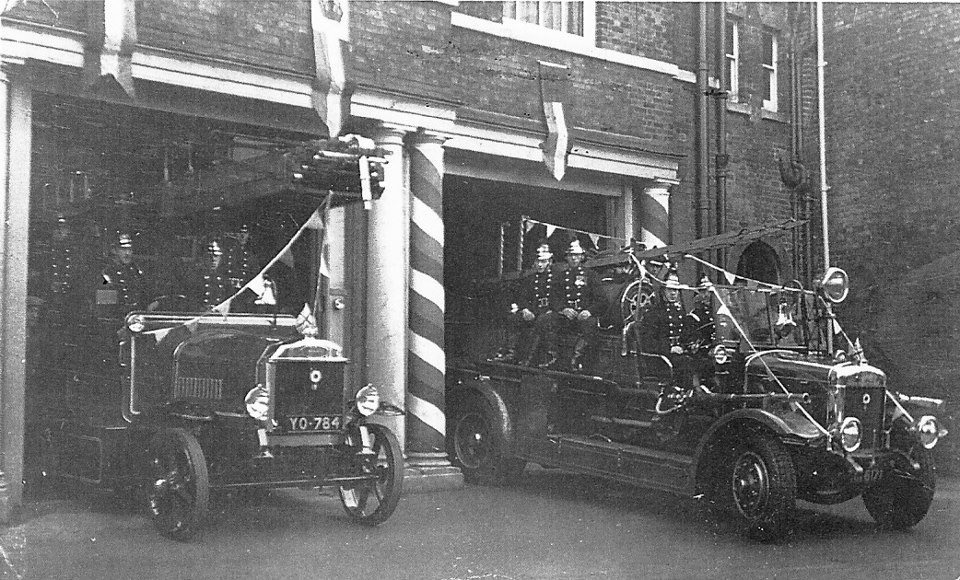
Fire Engines under the Town Hall celebrating King George V Silver Jubilee 1935
Sydney Rackliff
2 St. George’s Road became the home of Deal Fire Brigade’s Second Officers for the next twenty years. The first, Sydney Rackliff, probably took up residence sometime after August 1930; he would remain in post until 1937 when he transferred to Pinner. He had married Lucy Winborn early in 1930 so having a house that was rent-free was an obvious bonus to the newlyweds, much as it was for the police officers before them. A son was born to the couple in 1934.
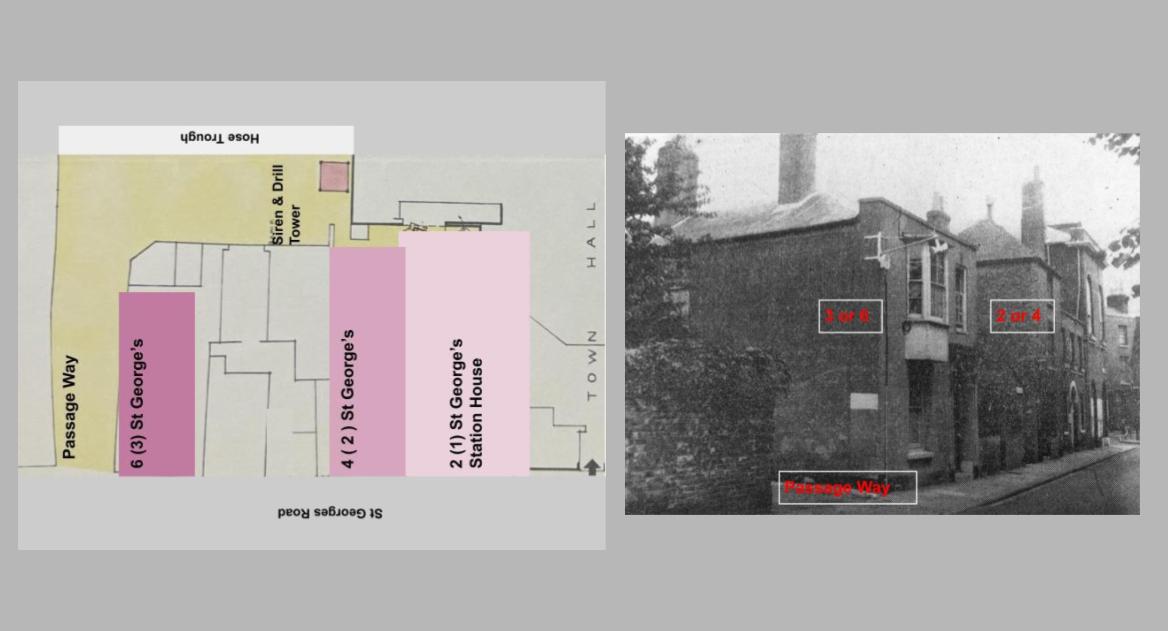
The area of ground behind the Town Hall and the two houses alongside the station house, on St. George’s Road, was taken over as a drill yard fitted out with a siren and drill tower plus troughs for the hoses. Access to the yard was via the passageway that leads today to the West Street Car Park.
In March 1931, the Carter Institute on High Street went up in flames and as Sidney, and other Deal firemen, fought the fire and to save the car showroom next door, he was “…severely cut by broken glass…” Luckily for him, there was no lasting harm done and thankfully no lives were lost in the fire.
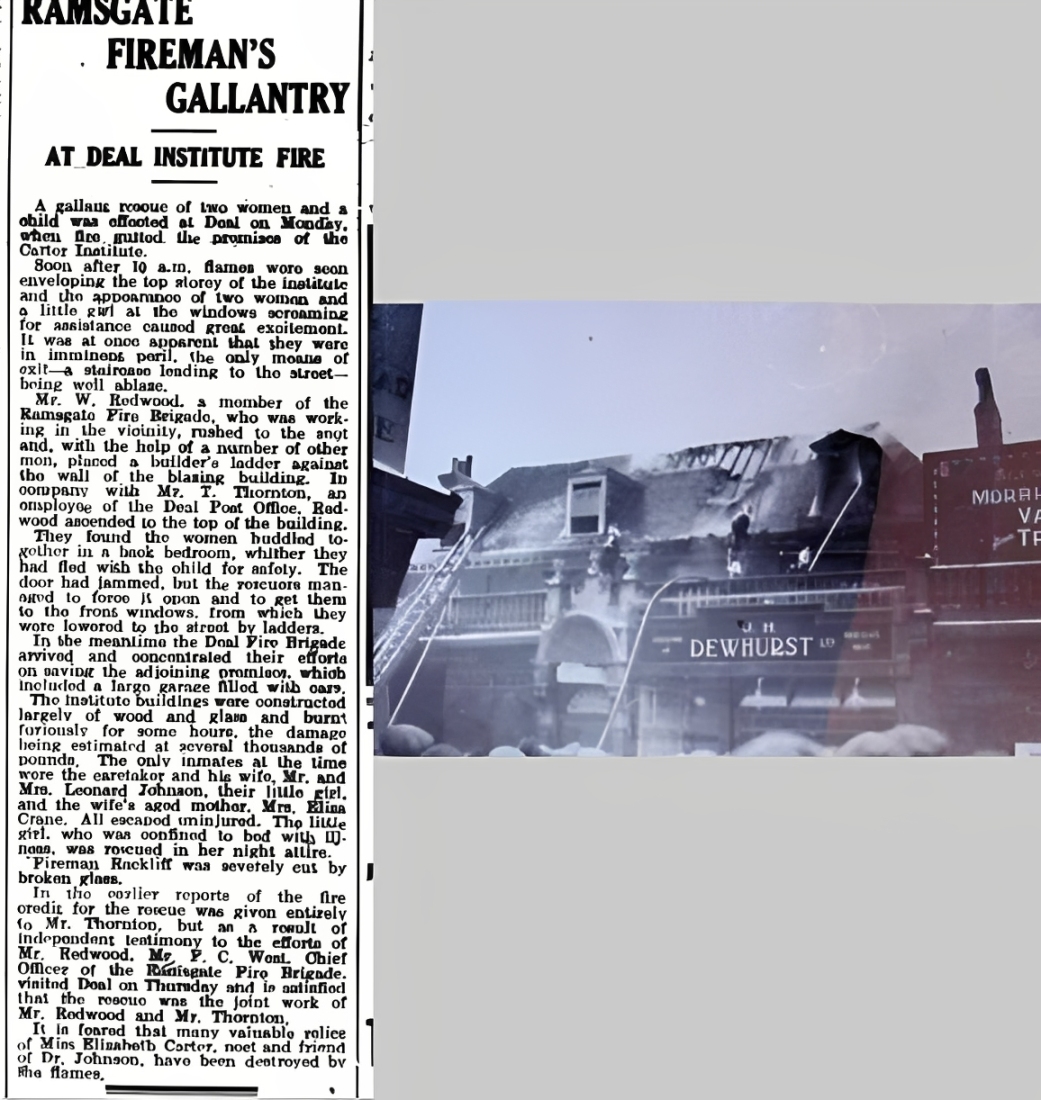
Thanet Advertiser 13 March 1931
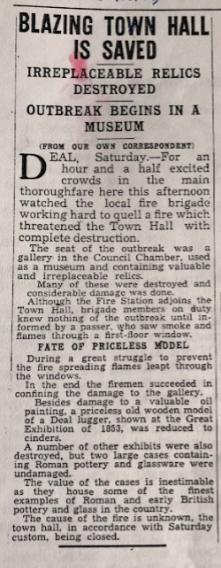
News of the World March 1938
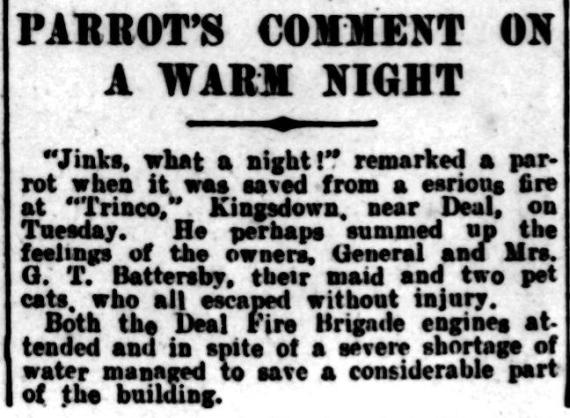
Kentish Express 29 May 1936
In 1936 there was a fire at Kingsdown which required both the station engines to attend and, despite water shortages, they managed to save most of the building. The occupants luckily all escaped with their pet parrot who, showing no ill effects, remarked “Jinks, what a night.”
Thomas Stott Harrison
In September 1937 Thomas Stott Harrison, who had followed his father of the same name into the fire service in Sunderland, joined Deal Fire Service as Second Officer.
In March 1938 there was a fire at the Town Hall. This had started in the Council Chamber, then used as a museum, which resulted in considerable damage. Somewhat embarrassingly, the on-duty brigade members knew nothing of the fire until alerted by a passer-by!
In June 1938 Thomas resigned and was succeeded by Richard Charles Cook.
Second Officer Richard Charles Cook
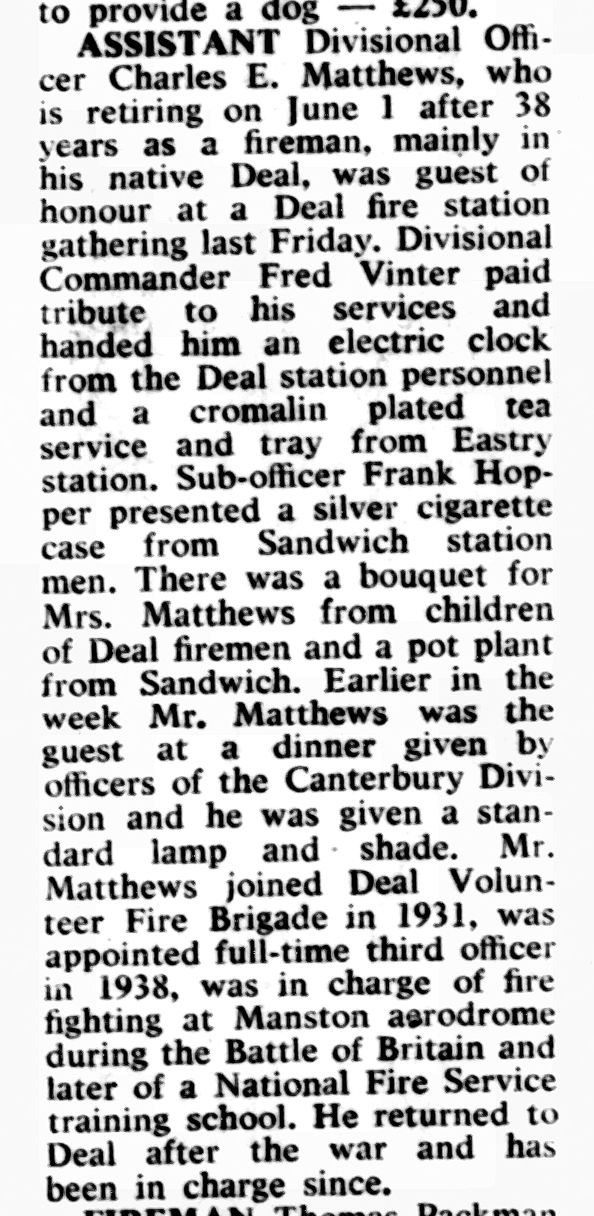
Richard Charles Cook’s appointment to Deal Fire Brigade was announced in the Kentish Express and at the same time it was confirmed that local man, Charles Edward Matthews, was also to become a permanent fireman. During this time Deal was mainly a retained station manned by trained part time men who responded, then as now, when called out.
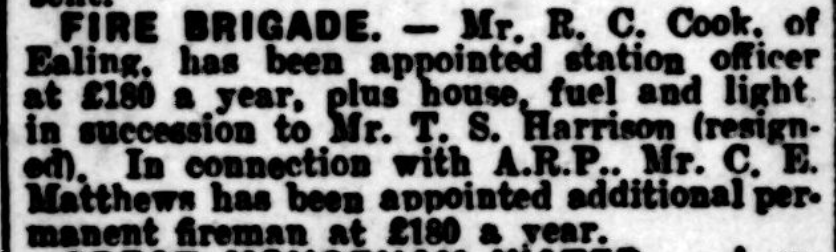
Kentish Express 3 June 1938
Richard was originally from the London area where his father worked for Thomas Norton, a blind maker. Richard, though, did not follow his father into manufacturing and fixing blinds but joined the Fire Service instead. In 1935 he was serving in Acton Station; then on June 1, 1938, he married Doris Louisa Bowles; he probably had already gained the position at Deal by then. Richard returned to the London area in around 1941 as in October that year, former third officer, then acting Chief Officer, Charles E. Matthews was presenting the newly promoted NFS Divisional Officer Lionel Denne a shaving and hairbrush set on behalf of the Deal Fire Service.
Auxiliary and National Fire Service It was also in 1938 that the Auxiliary Fire Service (AFS) was formed. This service was to supplement the local fire brigades and was part of the civil defence preparations, along with the Air Raid Precautions (ARP) made by the government in anticipation of war. Like all the civil defence organisations, the men and women of the AFS were all volunteers and continued to hold down their own occupations. However, they could be called on to become full-time firemen, just as was the case with any other military reservists. As the war progressed, it became clear that, with heavy bombing and coastal shelling, the local brigades could not continue to fight the resulting fires or carry out rescues night after night, day after day. So, in 1941, the AFS became a full-time service and was merged with the local authority brigades to become a wartime National Fire Service. This enabled easier sharing of men and firefighting services across the country, meaning that firemen could be sent to and from areas such as Deal and London to reinforce and give some relief to their exhausted colleagues. The Deal and Walmer AFS and the Deal Brigade became part of the NFS D Division, with responsibility for 200 square miles of East Kent under the command of Divisional Officer Lionel Denne. Station Officer Charles E Matthews (see below) was given charge of the Deal Fire Station at the Town Hall and No. 2 Station on Mill Road. No. 3 Station at Denne’s Yard, Walmer, was under Stanley Denne. The NFS was stood down in 1948 and the responsibility of firefighting returned to the brigades of the local authorities. Fire Brigade Uniforms Firemen’s uniforms and helmets had changed little since the Victorian era. With the formation of the NFS, men and women were issued with the “Brodie” or “tin hat” style, made of moulded steel. These replaced the brass helmets and the newer cork helmets then in use. Axes were also part of the equipment provided to all firemen.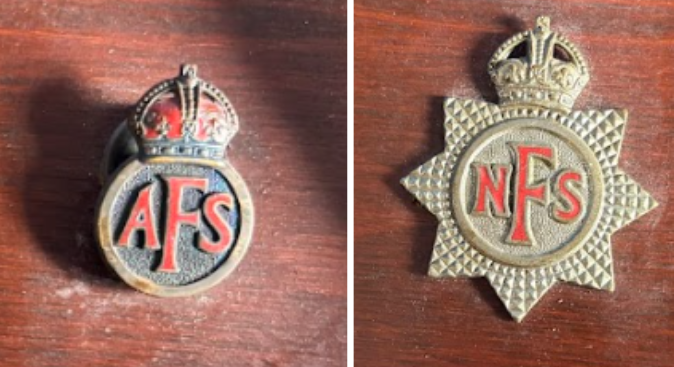
Badges issued to Fireman William J Marsh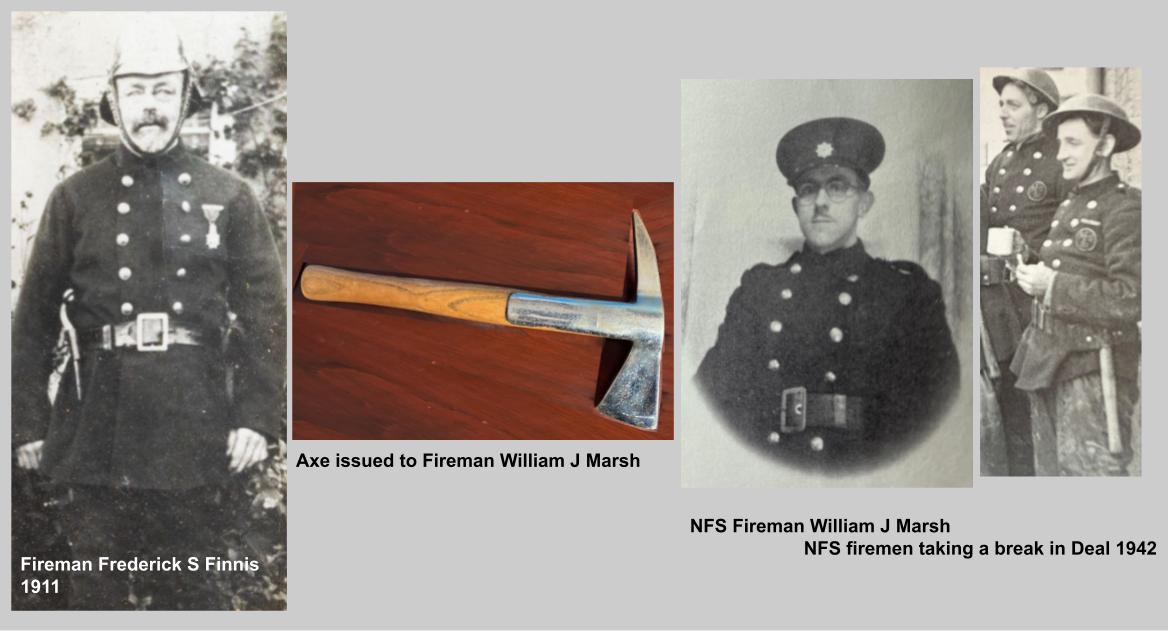
Kentish Express 24 May 1968
Station Officer Charles Edward Matthews
Soon after, Charles was given charge of the NFS main fire station at the town hall and No. 2 Station, 120 Mill Road, with Stanley Denne, Lionel’s brother, having charge of No. 3 Station at Dennes Yard in Walmer. Charles and his family probably moved the short distance from 6 St. George’s Road into the station house at number 2 at around the time of his promotion.
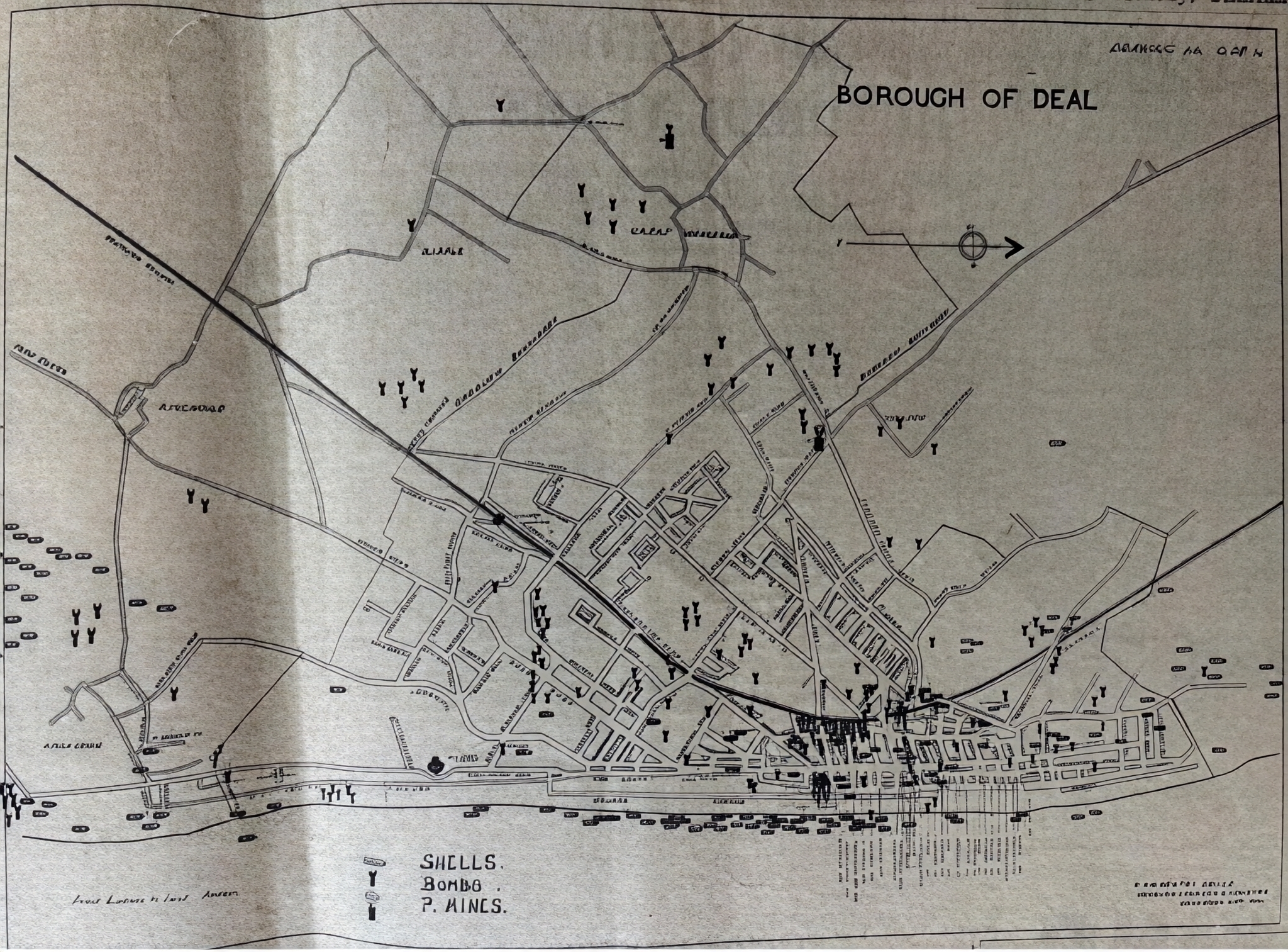
According to his obituary, during the Battle of Britain, just prior to his promotion, Charles found himself stationed at Manston. On his return to Deal, he was to be faced with the aftermath of air raids including the rescue of the townspeople whose homes had fallen prey to the enemy bombs and shells, and the recovery of those who did not survive.
The extent to which Deal suffered, though not easily reproduced here, can be seen from this map produced after the war.
From East Kent Mercury 14 October 1965
In 1946, the Fire Brigade started negotiations to hand back 2 St. George’s Road and the fire brigade facilities to the Borough Council. At the same time, plans were being drawn up to provide Deal with a new and full-time fire station. This was finally realised in 1959 with the fire cover in the intervening years provided by the full-time station at Walmer and the retained men of Deal using the facilities still available to them at the Town Hall and No. 2 Station, 120 Mill Road.
Charles E. Matthews became Station Officer after Richard’s departure and the final resident of 2 St. George’s Road when it was returned to the Borough Council on February 7, 1955.
Documents, held at Kent Archives, made during the handover negotiations include a diagram of the layout of the station house, thus giving us a last look at 2 St. George’s Road. From the front door, you enter the entrance hall with a drawing room on the right, and to the left is the dining room. Further along the hall to the left is the kitchen; opposite, and separated by the stairwell, are a toilet and the bathroom. Above are three bedrooms.
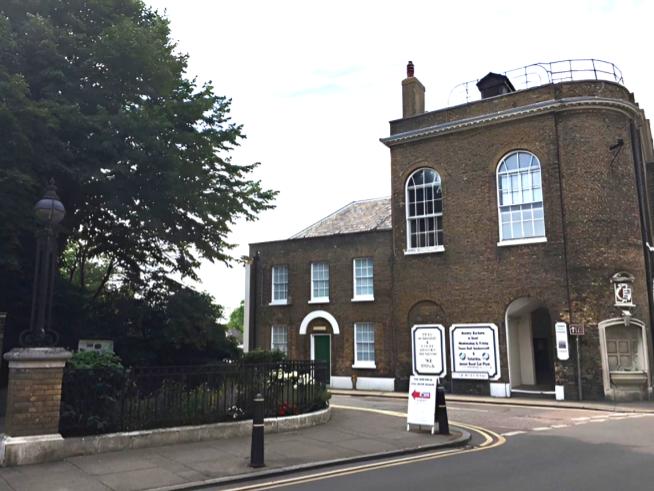
2 St Georges Road & Town Hall