Follow us on Facebook @FHofDW
Mary Amelia Macpherson, née Foster
38, Middle Street, Deal
8, Market Street, St Marys, Dover, Kent
Clarendon Place, Hougham, Dover, Kent
9, Beaumont Terrace, Hougham, Dover, Kent
65, Chancery Lane, St Andrew Holborn Above the Bars and St George the Martyr, London
Paris
17, Liskeard Gardens, Blackheath, London
Occupation: Teacher, Writer, Socialist Reformer
Mary Amelia was born in Deal on February 26, 1859. She was the eldest daughter of Mary Harvey, née Clark, and Trinity Pilot, Henry Foster.
We don’t know where Mary went to school but she grew to be not only a woman of intelligence but one with a social conscience.
By the time Mary was twenty-two years of age she was the Principal of a small school for ‘young ladies’ at 9, Beaumont Terrace, Hougham, (now 58 Folkestone Road, Dover).
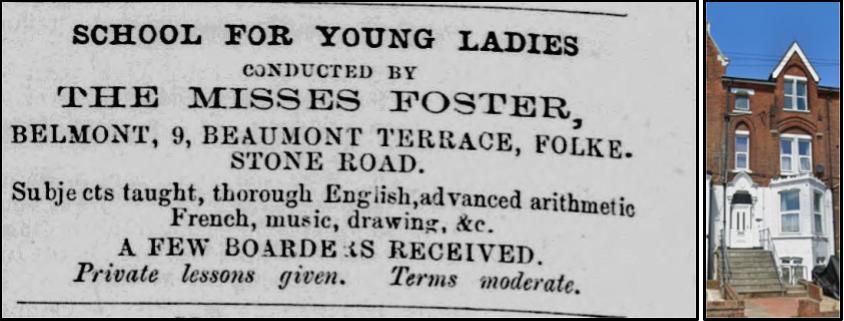
Dover Express 2 September 1881
We were unable to discover what teaching experience Mary had or the exact date when she opened the doors of her school but, it is possible that Mary and her pupils were amongst the first occupants of Beaumont Terrace, which was built in around 1880.
In 1888 the school was being run by her sister Christiana who, by 1891 had moved a few doors down to 1 Priory Gate where she continued to run a school for young ladies.
Mary’s quest for educational improvement extended not only to others but also to herself as, in 1890, she sat and passed the London University Matriculation Examination gaining a two-year scholarship at Bedford College. Studying to take the examination, which also offered prize money to those students, gaining honours, may well have been the reason why she left her school. Unfortunately for Mary she missed out on the prize money, as to qualify for the prize, a person had to be under nineteen years of age, Mary by then was thirty years old.
At Bedford College she studied mathematics, English literature, Latin and Greek, to which she added French in her second year. Mary graduated, in 1892, with a BA in English.
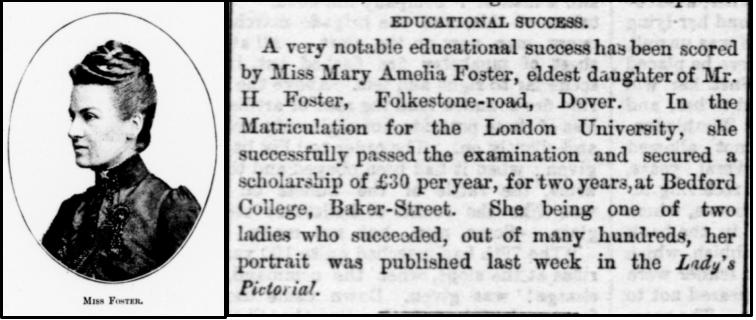
Lady’s Pictorial 1890 and Dover Express March 7 1890
Bedford College & The University of London Founded by Elizabeth Jesser Reid, Bedford College was the first higher education college in the UK for women. The college opened its doors in 1849 at the time women were denied a university education. Elizabeth wanted the college to be open to women from any class with tuition fees tailored to affordability and scholarships available for those with limited financial means. Mary we know gained a two year scholarship which the Lady’s Pictorial March says was worth £30 a year leaving Mary to pay just £2, 8s, 4d for her tuition. In 1878 the University of London became the first university in the country to accept women onto their degree courses with the first women to graduate in 1880. Bedford College followed suit and started to offer their own degrees with their first students graduating in 1881. The University of London, in 1865, was also the first to give students the opportunity to study wherever they lived. They were also the first University to allow students to continue to earn a living while studying, and to study privately as well as to take exams without having to go to London. Then from 1869 Bedford College students were able to participate in the University of London’s special examinations which enabled preparation for their external university assessment. 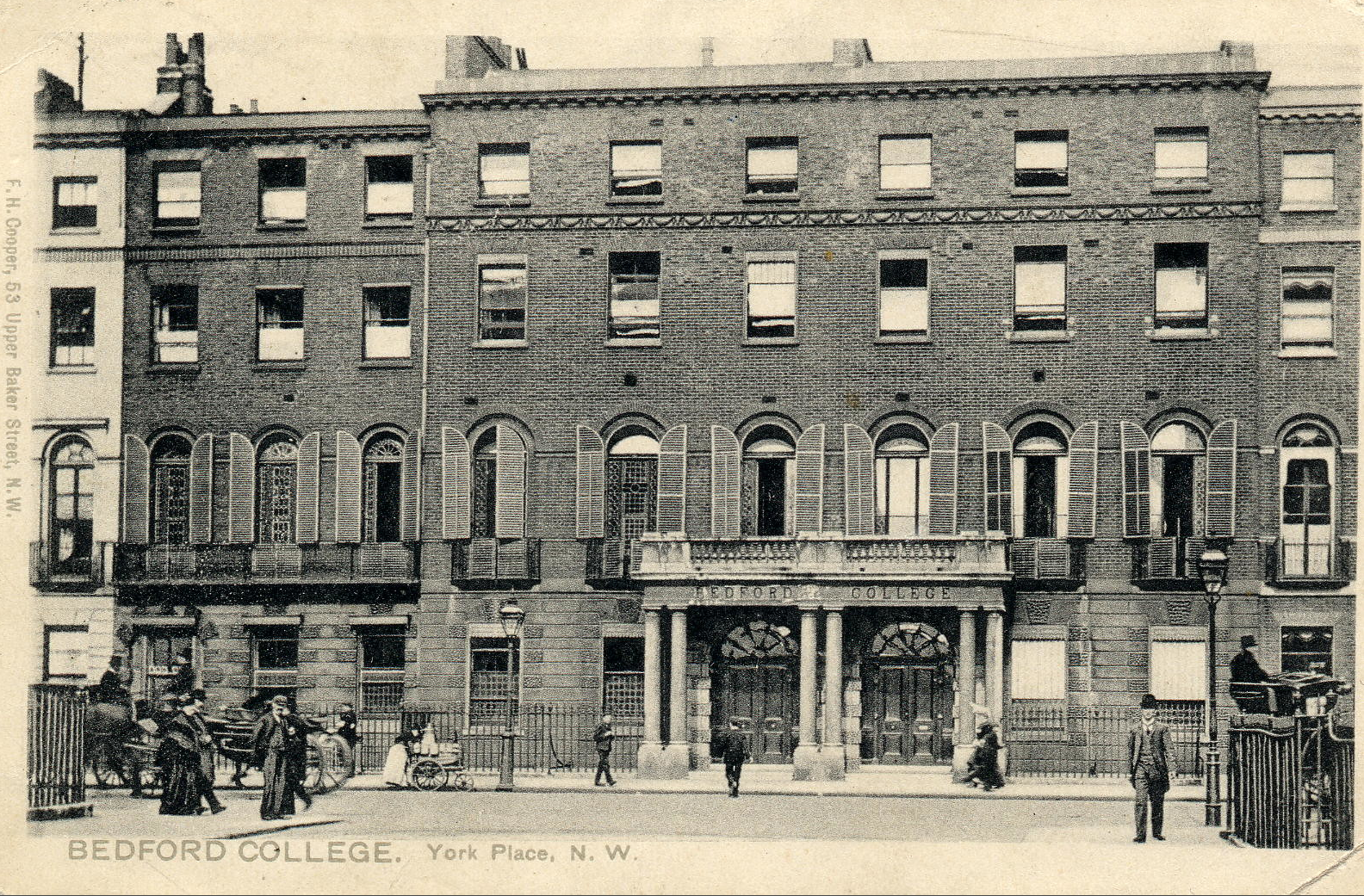
So it was that Mary gained an opportunity that would not have been open to her mother’s generation of women.
After graduating Mary moved north to Leeds where she became involved in the socialist movement, joining the Independent Labour Party, or ILP, (the forerunner of the Labour Party we know today), the Clarion Movement and the Fabian Society.
Up until her marriage it is not clear how Mary supported herself. She may have started teaching again, supplementing her income with writing newspaper articles. We know that she wrote for the socialist newspapers the Clarion, which had been founded in 1891 and the Labour Leader, founded in 1887.
Mary’s socialist beliefs led her to live in a ‘Communal Home’. Here she lived with three other women and two men in a large house, sharing all the outgoings. They employed a woman to come in from 9am until 7pm each day, except Sunday’s, to clean and cook their evening meals. Their laundry was done weekly and was ‘sent out’. Writing in the Clarion, in October 1896, she described this way of living as an ‘experiment’ and encouraged others to do so.
The Clarion Movement
The Clarion Movement originated in Manchester in 1891, with the publication of the Clarion, a cheap weekly Socialist newspaper providing news and propaganda. In 1894 the Clarion Cycling Club was founded in Birmingham other groups and organisations soon followed including Clarion Scouts, Drama, Music and Camping Clubs.
In July and August 1896 an International Workers Congress was held. Her report, ‘Women At the International Congress,’ showed that the Congress had declared that women workers should be treated on equal terms with men. After speaking to women from several European countries Mary reported that in Poland and France there was no women’s movement; in Germany women could join unions but in recognition of their lower wages the subscription fees were less than their male counterparts. All the women Mary spoke to agreed that women workers should receive the same wages, when employed in the same work, and for doors to be opened to enable them to be trained and employed in work that was then only open to men.
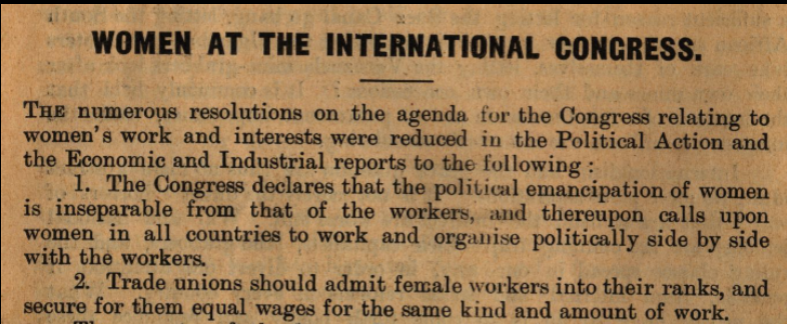
International Workers Congress Report 1896
Marriage and Paris
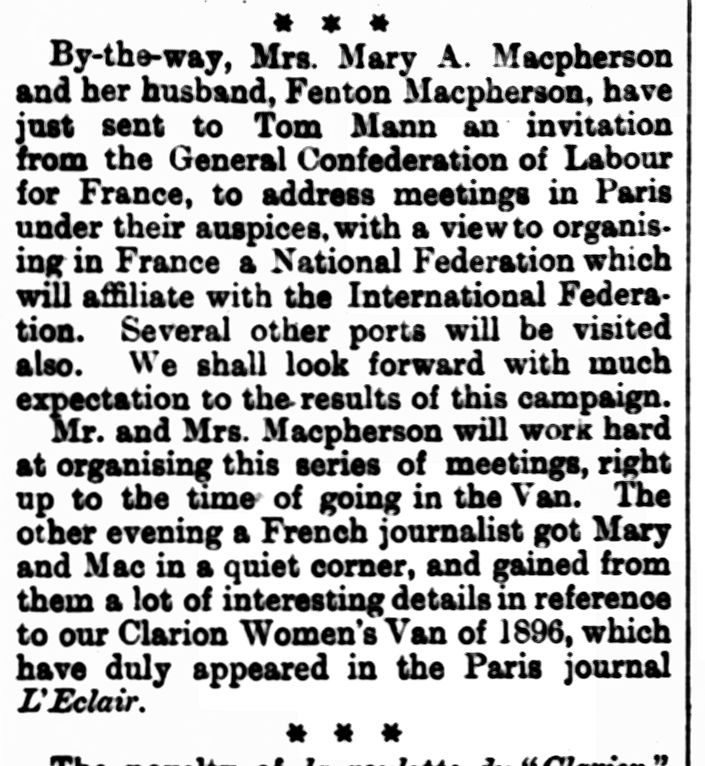
The Clarion April 24 1897
Through politics she met journalist Fenton Macpherson who she married late in 1896. The newlyweds then left for Paris where Fenton continued to work as a journalist.
Tom Mann was a trade unionist and activist, organiser and a popular public speaker in the British labour movement and the President of the International Ship, Dock and Riverworkers Federation. After hearing him speak at the International Transport Workers Conference, held in London in 1897 the French Trade Union officials invited him to visit French Ports. This invitation was passed to Tom through Mary and Fenton who proceeded to make the arrangements and pave the way for Tom’s visit. However, on April 30th Fenton was stopped in the street by French detectives who told him he was to be expelled giving him 24 hours to leave the country on the grounds that ‘his presence on French territory in connection with the Federation was of a nature to compromise the public safety’
Mary remained, at least temporarily, in Paris, being privy to her husband’s plans and, unlike Tom Mann, a French speaker; it was to her that the Federation now turned, to enable Tom Mann’s visit to go ahead. So it was that Mary found herself accompanying and translating for Tom Mann and was present when he too was expelled.
Despite being in France it had been planned for Mary and Fenton to join the Clarion Van’s West of England tour in May 1897. The vans were used to reach the small towns and rural communities enabling them to spread the socialist message by holding open-air meetings, selling Socialist literature and handing out leaflets. Setting off in May, they all but made the van their home for the planned three month tour. Others joined them on route including Tom Mann who joined them in June for a few weeks.
Later that year, drawing upon Mary’s experience of women and socialism, their joint ‘vanning’ and Parisian experiences they set out on a lecture tour in October.
By this time Mary had become heavily involved in socialist politics, leading her to speak and to sit on the platform at ILP campaign meetings and during parliamentary elections.
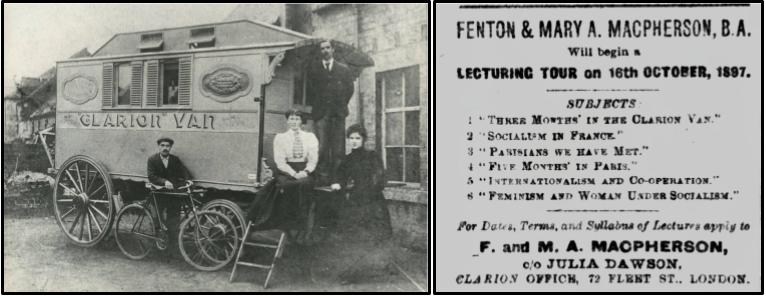
Clarion Van 1896 Labour Leader 8 September 1897
The Fabian Society
Mary joined the Fabian Society in 1898, a socialist organisation whose purpose is to advance the principles of social democracy by gradual reform. When she was nominated as a candidate to serve on the executive in 1900 her socialist credentials were recorded in the April edition of the Fabian News.
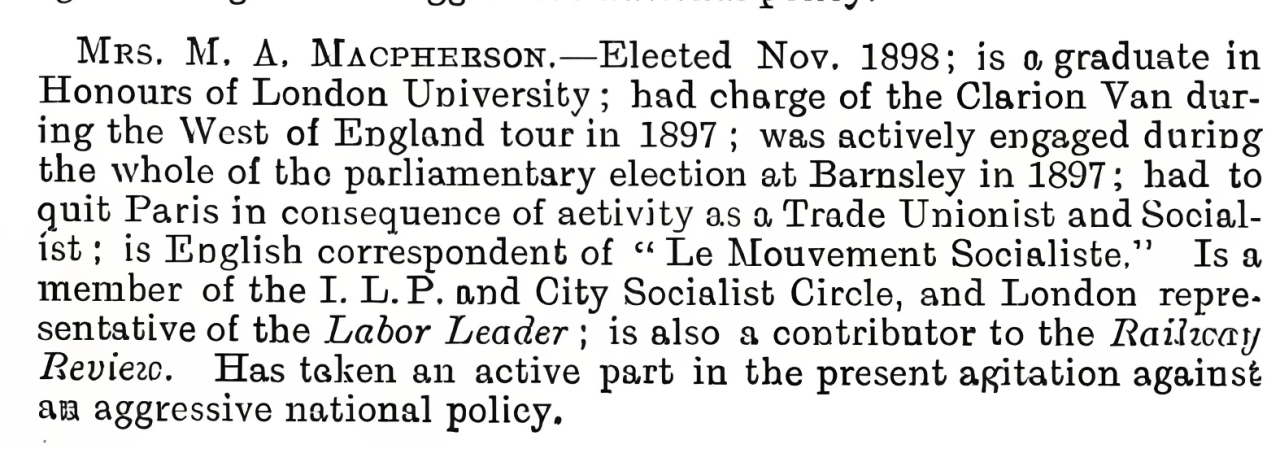
Fabian News April 1900
She had also started writing for the Railway Review, a weekly newspaper for railwaymen. Soon after she organised a conference of wives of members of the Amalgamated Society of Railway Servants. They then formed the Railway Women’s Guild who, amongst other organisations, supported the Labour Representation Committee.
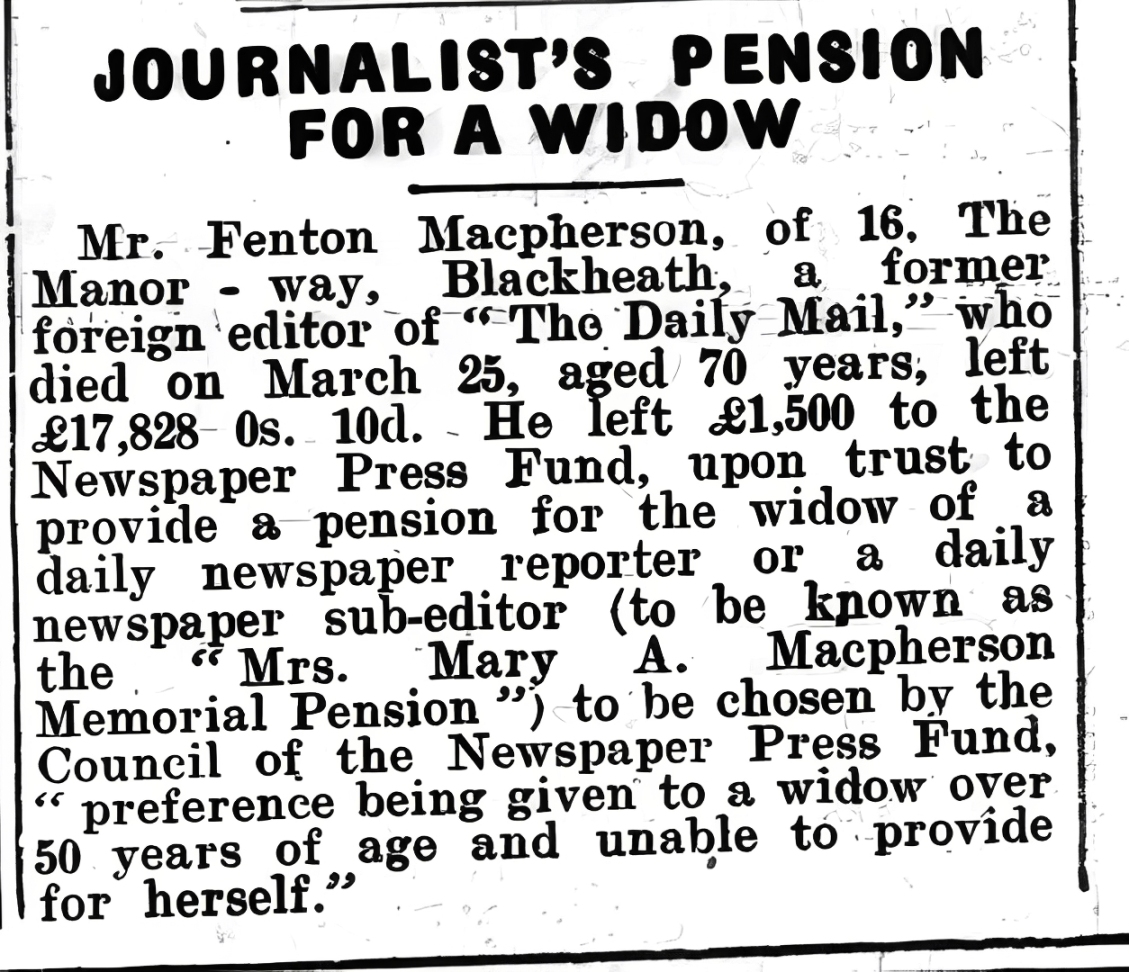
Lewisham Borough News 9 July 1940
Under Mary’s guidance, the Women’s Guild passed a motion calling on it to form a Women’s Committee, a sister to the male dominated Labour Representation Committee but the proposal would require approval. Mary wrote to Ramsay Macdonald, the Labour politician who twice served as Prime Minister, and after initial resistance, the Women’s Labour League was founded, in 1906, with Mary serving on the executive.
Keir Hardie, was a Scottish trade unionist and politician who was a founder of the Labour Party, and was its first parliamentary leader from 1906 to 1908. Being such a prominent figure a celebratory party was held for his fiftieth birthday, in 1906, at which Mary sat on the speakers platform with other leading Labour members and social reformers. Amongst the women speakers were the leaders of two of the Women’s Suffrage organisations, Mrs Charlotte Despard, of the Women’s Freedom League, who spent her early years growing up in Ripple, and Mrs Emmeline Pankhurst, of the Women’s Social and Political Union..
Mary continued to support women and the Labour cause right up until her death in a road accident in 1933.
Fenton, following his own death in 1940, gave £1,500 to the Newspaper Press Fund to provide a pension for the widow of a daily newspaper reporter or subeditor and, to Bedford College, the sum of £1,500 to fund a prize for an annual essay competition.
| Name | Born | Baptised | Married | Died | Buried |
| Mary Amelia Foster | February 26 1859 38 Middle Street, Deal |
Fenton Macpherson 4th quarter 1896 Leeds Born Perth |
December 17 1933 Blackheath |
1933 |
Census
| Year | Address | Name | Relationship | Occupation |
| 1861 | 8, Market Street, St Marys, Dover | Henry Foster | Head | Cinque Ports Pilot |
| Mary H | Wife | |||
| Harold | Son | |||
| Mary A | Daughter | |||
| Christiana | Daughter | |||
| Charlotte Sawkins | Servant | Servant |
Census
| Year | Address | Name | Relationship | Occupation |
| 1871 | Clarendon Place, Hougham, Dover | Mary H Foster | Piltos Wife | |
| Mary A | Daughter | Scholar | ||
| Christiana | Daughter | Scholar | ||
| Fanny E | Daughter | Scholar | ||
| William C | Son | Scholar | ||
| Benjamin F | Son | Scholar | ||
| Mary J Langley | Servant | Servant |
Census
| Year | Address | Name | Relationship | Occupation |
| 1881 | 9, Beaumont Terrace, Hougham, Dover | Mary Amelia Foster | Head | School Principle |
| Amelia Henry | Assistant | French governess | ||
| Mildred J Bednall | Scholar | |||
| Marian Turner | Scholar | |||
| Annie Seymour | Scholar | |||
| Agnes Gold | Scholar | |||
| Laura G Carpenter | Scholar | |||
| Caroline Becknell | Scholar | |||
| Alice Becknell | Scholar | |||
| Ada Hawkes | Scholar | |||
| Elinor Mumford | Scholar | |||
| Anne James | Servant | Servant |
Census
| Year | Address | Name | Relationship | Occupation |
| 1891 | NOT FOUND |
Census
| Year | Address | Name | Relationship | Occupation |
| 1901 | 65, Chancery Lane, St Andrew Holborn Above the Bars and St George the Martyr, Holborn, London & Middlesex, England | Fenton Macpherson | Head | Journalist |
| Mary A | Wife |
Census
| Year | Address | Name | Relationship | Occupation |
| 1911 | Cluny, Liskeard Gardens, Blackheath, Charlton & Kidbrooke, London & Kent, England | Fenton Macpherson | Head | Journalist |
| Mary A | Wife | |||
| Luise Peter | German Visitor | |||
| Jennie Mason Kennaird | Servant | General Servant |
Census
| Year | Address | Name | Relationship | Occupation |
| 1921 | 17, Liskeard Gardens, Blackheath, Charlton & Kidbrooke, London & Kent, England | Fenton Macpherson | Head | Journalist Disposal & Liquidation Commission |
| Mary A | Wife | |||
| Doris Hudson | Servant | General Servant |
Poll Books (selected)
| Year | Profession | Residence |
| 1918 onwards | 17, Liskeard Gardens, Blackheath, Charlton & Kidbrooke, London & Kent, England |