Follow us on Facebook @FHofDW
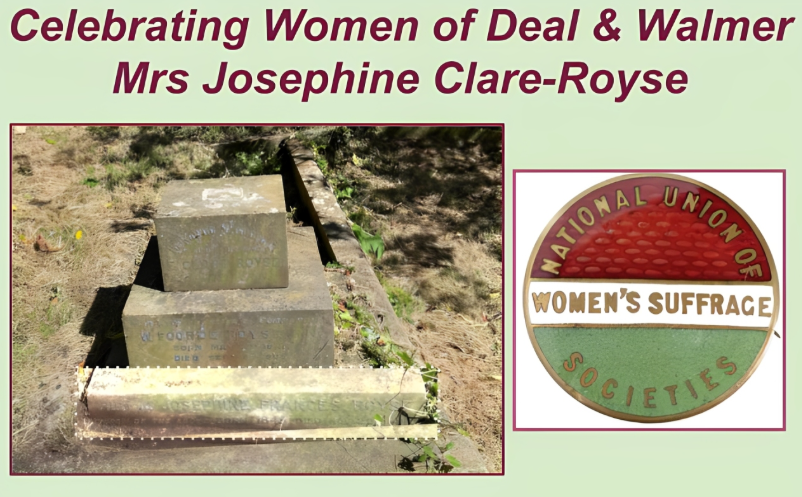
In 1908, local resident Mrs Josephine Clare-Royse attended a ‘Votes for Women’ meeting in Walmer whose speaker, Evelyn Sharp, was a member of the Women’s Social & Political Union. Josephine asked Evelyn, “…under what conditions was it proposed to confer the vote upon women…?” Evelyn responded saying “…our aim is to gain the vote for women on the same terms as men…” Only rate-paying men could vote at this time so only between 1 and 2 million single or widowed women would have gained the right to vote.
Over the next two years, Josephine attended other meetings in the area, perhaps even those held on the beaches of Deal & Walmer, and started to make plans. She was eventually approached by the National Union of Women’s Suffrage Societies with a view to setting up a branch in Deal. In November 1910, the inaugural meeting of the Deal, Walmer, Kingsdown and Sandwich NUWSS was held in Deal’s Masonic Hall, with Josephine as the branch’s Honorary Secretary.
They organised meetings, fundraising events, and petitioned MPs. After the WSPU’s mass window breaking in 1912, the branch, under Josephine’s leadership, expressed their opposition to the ‘outrageous and wanton window-breaking and other acts of militancy.’ The branch continued to hold meetings throughout WW1 even being interrupted, on one occasion, by an air raid.
Following the Representation of the People Act of 1918, when some women aged over 30 finally gained the right to vote in Parliamentary Elections, Josephine became a founding member of the Women’s Citizens Associations. The WCA’s aim was to encourage women’s interest in social and political issues so they could vote with an informed opinion.
Josephine by this time was very ill. She died in 1919 and was buried in Walmer’s St. Mary’s Church. Despite her involvement with the NUWSS, the WCA and a lifetime of supporting many local charitable organisations, which included the St. Saviour’s Dorcas Society (an organisation that provided clothing and other necessities to people in need), the Walmer Parish Guild, Walmer Mission Reading Circle, the National School at Walmer, and the Deal & Walmer Clergy Pension Fund; as well as being an inspector of Homes for the Mentally Deficient, an active member of the Deal and Walmer Belgian Refugee Committee in WW1, and the Ladies Work Society (which she founded in 1903 to help ladies in reduced circumstances to help themselves), she was sadly soon forgotten!