Follow us on Facebook @FHofDW
Deal’s Early Freshwater Schemes
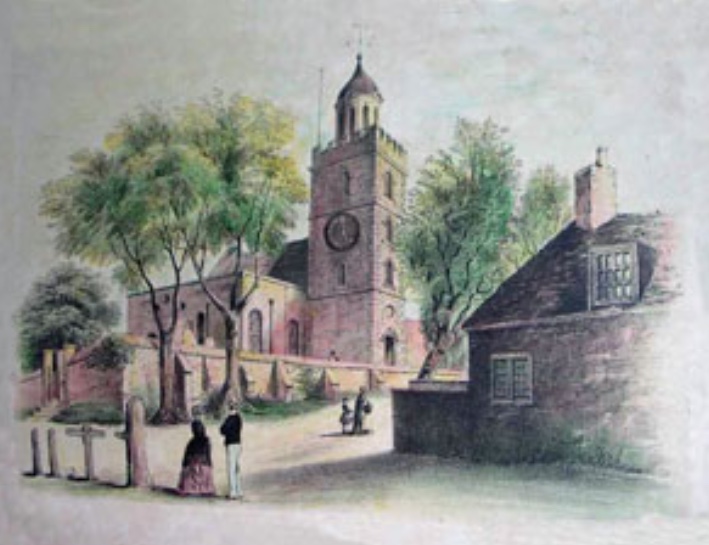 Deal was once a mainly agricultural village centered around the parish church of St Leonard’s. Therefore it must be safe to say that there was a reliable and easily accessible water source nearby.
However, this could not be said for the rapidly growing ‘New Town of Deale’ on the foreshore. Here the people obviously dug wells but, being so near to the sea, the water was often brackish. To supplement this, rainwater was also collected in tanks or cisterns that were made of whatever was available to them.
With the growth of the town, a reliable water source was needed not just to supply the people residing there, but also the merchant and naval shipping anchored in the Downs as well as the Naval Yard.
Ships were often supplied with barrels of water that were carried out to them by smaller vessels. Barrels were also tied together and the floating barrels were then towed out to the awaiting ship.
A Grant of Letters Patent
By 1688 two men had, they thought, come up with a solution and on 21 July that year, Edward Burdett and William Ryder, were granted Letters patent from James II to enable them to bring freshwater into Deal and to supply the shipping in the Downs.
The entry in the Calendar for the patent rolls says “The King the 21st July Grants unto Edward Burdett and William Ryder License
to convey in pipes Freshwater to Deal in Kent for 99 years”
The Patent itself tells us that the water brought from Deal to His Majesty’s Ships was often brackish and unfit to drink and that Burdett was willing “at his own charge to bring freshwater from a spring …to the town…” The King gave his license” for that purpose and “…to erect a conduit head and wharf upon the beach for the …convenience of the ships and vessels…” It also says that Edward Burdett requested that William Ryder Esq. Should have “full and sole license liberty and authority…” to carry out this proposal. The right to dig up at “…suitable times the highways and streets…” of Deal to lay the pipes and to repair these as and when necessary was also given.
The Glorious Revolution
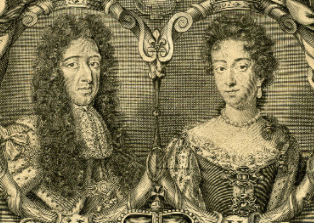
Engraving of King William III and his wife Queen Mary. Dated between 1689 and 1703
Whoever William Ryder and Edward Burdett were, neither man did anything to use their Patent to bring fresh water to the ‘New Town of Deal’ for the next 12 years.
This is possibly due, in part, to the ’Glorious Revolution’. James II was a catholic and there were fears with the birth of his son, Prince James Francis Edward Stuart, that there would be a new catholic dynasty. This at a time when there were deep seated fears of ‘popery’ led the Whigs to invite William of Orange and his wife Mary, who was James’ daughter, to take the throne. So in November 1688 William of Orange landed at Torbay and marched on London, then in February they were declared King and Queen and crowned on April 11th.
This ’Revolution’ may well have brought financial and or religious difficulties for one or both of these men to the detriment of the freshwater scheme.
The Second Water Scheme
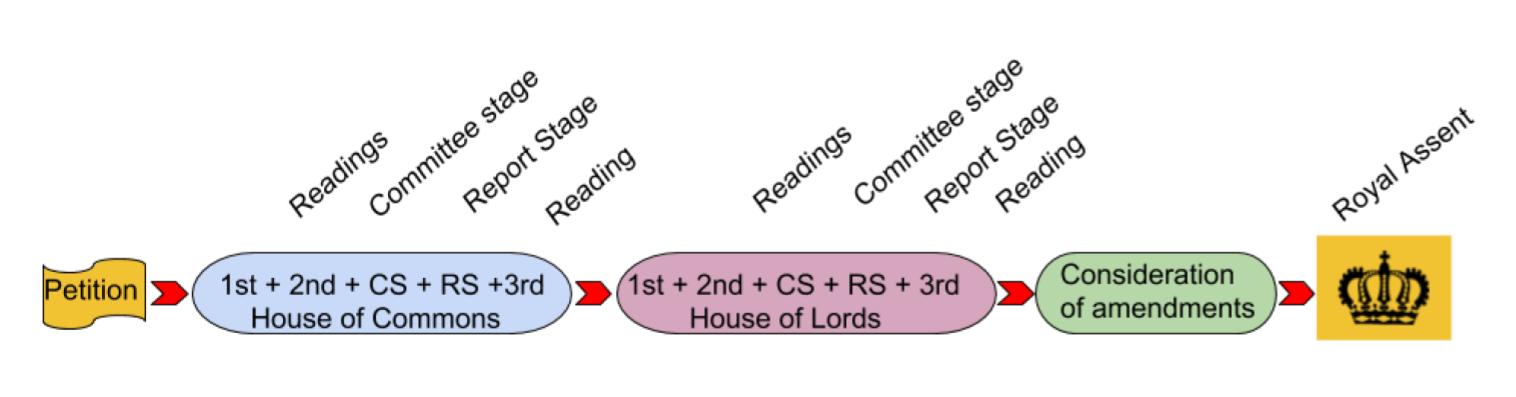
Then in 1698 or early 1699 another man, William Warner, presented plans to the inhabitants of Deal and also to the Archbishop of Canterbury, whose See owned much of the land in and around the town at the time. By the middle of 1699, he had at least made a start by digging test wells and ‘selling’ his scheme to those who could afford to buy into it. To bring his plans to fruition though, he needed to dig trenches across people’s land in which to lay down pipes and also, to do the same within the streets and roads of the town. For this he needed an Act of Parliament. In January 1699 Warner petitioned the House of Commons to bring in a Bill, which if passed would gain him an Act of Parliament giving him the authority to proceed with his plans.
Passage of Bills
He had by this time already gained a grant from Archbishop Thomas Tenison, taken out a ninety-nine year lease from Deal’s Corporation at a yearly rent of £22, and had already invested £1,600 upon the work, which he states was nearly finished.
His petition says that he had found a “…method…” of providing Deal with freshwater and that “… the Town of Deal hath always been in want of wholesome Water…”. Thus indicating that Burdett and Ryder’s scheme had gone no further.
Indeed the Mayor and Jurats of Deal confirm this when, in May 1701, they petition the House of Commons in favour of William Warner, saying that “..for 12 years after Mr Rider nor any concerned in the Patent hath conferred with the inhabitants nor given a satisfaction or reason of the cause of the long delay…”
The Petition was read on 23 January 1699/1700 it was then ‘Ordered’ that a Mr. Brewer was to prepare and bring in the Bill which was duly done and ‘Read’ for the first time on 1 February when a second reading was agreed to be made two weeks later on the 14th.
Ryder’s Response
Ryder, seemingly now being in a position to commence with his own scheme, and hearing of Warner’s petition and or the work at Deal, decided to take action. So on 6 February, he presented his own petition to the House of Commons reminding them that ‘Letters Patent’ had already been granted to himself and Edward Burdett and that they too had laid out a great deal of money for engineers to “…go from London to Deal…and to treat with the inhabitants, in order to the speedy completing of the said works…”
He was obviously not happy about Warner’s claims and went on to say that “…William Warner is endeavouring to advantage himself by the Petitioners (Ryder’s) discovery…”
It was ordered that Ryder’s petition was to “…lie on the table…” until Warner’s Bill had had its second reading. Unfortunately for Warner his Bill failed to gain approval, passing as they say “…in the Negative…”.
With Warner seemingly out of the way Ryder must have been hopefully optimistic when, two days later, his Petition was read and Robert Davers was then ordered to prepare and bring in his Bill. After passing it’s second reading the Bill went on to the committee stage on 29 February.
A Favourable Impression
Although Warner had lost out, he was not to be put off, especially as he seems to have made a favourable impression on the newly formed Corporation of Deal.
The town had finally gained independence from Sandwich when it recieved its Charter of Incorporation on 13 October 1699. Therefore, choosing to side with Warner and to write three letters in his support, must have been amongst the first important actions taken on behalf of the town by the newly elected Mayor and Jurats.
John Mumbray, the then Deputy Mayor of Deal, sent the first letter of Petition in support of Warner’s Bill dated 24 March 1699/1700.
It says that, in their opinion, the “… water is very good and wholesome and sufficient for the town and also for supplying his Majesty’s ships riding in the Downes…” it ends “Your Petitioners Humbly pray that the same may pass into a Law” and is then signed by him and thirty-nine others.
Failure and Success
After Ryder’s Bill was examined by the Committee and the Petition from Deal was read to them Robert Davers reported back to the Commons. However at this stage they decided not to pass the Bill.
He must have been devastated. As we will see later, as he, like Warner, had a lot of money tied up in the scheme, in fact a lot more. Providing freshwater had the potential to be a lucrative business and both men, for the present at least, had lost out on any possible income deriving from their schemes.
A year later on 4 March 1700/01 Ryder tried again, this time he was successful and the Bill was passed to the Lords for it’s reading in that House.
Warner was still not willing to give in and on 27 March a Petition from him was presented to the House of Commons. In which he states that his “…Undertaking which may effectually be completed within two months time…” but now as Ryder’s Bill was again in the way Warner now asked to be heard in Counsel by the Committee. This was agreed to be held on Monday, 19 May. We know that this was postponed as a letter from Warner asking for a postponement survives in which he says that his engineer, and principal witness, Thomas Tuttell “… and some other material witnesses from Deal cannot be in Town so soon…”
Thomas Tuttell
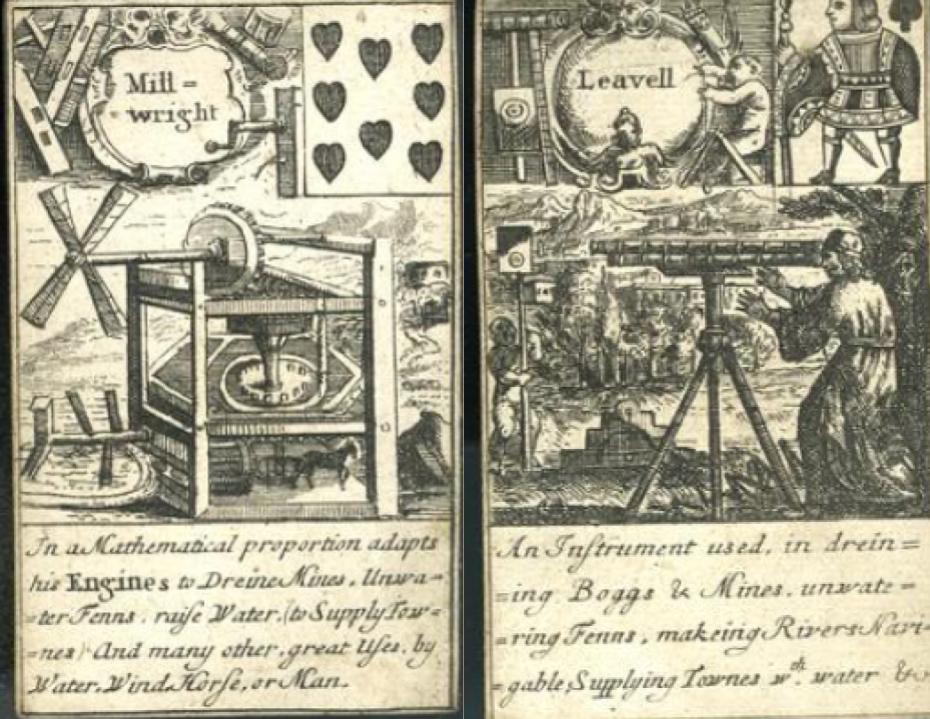 Warner calls Thomas Tuttell an engineer. We can not be certain but as he says in his request that Tuttell was “…out of Town, for services of his Majesty and the publick…” we feel that he could be the Mathematical Instrument Maker and Hydrographer who was appointed to the King in 1700 who made a whole range of instruments for measuring, gauging and surveying for use both on land and on water.
This Thomas Tuttell had, in around 1700, sets of playing cards made and engraved with his ‘instruments’ and interestingly for us one of his instruments he called a ‘Leavall’ which he advertises as “An Instrument used, in dreining Boggs & Mines, unwatering Fenns, making Rivers Navigable, Supplying Townes with water” Another advertised for Mill-Wrights says “In a Mathematical proportion adapts his Engine to Dreine Mines, Unwater Fenns, raise Water (to Supply Townes) and many other great uses by Water Wind, Horse or Man”
A Letter of Support
It is at this point that the Mayor and fifty-three other inhabitants of Deal send their second letter in support of Warner and Petitioning against Ryder’s Bill. This letter, dated 26 May 1701, says how Warner had over the past year offered and had begun to erect a “waterworks for supplying them with good water” and had made good progress in doing so. Ryder, however, they stated had “…not expended any money in erecting any waterworks for the service of this Corporation to our knowledge nor obliged to pay this Towne any rent for the Benefit of the same…” They go on to ask if they can be ‘heard’ by their Lordships in the House to speak in favour of Warner’s scheme.
A third letter, stating the same, was sent on the 22 May time to the Lord Warden of the Cinque Ports and the Admiral and Lord Lieutenant of Kent, the Earl Romney Henry Sidney. This letter was read in Committee on 30 May. The Journals of the House Lords state that “…The Mayor and Inhabitants of the Town of New Deale are to be heard by their Counsel, (as desired in their petition) …on Tuesday next at Eleven a Clock.”
This though only led to amendments being made to the wording in Ryders Bill, striking out the paragraph relating to the Letters Patent. Ryder’s Bill became an ‘Act for furnishing the Town of New Deale with fresh Water’ and gained Royal assent on 12 June 1701.
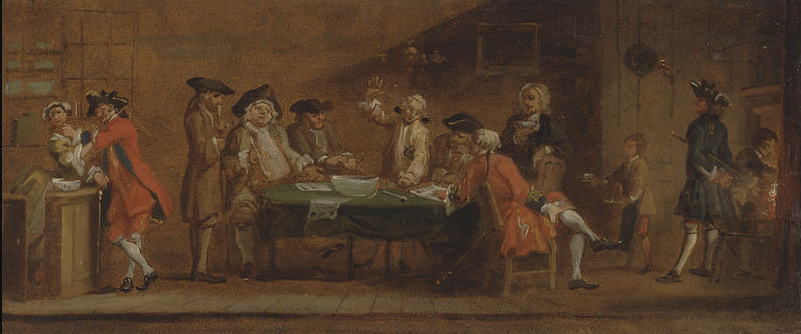
News-sheets and Coffee Houses
News-sheets and newspapers were printed and sold just as they are today. They were distributed and discussed in the fashionable coffee houses where trade, banking and insurance deals were often made. Books were sold, politics debated and shipping intelligence shared. Some of these news-sheets survive, and four relating to Ryder and Warner’s ‘Cases’ can be found in the British Library. It is quite probable that these ‘Cases’ with their claims and counterclaims were discussed and shared in London’s coffee houses.
The First News-sheet ~
Mr. Rider’s Case
In early 1700 the first news-sheet, reporting on Ryder’s Bill, was circulated. Titled ‘Mr. Rider’s Case’ it says that in order to bring the water in pipes from the North Stream a sum of £2,500 (approximately £300,000 in today’s money) was needed for the cost of the “…Grant (the Patent), the Engineers and the Agents to Treat with the inhabitants from whom Subscriptions were obtained…” But there was a dispute over the £2,500. Was it raised for the Mortgage that Ryder had taken out to pay for the Grant to enable him to solely benefit from it or was it raised to fund the waterworks themselves? When the matter of this money was settled with the parties concerned, though there is no mention of who these parties were, Ryder petitioned for a Bill to bring about the needed Act of Parliament to enable him to “..digg open the High-Ways, Streets… for laying of Pipes to bring fresh Water to the said Town and Conduit Head.”
The news-sheet goes on to point out that if Warner were to be successful then Ryder would be left with a £2,500 debt and “…destroyed…” by Warner’s undertaking.
It goes on to blame the disagreement over the disputed use of the mortgage as the reason that had prevented Ryder from starting the work and laying out any money “…on the Place.”
The Second News-sheet ~
William Warner’s Case
Warner’s response is printed in the second news-sheet titled ‘The Case of William Warner, Gent. Relating to his Water-Works at Deale’ in which he accuses Ryder of not actually borrowing the £2,500 for the use of the Water-works but that it was “…in Trust for Edward Lord Griffin, who was Attainted and Outlawed for High Treason..”
Warner went a whole lot further saying that the agents Cole, Gillibrand and Robinson who Ryder had employed to ‘Treat’ with the inhabitants of Deal to sell subscriptions for his fresh piped water were named in the trial of Sir John Friend in 1696 for his part in the assasination plot against the King. He suggests that as the Patent, either before or since the plot had not been made use of “Whether it may not be necessary to enquire who those parties that disagreed, and what use this £2,500 was applied? Is Humbly submitted to the Consideration of the Honourable House of Commons.”
Griffin Ranelagh and Friend
 Sir Edward Griffin had borrowed £2,500 from Valentine Duncombe a London Goldsmith and Ryder had stood surety for the bond. In December 1688, just prior to James II exile, Sir Edward had become the first Earl of Braybrooke. Accompanying his King into France he was soon Attainted and Outlawed for High Treason and his lands forfeited to the crown. With no access to Sir Edward this left Ryder responsible for the £2,500 which today is about £300,000.
Valentine Duncombe, himself owing a debt to the Earl of Ranelagh, passed on Sir Edward’s debt to him.
Sir Edward later returned to England, in the Jacobite cause, and was taken prisoner in Northamptonshire, was sent to the Tower, condemned for treason and executed on Tower Green in 1710.
Earl of Ranelagh
In 1685 Richard Jones, 1st Earl of Ranelagh was appointed Paymaster of the Forces. He was later expelled from the Commons, in 1703, when discrepancies were found in his accounts. It was discovered that he had misappropriated more than £72,000 of public funds.
He died in poverty on 5 Jan. 1712 and was buried in Westminster Abbey.
Sir John Friend
Sir John, though not a catholic, was a Jacobite conspirator. He helped with the plans to assassinate William III. Once the plot was exposed, a warrant was issued for Sir John’s arrest. He was put on trial for High Treason at the Old Bailey and during his questioning by Brice Blair, it was put to Sir John that –
“I said, I had Mony from you for Incouraging those that were Listed; and you told me it was impossible to do it but we must have Mony now and then, and we must be good Husbands, you told me, Sir John. Did not I bring you Mr. Cole that Lives at Deal? Did not his Brother-in-law Mr. Robinson and Mr. Gillibrand Dine there?…”
Sir John Friend was found guilty and was hanged at Tyburn on 3 April 1696.
As for Cole, Gillibrand and Robinson, Warner says a search was made for them but after the plot’s discovery they fled and had not been heard of since at Deal.
The Third News-sheet ~
Mr. Rider’s Case
Of course Ryder denied all these claims and his responses are also found in the third news-sheet. Also titled Mr. Rider’s Case it says that Warner knew of Ryder’s right and without consulting him began work, that the Archbishop did not then know of Ryder’s Title but is now willing to leave the decisions to Parliament. It goes on to give some details of Ryder’s opinion of how Warner proposed to provide the town with water.
It states that Warner was digging wells, one of which was very near to Tobias Bowles’ and that the water in it was ‘brackish’ Warner it says had purchased and was storing bored Fir pipes which he says “…Confirms the Ignorance of those employed in that Undertaking , for they crack and become useless…if not laid in time…” . George Sorocolds and a Mr. Ayres went down to Deal to view the work on their engine and stated that Warner’s work had by this time come to a halt and no engine was being prepared for it.
Feelings were obviously running high as the last paragraph questions the fact that Warner had stated he had spent £1,600 “…for which nothing but a Well that may be done for fifty Pounds, and some useless Fir Pipes…”
Who was George Sorocold?
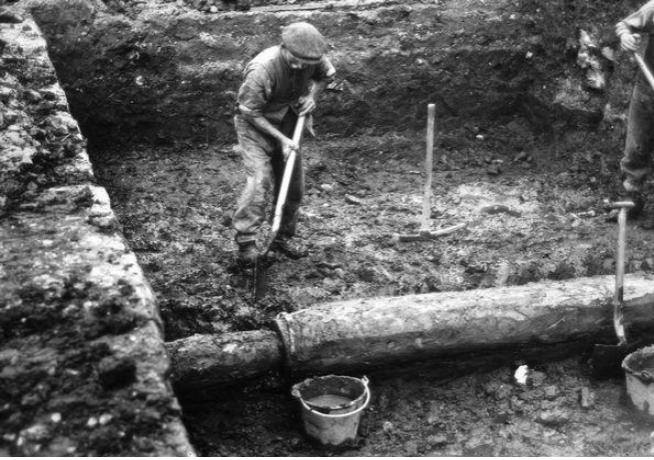
One of George Sorocold’s elm pipes was uncovered during the widening of Queen Street, Derby, in 1928
By 1699 George Sorocold was making a name for himself. He was the eminent water engineer of his time. He had already designed and built a water engine to supply fresh water to a great part of his home town of Derby and had just finished a similar undertaking in Norwich and was now in the employ of London merchants and goldsmiths erecting an engine to extract water from the Thames for public purposes. It was possibly the work here and Sorocold’s previous success that made William Ryder decide that his Letters Patent could now be put to good use and the idea of bringing ‘fresh water to Deal’ was rejuvenated.
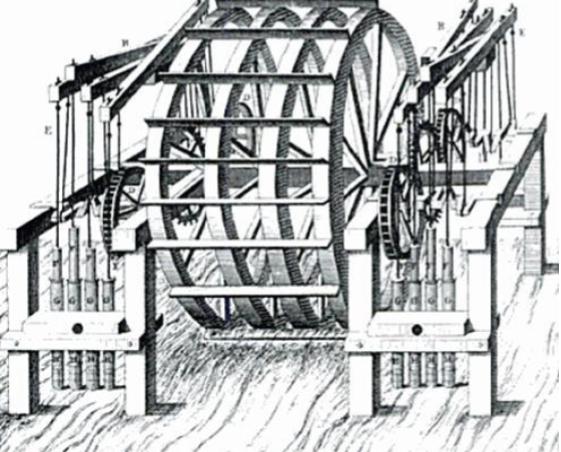
George Sorocold’s Water Power wheel from the River Thames at London Bridge from a 1729 book by Stephen Schwitzer
However, someone else had already started on their own scheme. That someone was William Warner.
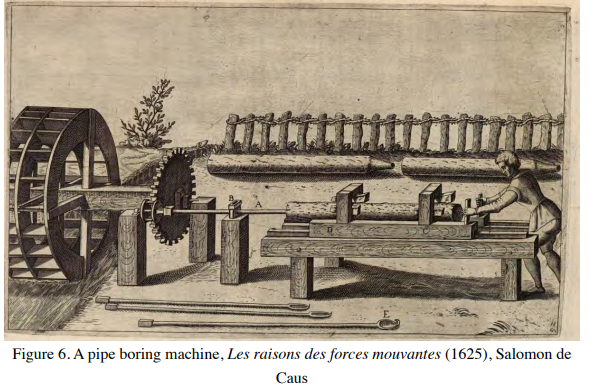
 In 1692, George Sorocold constructed Macclesfield’s first waterworks, using a waterwheel to pump through some four miles of pipe made of elm trunks. For these, he developed a boring machine, which he later patented. This waterworks lasted nearly a hundred years. Amongst his other achievements, he rebuilt London Bridge Water Works. Among his many innovations were pumps worked by water‑wheels which rose and fell in accordance with the level of the stream.
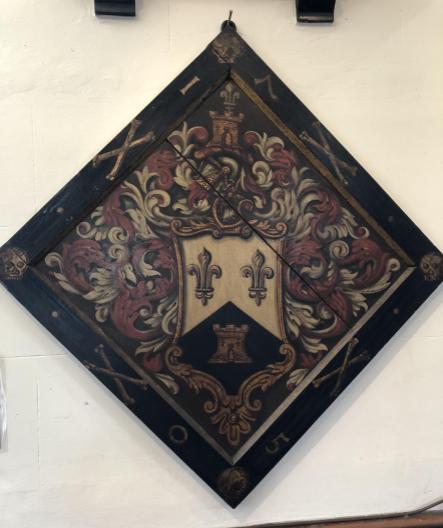
In St. Leonard’s Church, Deal there is a hatchment commemorating a George Sorocold who was buried there 1705. However, there is no evidence, apart from the name, that these two George Sorocold were actually related.
Mr. Warner’s Answer to Mr. Rider’s Reply.
Warner makes one last response in the fourth news-sheet where he again pushes the fact that the £2,500 was not money borrowed for the Water-works but had been borrowed by Sir Edward Griffin for whom he stood surety for.
All these claims and counterclaims did little good as William Ryder’s Scheme “to bring fresh water to the new town of Deal” received Royal Assent gaining its Act of Parliament on 12 June 1701.
The Act gives the basic details of what Ryder then intended to do. It also sets in law the protection for Ryder’s scheme but also for those people whose land that may be affected by the laying down of pipes or any other works associated with the scheme so that it “...may not be prejudicial or injurious unto the owner or occupier…” and as such The Constable of Dover Castle was authorised to hear any complaints and to “impanel a jury or Jurys of 12 men” if the need arose.
Warner did not give up though as his scheme did not rest on the authority of Parliament so he must have somehow changed his plans and by 1702 he had successfully completed the building of his scheme.
A Planning Meeting
In 1702 a meeting was held at the then The Three Kings Tavern, now The Royal Hotel, to decide where to make “…a Bason or other receptacle to receive the River Water to supply the Engine”.
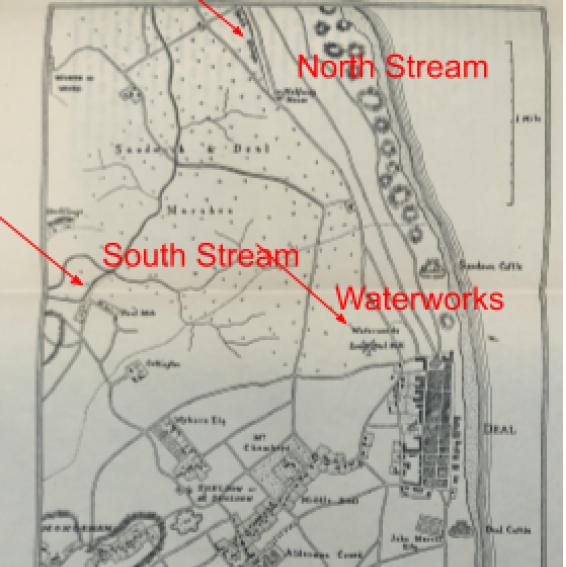
W P D Stebbing suggests that this ‘engine’ could have been the horse-driven machine that was erected in Water Street to pump water drawn from the North Stream into conduits in the town. That being so this could be Ryder’s scheme as it was he who took his water from the North Stream, though the South Stream is sometimes mentioned in documents relating to him too.
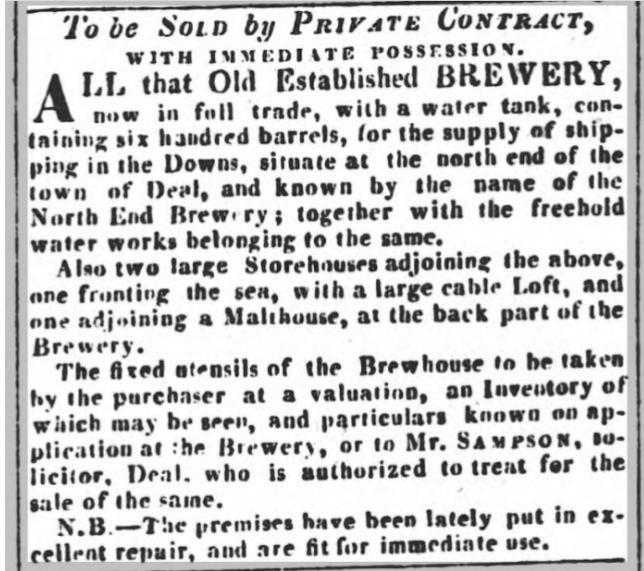
Kentish Weekly Post or Canterbury Journal – Friday 15 October 1813
In 1813 a Brewery at the North-end of Deal was put up for sale which included “…water tanks with six hundred barrels for the supply of shipping ……with the freehold waterworks belonging to the same …”
Litigation
In May 1709, William Ryder took out a Bill of Action against George Sorocold accusing him of overcharging him for the services he had provided and even those he had not. This litigation gives us an idea of the activities and efforts made by Ryder to bring about his ‘freshwater scheme.’
The Bill was taken out against Sorocold in response to his Bill against Ryder for “…one hundred and eighty pound for the preparing, building erecting and finishing the same. And also for the further sum of Three Hundred pounds for his labour and pains and moneys…”
Sorocolds’s Bill doesn’t survive but Ryder’s tells us that Sorocold made a visit to Deal, from London, with a Mr Ayres. Though who Mr Ayres is we have no idea. Ryder says that he paid for the visit in which the two men were “…to view the said Warners waterworks…” at a cost of ten pounds “… besides two pounds five shillings and sixpence for Horse, meat and other expenses…” . On this visit Sorocold was also to report back to the House of Commons Committee but Ryder says this report was “…so lame and imperfect an account that your orator (Ryder) was obliged to send down for and bring up several persons from Deal to give a full and satisfactory account…”
In June or July 1701 Ryder said that he went to Deal with Sorocold, who insisted on taking Mr Ayres, at a total expense of twenty pounds. Mr Ayres, Ryder seems to think, had come along “…to no purpose…” This visit was apparently to view and examine the “levell”, or marsh, through which the water was to be brought. It was on this visit that Ryder “…Did come to several agreements with many persons whom your orator (Ryder) employed there…”
These ‘persons’ were probably employed to do preparatory ground work and labouring.
An agreement had previously been made whereby Sorocold would offer advice “…from time to time…only in and about the said works…” Sorocold though was a busy man at this time with “…several other works at several places…” Not least the Great Waterworks at London Bridge where he was employed by Mr Richard Soames. So large was this undertaking that Soames’ company paid the rent on a large residence for Sorocold and his family to live in while he undertook the work.
During the visit to Deal, in 1701, Sorocold told Ryder that he had not as much time to offer him, because of his work on Mr Soames’ Great Waterworks. He did however recommend a “… George Howett for the making and erecting an engine for the forcing and bringing up the water out of the levell near the said town of Deal in pipes into and through the said Town…”
Howett then is the builder of Ryder’s water engine. The two soon employed a Joseph Hollam and several other workmen to bore pipes and for brass and iron works. No mention is made as to where this work was carried out. The engine itself would have had to be transported, probably by sea, to Deal so maybe the pipes were shipped at the same time.
The engine and frame were built in Mr Soames’ yard at Whitehall. This, it was agreed, would enable Ryder to still gain advice from Sorocold without causing him “…trouble or obstructing any other of his affairs…”.
Then in October 1701, with the engine near completion, Ryder with Howett visited Deal to look for a “…proper place…” to erect it. Imagine Ryder’s surprise to find Sorocold in Deal with a Mr Henry Beighton who had recently returned from viewing the waterworks at Versailles “…in order for the better carrying of the London Bridge Waterworks…” This visit was, Ryder says, at his expense!
He goes on to claim that through Sorocold’s negligence he had “…suffered at least five hundred pounds damages by the laying of pipes in clay for want of driving longer pipes for supplying the said engine at the low water …” Also that the parts for the works required for the “…Sea Service is still wanting and unfinished…” Thus he said George Sorocold was overpaid for his help in assisting with the passing of the Act of Parliament, for his ‘fictitious’ attendance on juries, his journeys made that “…he well knows he never undertook…” and for the advice on erecting and finishing the engine.
Who was the actual victim here? Sorocold himself was, it has to be said, no stranger to litigation.
In the same year, there is a bill of law taken out by Elizabeth Cockayne the wife of James Cockayne against William Ryder and the sisters of Anthony Rowe for the £1,500 that Ryder had borrowed from Anthony Rowe for his waterworks scheme.
Interestingly there is a William Ryder and an A Rowe listed as ‘Purveyors and Granyors’ for James II stables in 1685 also listed as an ‘Equery of the Hunting Stable’ was a James Cockcayne.
Ryder was no stranger to the claim courts. The National Archives hold the surviving copies of the court cases taken out by and against him. Some are joint claims with his wife Ann Pye some are against his sister-in- law the earliest is when Ryder contests his father’s will.
The Water Schemes in Practice
It appears that Warner and Ryder both then supplied the town with water via their different schemes. But how?
Historians have said that water was taken from the North Stream via a water pump that was driven by a water mill to lift water to a sufficient height so as to feed water by gravity to all parts of the town. We are also told that a brick built building, on the property of the Cannon family, was erected for this purpose and bored Elm log pipes were used. Likewise historians cite the North Stream in the discussion held at the Three Kings Tavern in 1702. So this all seems to point to Ryder’s scheme as it was he who proposed to use the North Stream.
Presumably private subscribers had their own ‘reservoir’ to enable them to have water pumped in or near their homes. In later property descriptions in the newspapers and deeds water pumps are mentioned. Could these originally have been part of Ryder’s scheme?
So far though we have not been able to find any references to water being taken from the South Stream as proposed by Warner. His scheme was based on wells and we know of several including The Bear Pump, near the Town Hall, one in St. Andrew’s Rectory, another on St. Andrew’s Road and the old Swan Public House. Are these Warner’s Wells?
The letter dated 22 May 1701, that was sent to Earl Romney Henry Sidney, tells us that Warner had plans to dig what he called a ‘receptacle’ to “…hold a quantity of water with wood pipes from the South Stream, at Pinnocks Wall to the well and from thence ….to a cistern intended to be in the middle of the town for general supply…” The South Stream we are told was “…one mile and a half from the towne and the other called the North Stream three quarters of a mile distant from there…” The letter goes on to say that three further Conduits will be erected “…in such places as the Mayor and Jurats shall think fit…” Whether any of this happened we just don’t know.
 How successful either of these schemes actually were is in doubt. Deal, though growing, was a small town and the water being proposed was being brought at least a mile before it actually reached the town. Added to which the available profits would have been somewhat reduced by having the two schemes running.
We know from a letter at The National Archives, written in 1709 by Thomas Warrin, that there were problems with the reliability in the supply of water as far as the Naval Yard. In his letter to the Naval Commissioners, he complains that “….I am the last served when it is to be had, but most winters… the pipes are frozen , and in little winds they can’t always force it up to me…” He goes on to say that he was “…frequently obliged to hire men to fetch it in…” and that as a defect in the pipes “…yet to be found..” he asked for permission to sink a well and fix a pump in it in the Yard at a cost of £20. He also requested to “..order an Engine for the playing of water in accidents of fire….”
Despite this supposed ample supply of good water most of the town’s inhabitants continued to rely on wells that were often brackish, some being contaminated by human and animal waste seeping into them. At some point public pumps were erected, probably using water accessed from one of the original schemes. Rainwater was still collected and stored in tanks or butts well into Victorian times; there are references in the newspapers to property or leases being sold that refer to rain water tanks.
Deal Water Works in the Nineteenth Century
By the early 1800s moves were a foot to again provide the town with freshwater. In 1810 a notice was placed in the newspaper proposing a Bill for making and maintaining waterworks for Deal.

Kentish Weekly Post or Canterbury Journal – Friday 21 September 1810
This didn’t seem to get far as by 1838 another proposal was made. This time it led to the Deal Water Act being passed in 1840. It took decades but gradually throughout the years every Deal inhabitant gained freshwater piped directly into their homes.
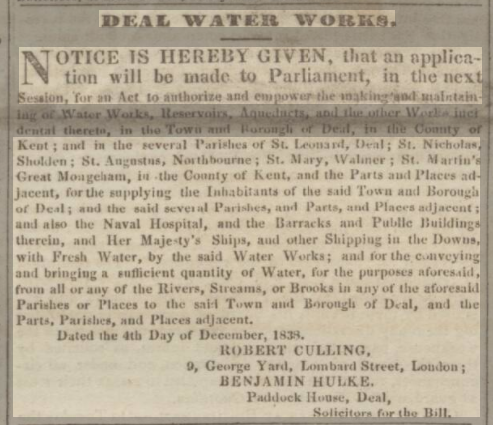
Dover Telegraph and Cinque Ports General Advertiser – Saturday 22 December 1838
And now we just take it for granted that all we have to do is turn on a tap to get ‘freshwater.’