Follow us on Facebook @FHofDW
Bowes Mackney Beer
13, Prospect Place, Deal
Dover Road Newington, London
96 Beach Street,Deal
27, Duke Street, Deal
Guildford Lawn West, Dover
Sherrand House Middle Deal Road, Deal
2 Castle Road, Deal
Occupation: Cinque Ports and Trinity Pilot
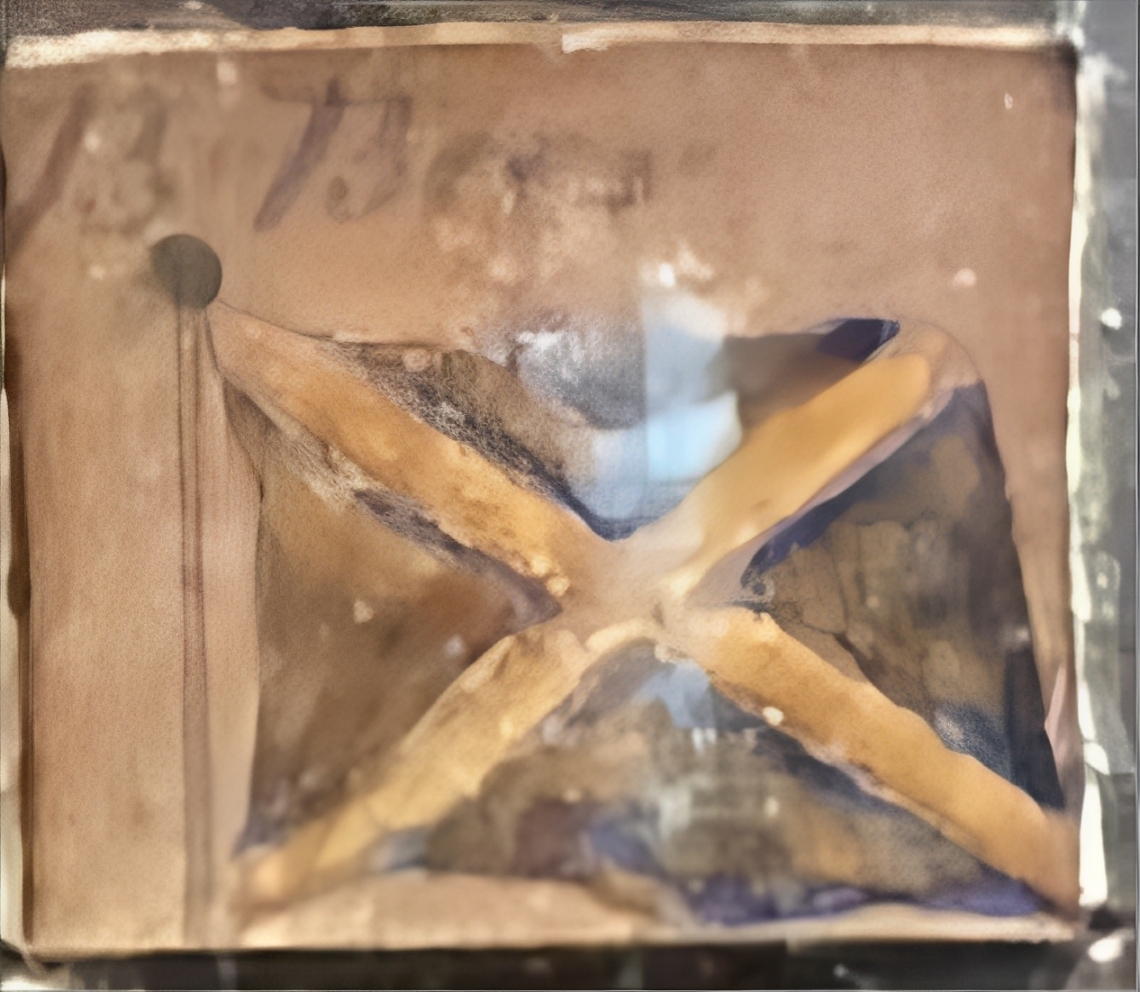
Trinity Pilot Flag for Bowes Mackney Beer
Bowes Mackney Beer was born in Deal in 1834 to James and Elizabeth, nee Mackney, Beer. James was the proprietor of a chemist’s shop in Lower Street, Deal, which appeared in the Poll Book and Electoral Registers for 1830. James and Elizabeth produced three children: James John, born in 1830, Elizabeth Harlow born in 1833, and Bowes Mackney, born in 1834. Sadly, James Snr passed away very soon after Bowes’ birth, leaving his mother to raise her young family on her own. By 1841, Elizabeth was living in Prospect Place with her 76-year-old mother-in-law, Elizabeth Beer Snr, the three children plus servants. Fortunately, Bowes mother seems to have been well connected.Her family, the Mackney’s,were involved in both farming and building in Deal and Sholden and Elizabeth possibly had an income from properties which meant she could afford a reasonable standard of living for herself and her children.
Both Bowes and his older brother, James Jnr, forged good careers. James went to Westminster Hospital where he trained to become a surgeon gaining a MRCS. Eng in 1857 and a LSA in 1860 (Guys). eventually becoming a chloroformist and apothecary at Broad Westminster Hospital. It is likely James trained under Dr John Snow who, besides tracing the source of the 1854 cholera outbreak in Soho, London to the Broad Street water pump, also became an expert in the administering of Chloroform during operations.
Bowes followed a different career path opting for a life at sea.In 1853 at the age of 18 years Bowes was issued with his Certificate of Competency as Second Mate, in Southampton. He then went on to gain his Certificate as First Mate in 1855 and finally became a Master in 1857. By this time he had met and proposed to Elizabeth Ham Rogers. Elizabeth was born in Deal and baptised on 8 February 1837 in St Andrews Church her father, Richard Rogers,being a Cinque Ports Pilot. How she met Bowes we don’t know, but it’s not hard to imagine, with her father being a Cinque Ports Pilot, Richard and Bowes more than likely knew each other and Richard’s daughter caught the young Bowes eye.
They were married on 24 August 1858 at St Mary’s Church, Newington,London where Bowes was adding to his skills by working as a Pilot – assisting ships who were ready to leave the busy Port of London and to be guided down the Thames and out into the North Sea. Piloting ships successfully through this extremely busy stretch of water whilst being monitored by Trinity House enabled Bowes to eventually qualify as a Trinity Pilot.
Elizabeth and Bowes appear to have had three homes at one time or another in London, Deal and Dover. A year later in December 1861 their only child, a boy, was born in Dover and baptised Alfred William Beer in Deal.
In the early years of his marriage Bowes was Master of a steam ship that ferried between Calais and Dover and was often at sea away from his family. In the 1861 census for Deal, Elizabeth and little Alfred are to be found registered twice, at both Wellington Terrace with her mother and sisters and Beach Road with her mother-in-law and family. In both entries Bowes is noted as being ‘at sea’. It would seem that she had a solid network of support around her when Bowes was absent.
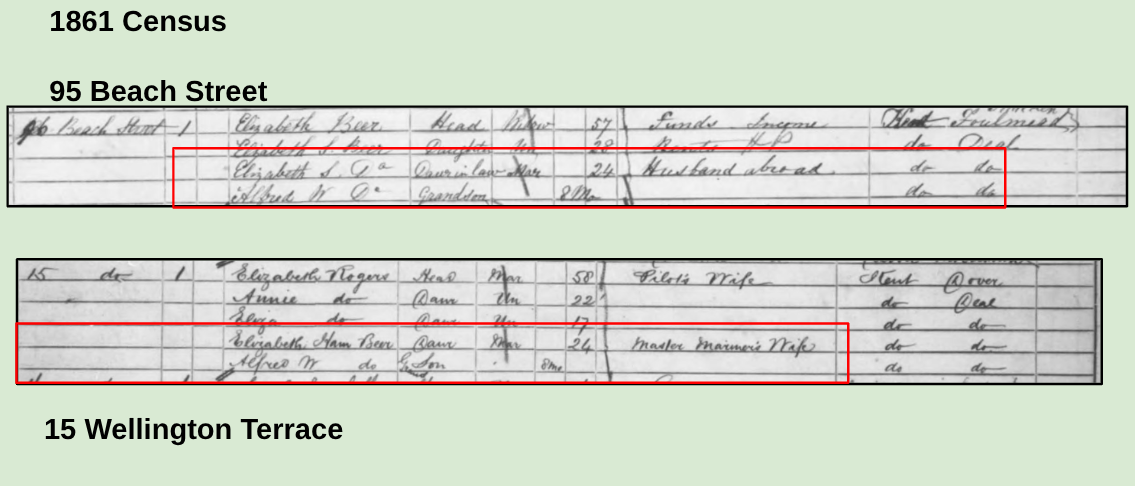
1861 Census
Commendation for Bravery
In September 1863 Bowes appeared in the local newspaper. He was commended for his bravery in rescuing a swimmer from the sea off Marine Road, Dover.
A young man, named as Mr Clayton, was visiting Dover and decided to go for a swim in the sea with his friends despite being warned that the weather conditions were not ideal and the waves both high and powerful. He was soon in difficulties being thrown on to the shore and dragged back out again by the force of the waves. Bowes appeared on the beach with a rope tied around his waist which he threw to the struggling swimmers. The rope reached the boy but he was unable to grasp it being almost unconscious by this stage and despite Bowes managing to grab another of the struggling swimmers and dragging them ashore, Mr Clayton was soon thrown back into the waves where he drowned finally being pulled on to the beach near the stone groyne. The Coroner summed up the evidence observing that, ‘but for the courageous efforts of Mr Beer the occurrence might have had a fatal termination in two cases instead of only one.’
Divorce, Prostitutes & Venereal Disease
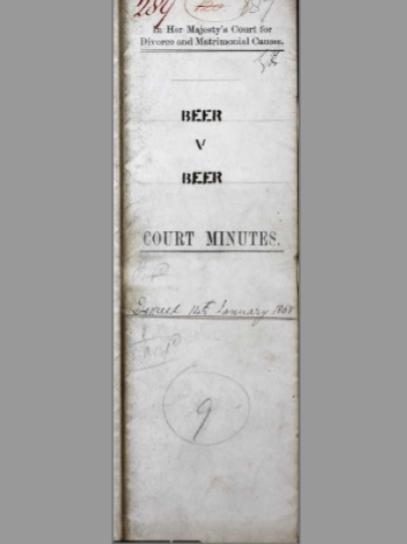
So as far as we can tell it would seem Elizabeth was well provided for but as to the love, respect and companionship they provided each other during their marriage our research had, so far, failed to provide us with any information until we came upon the following. On 21st June 1866 Elizabeth’s Solicitors Mercer and Mercer of Mincing Lane, London filed a Petition and affidavit and issued a Citation against Bowes. It would seem that Elizabeth was finding life impossible being married to him. Her Petition opens with her accusing Bowes of cruelty. Since the passing of the Divorce Act in 1857, cruelty was one of the most crucial grounds for women, either as a single justification for judicial separation or, in combination with adultery, for divorce.
Elizabeth claims, in November 1863, Bowes committed the act of cruelty by ‘knowingly and wilfully communicating to her the Venereal Disease’. Within a marriage it wasn’t uncommon for the infected husband to transmit the disease to his wife. She, the innocent victim, was likely to pass on the infection to her unborn child who may have been stillborn or inherited the disease from its mother and suffer the effects until this resulted in an early death. The ‘wilful communication of a loathsome disease’ was used by many wives against their husbands to enable them to gain a divorce.

The 1866 divorce case Boardman v Boardman and earlier in 1865, Brown v Brown, seem to have guided the Divorce court during Elizabeth Beer’s period. These cases set a precedence by explicitly defining the knowing and reckless communication of disease by the husband to the wife as cruelty. Brown v Brown basically stated that the husband knew what he was doing as “the husband’s state of health is to be presumed to be within his own knowledge”. These decisions provided wives with the opportunity to claim the court’s protection against this particular variety of marital cruelty.
Elizabeth continued, in her Petition, by accusing Bowes of deserting her in favour of prostitutes. She names two of these prostitutes she alleges he has been consorting with, and their addresses in Pimlico, The Strand, London, Dover and Ramsgate which made us think Elizabeth might have employed the services of some sort of ‘private detective’ to gather evidence to support her case.
Bowes took his time in responding. On 10 July he informs the court he is going to defend himself and in due course he gives his version of the state of his marriage and denies all Elizabeth accuses him of.
Her accusation of Bowes transmitting the Venereal Disease to her was brave, but necessary, if she was to highlight his cruelty and as someone who was unsuitable to rear their son. Reading through the Court Papers we can see nothing that implied Elizabeth had subjected herself to an examination by a doctor to prove she had contracted the infection and, indeed, if Bowes had also undergone this procedure. We can only guess that she must have had to provide the court with some form of Doctor’s certificate. In a newspaper report it was reported that Elizabeth claimed she left the home so she could undertake medical care which helped her to recover after which she returned to Bowes saying she was willing to return to him. Elizabeth declares that he refused her. Perhaps Bowes was aware that neither of them could recover from the Syphillus as there wasn’t a reliable treatment for the disease until after the first world war.
When she gives her oral statement in the court in front of the Judge Sir James Wylde, it is accompanied by another statement given by a witness on her behalf. We cannot say conclusively who this witness was but possibly the detective who had supplied Elizabeth with the names and addresses of Bowes’ prostitutes. Her strategy obviously worked and we know she was granted her divorce from Bowes in 1866. Custody of Alfred went to his mother.
After she was given her Decree Nisi in 1868 Elizabeth re-married a John Fletcher Norfolk in Croydon. John was one of the sons of a practice of Veterinary Surgeons, well established, in Dover headed by their father John Fletcher Snr. In 1871 Elizabeth’s son, Alfred,now known by his second name, William, was residing with his paternal grandmother Elizabeth Mackney Beer, and his aunt, Elizabeth Harlow Beer at their, now established, Boarding School situated along South View terrace in Deal. He is 10 years old. He eventually rejoins his mother and his step father now settled in Coventry. Elizabeth died in July 1901 and is buried in Lambeth.
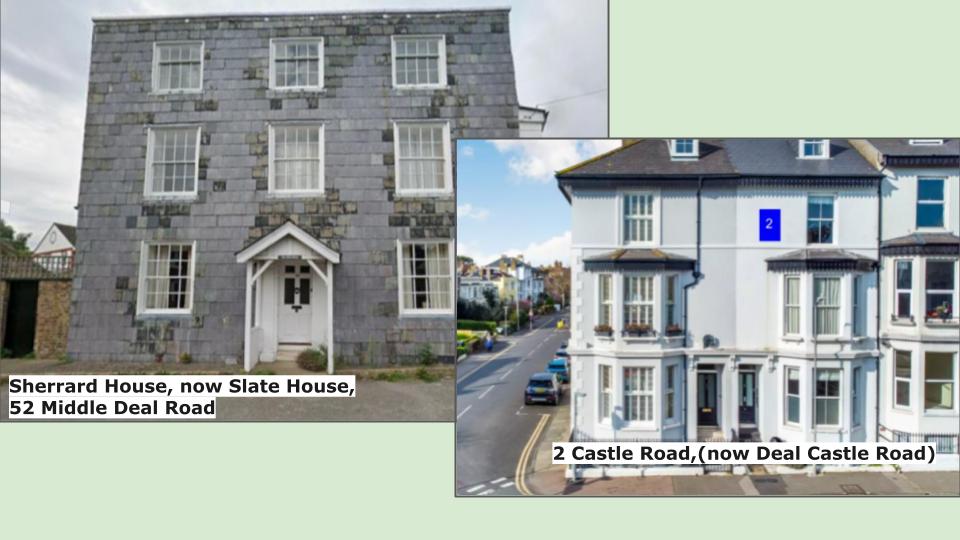 1868 was a memorable year for Bowes too who was to qualify as a Trinity and Cinque Ports Pilot and, like Elizabeth, remarry. How Bowes met his new bride, Jane Bristow, we don’t know. Jane’s family came from Ramsgate and she was one of six children born to Abraham and Joan. Abraham supported his family working as a Porter at the Ramsgate Dock. Her family must have been impressed when Bowes moved Jane into a house in Prospect Place (now Victoria Road) with a servant and a Monthly Nurse to support her after the birth of her first child. Unfortunately her little girl didn’t survive, but they did go on to have a family of six children, two boys and four girls. Bowes and his family continued to live in a number of different houses including Sherrand House in Middle Deal and 2 Castle Street opposite Deal Castle. Sherrard House can still be seen today at 52 Middle Deal Road renamed ‘Slate House’ and 2 Castle Road remains in its original location.
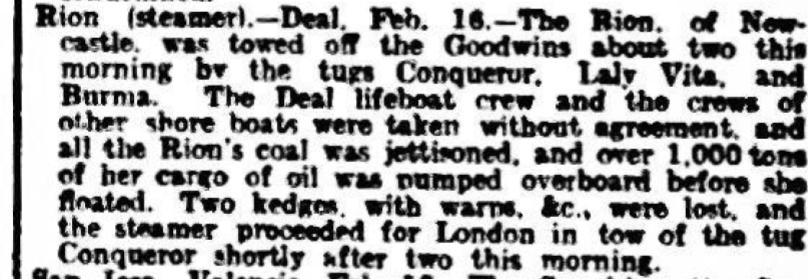
Liverpool Daily Post 17 February 1902
In 1902 a report in the Liverpool daily Post tells us that there was an incident at Deal on February 16th. A ship,the Rion of Newcastle, was towed off the Goodwins at about 2am by various tugs. It seems Bowes was involved with taking the Lifeboat Crew and crews of other shore boats without permission and jettisoning Rion’s coal and pumping over 1000 tons of her cargo oil overboard in a bid to re-float the ship. Bowes was suspended from his role as a Trinity Port Pilot and was to retire by 1911.
Jane died in 1905 and Bowes in 1916 being nursed to the end by two of his daughters. Both Jane and Bowes are buried in Hamilton Road Cemetery.
| Name | Born | Baptised | Married | Died | Buried |
| Bowes Mackney Beer | 1834 | 10 August 1834 St Andrews Church Deal |
1) Elizabeth Ham Rogers 24 August 1858 St Mary’s Church, Newington, SouthwarkBorn Deal 1837 Died Lambeth 1901 2) Jane Bristow 1868 Ramsgate Born Ramsgate 1847 |
1916 | Hamilton Road Cemetery. Deal |
The Children of Bowes Mackney Beer & Elizabeth Ham Rogers
| Name | Born | Baptised | Married | Died | Buried |
| Alfred William | 1860 | 4 January 1861. St Andrew’s Church, Deal |
The Children of Bowes Mackney Beer & Jane Bristow
| Name | Born | Baptised | Married | Died | Buried |
| John Bowes Beer | 1869 | Beatrice Wood June 2 1906 Mitchum, Surrey |
15 January 1953 | Cremated 20 January 1953 Kensington and Chelsea |
|
| Kate Jane | 1871 | 3 December 1962 St Johns Hospital Battersea |
|||
| Herbert James | 1873 | June 1959 | Hendon Cemetery | ||
| Elizabeth Nellie | 1874 | Walter Talboys Wheeler 1907 Maidstone, Kent |
1916 | 19 March 1916 West Midlands | |
| Maud Mary | 1876 | 1966 Eastbourne |
|||
| Mabel Norah | 1879 | March 24 1936 | Hamilton Road Cemetery, Deal | ||
| Ethel Dora | 1882 | June 1975 Downside Hospital Eastbourne, Sussex | St Mary’s Eastbourne, Sussex | ||
| Frank Mackney | 1885 | 19 June 1915 Harriette Mary George 19 June 1915 Littlebourne, Wingham, Kent |
1957 Dover |
Census
| Year | Address | Name | Relationship | Occupation |
| 1841 | Prospect Place, Deal | Elizabeth Beer | Head | Independent |
| James | Son | |||
| Elizabeth | Daughter | |||
| Bowes | Son | |||
| Elizabeth | Mother in law | Independent | ||
| Sarah Smith | ||||
| Eliza Lawrance | Servant | Servant |
Census
| Year | Address | Name | Relationship | Occupation |
| 1851 & 1861 | UNKNOWN |
Census
| Year | Address | Name | Relationship | Occupation |
| 1871 | 13 Prospect Place, Deal | Bowes M Beer | Head | Cinque Ports and Trinity Pilot |
| Jane | Wife | |||
| Infant | Daughter | |||
| Elizabeth Butress | Nurse | Monthly Nurse | ||
| Mary Osborn | Servant | Servant |
Census
| Year | Address | Name | Relationship | Occupation |
| 1881 | Sharrard House, Middle Deal Road | Bowes Beer | Head | Pilot |
| Jane | Wife | |||
| John | Son | Scholar | ||
| Kate | Daughter | Scholar | ||
| Herbert | Son | Scholar | ||
| Elizabeth | Daughter | Scholar | ||
| Maud | Daughter | Scholar | ||
| Mable | Daughter | Scholar | ||
| Jane Bristow | Mather in law | |||
| Mary A Ellis | Sister in law |
Sources and further reading:
Newspaper image © The British Library Board. All rights reserved.
With thanks to The British Newspaper Archive (www.britishnewspaperarchive.co.uk)
Poll Books (selected)
| Year | Profession | Residence Residence |
| 1868 | Pilot | 96 Beach Street |