Follow us on Facebook @FHofDW
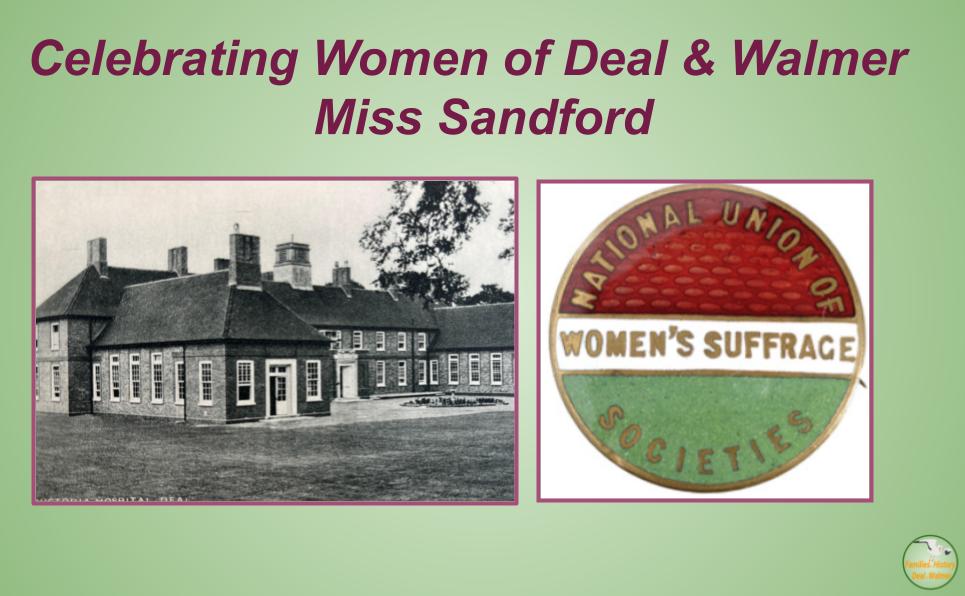
Edith Charnock Edmondstone Sandford, was born in 1861, and trained as a nurse at the Royal Infirmary, Edinburgh, where she qualified in 1888. Three years later she was a Nursing Sister at King’s College Hospital, London. By 1901 she had returned to Edinburgh as a Matron until she retired. When the 1911 census was taken, she was living in Deal. In around 1912 Miss Sandford came out of retirement for a short while, working as the Honorary Commandant of the Kent 22 Deal, Voluntary Aid Detachment. Later, in 1916, she became
involved with the Y.M.C.A. and was amongst the organisers who opened the Stanhope Theatre (now the Astor) as a wartime Y.M.C.A. for the use of troops on leave.
In 1919 she became the first lady member of Walmer’s Urban District Councillor and later a J.P.
She was a member of the Deal & Walmer branch of the Women’s Citizen Association, whose aim was to stimulate women’s interest in social and political issues. By November 1920, with membership waning, it was decided to close the branch. Miss Sandford then helped form The Housewives’ Union, which campaigned for fairer pricing of sugar and milk, even setting up their own dairy.
As the Secretary of the Women’s Conservative Association, during the 1920 local by-election, she gave a speech saying that “… women got the vote, not because they broke windows, but because of the excellent work they did during the war. The country needed them then, and it needed them now…”
Beyond politics, Edith was involved in the local schools, girls’ clubs, Walmer Nursing Association and the activities of St Saviour’s Church. The local Mothers’ Union was another organisation close to her heart and after her death, it was they who raised the funds for the fitting tribute of a bed, which was named after her, at the Deal & Walmer District War Memorial Hospital, the hospital in which she had so recently died.
Her funeral, in 1928, was held at St Saviour’s, Walmer; such was the respect for her, the flags along the seafront were flown at half-mast.