Follow us on Facebook @FHofDW

Charlotte Despard was born in Edinburgh but brought up with her siblings in Ripple. She was the daughter of Royal Naval Captain John Tracey French and his wife Margaret (née Eccles), the sister of Katherine Mary Harley and the Captain of Deal Castle Field Marshal John Denton Pinkstone French, 1st Earl of Ypres.
After falling out with Emmiline Pankhurst, Mrs Despard, as she was always known, founded the Women’s Freedom League. The WFL was to become one of the three main campaign organisations fighting for women to gain the right to vote.
In September 1908 Mrs Despard, with a fellow WFL member, arrived in Deal in the purposely fitted out horse drawn caravan. Here they held several large open air ‘Votes for Women’ meetings on the beaches of Deal and Walmer before travelling to other towns.
Follow us on Facebook @FHofDW
Charlotte Despard, nee French
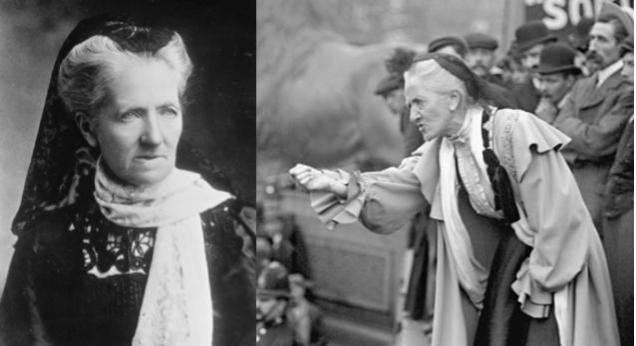
Mrs Charlotte Despard was born in Edinburgh in 1844 but was brought up with her siblings in Ripple. As well as a women’s suffrage campaigner she was a life-long pacifist, taking part in anti-war rallies and sat on the committee of the Women’s Peace Crusade set up in 1917. Her pacifism led to a rift with her brother, Field Marshal John French, the 1st Earl of Ypres and Captain of Deal Castle. Charlotte was also a novelist, ‘Chaste as Ice, Pure as Snow’, published in 1874, was followed by seven more novels. ‘Outlawed: a Novel on the Women’s Suffrage Question’ was written with her friend and fellow theosophist, Mabel Collins, was published in 1908.
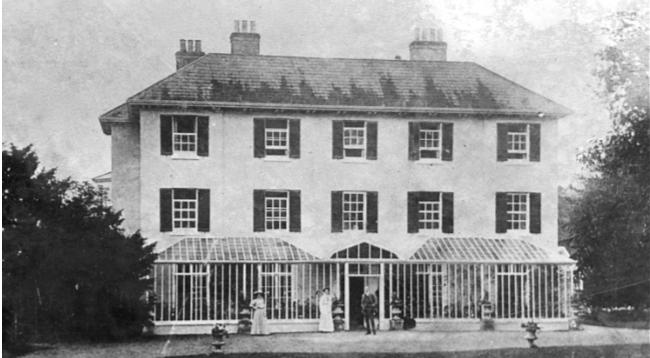
When her father, Naval Captain John French, died in 1855, the family at first remained in Ripple but, gone were the happy childhood days of playing with the village children as Captain French had given the guardianship of his children to a friend who had different views about how the French children should behave. He even planted a high hedge to keep the children away from their playmates.
In around 1861, Charlotte visited a rope factory and, perhaps for the first time, she saw the poverty in which those far less fortunate than herself lived. Women and children, some as young as eight, were picking threads from mounds of rags to be made into rope. Perhaps it was these things that set Charlotte on the path of social reform.
Her mother died in 1869, and in the following year she married Maximillian Despard, a wealthy Irishman who, like her, supported the idea of social reform, a wider franchise and safer working conditions.
Throughout their married life, Maximillian suffered from ill health. In 1890, seriously ill, he fell into a coma and died.
For a while Charlotte, or Mrs Despard, as she was later always known, hid herself away at Courtlands, the home she and Maximilian had bought together in the Surrey countryside. The Duchess of Albany, the widowed wife of Queen Victoria’s youngest son, Prince Leopold, lived nearby, summoned her, and suggested that she take up some charity work. The Duchess was the patron of the Nine Elms Flower Mission, which supplied flowers to poor families to bring colour into their daily lives.
Mrs Despard, though, was not satisfied with just sending flowers and she soon was living in the Nine Elms district, which was then one of the poorest slum areas of London. Here she set up and ran health clinics, youth and working men’s clubs and organised soup kitchens.
She became a workhouse visitor, where the women inmates told her about their lives both in and out of the workhouse. She appealed, on their behalf, against the ill-fitting workhouse clothing and the atrocious food.
Later she was elected as a Poor Law Guardian for Vauxhall, a post she held for nine years, fighting for change from within.
In 1903 the Pankhursts set up the W.S.P.U., an organisation campaigning for women who paid the rates to have the right to vote on equal terms with men. Mrs Despard, who believed in Universal Suffrage, was initially averse to joining them. But when it was pointed out that this was just a stepping stone and that many working-class widows would gain the right to vote, for the simple reason that working-class men married earlier and died sooner, this changed her mind and in 1906 she agreed to join. Soon after, she became joint secretary with Edith How-Martyn, who also campaigned for birth control.
Mrs Despard was arrested and imprisoned twice during protests. But after Emmeline and Christabel Pankhurst started to make decisions without consulting the membership, Mrs Despard and 70 others, including Edith How-Martyn, left the WSPU in 1907.
At the end of the year she had formed the Women’s Freedom League who, like the WSPU, were prepared to break the law, but only through civil disobedience.
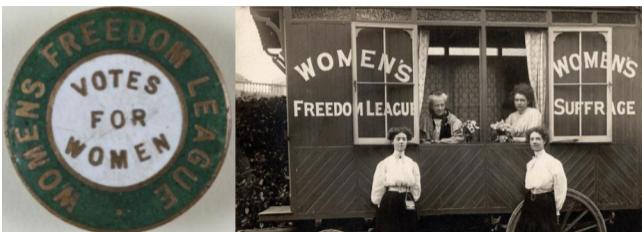
From May 1908 Mrs Despard was on the road touring in the W.F.L. caravan, raising and gaining support for the women’s suffrage cause. She arrived in Deal in September and held several meetings which hundreds attended on the beaches of Deal & Walmer.
The Women’s Tax Resistance League was formed in 1909. In the five years of its existence over 220 women refused to pay taxes. Mrs Despard was one of those who lost her furniture to bailiffs, on at least two occasions.
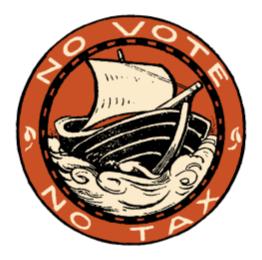
It was Mrs Despard who helped devise the 1911 Census Boycott.
After gaining partial women’s enfranchisement in 1918, Mrs Despard resigned as president of the W.F.L. and stood as a candidate for Battersea in the general election. She, like all but one of the women candidates, was defeated. Her pacifism and now extreme left-wing views probably didn’t help her cause.
She moved to Ireland in 1925 and became involved in Irish politics, supporting Sinn Féin and Republicanism.
Her 84th birthday celebration was also marked by the final goal of equal voting rights with men in 1929.
She remained in Ireland for the rest of her life. She died in Belfast in 1939 and is buried in the Republican Plot at Glasnevin Cemetery in Dublin.
Despite being the leader of one of the UK’s largest women’s suffrage organisations, not to mention all her good works, Mrs Charlotte Despard, unlike Emmeline Pankhurst and Millicent Fawcett, does not have a monument dedicated to her.
She is, though, named on the plinth, with 50 others, below Millicent Fawcett’s monument in Parliament Square and has two blue plaques and a memorial board in Battersea, and now has an, albeit brief, mention (despite an error and the use of the term Suffragettes) on the Victoria Town Deal History Board.
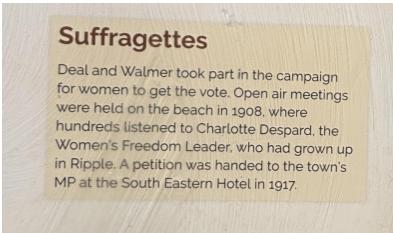
Deal History Boards Victoria Road
It should read ‘Charlotte Despard was the Women’s Freedom League leader’
The women of Deal & Walmer were against the violent activities so were Suffragists not Suffragettes