Follow us on Facebook @FHofDW
81 Beach Street
formerly
123 Beach Street
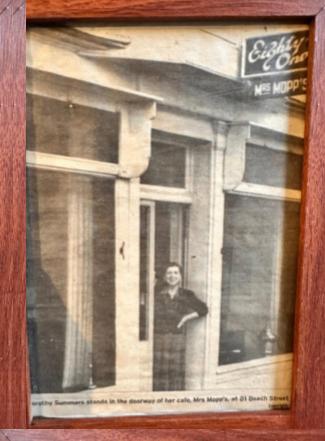
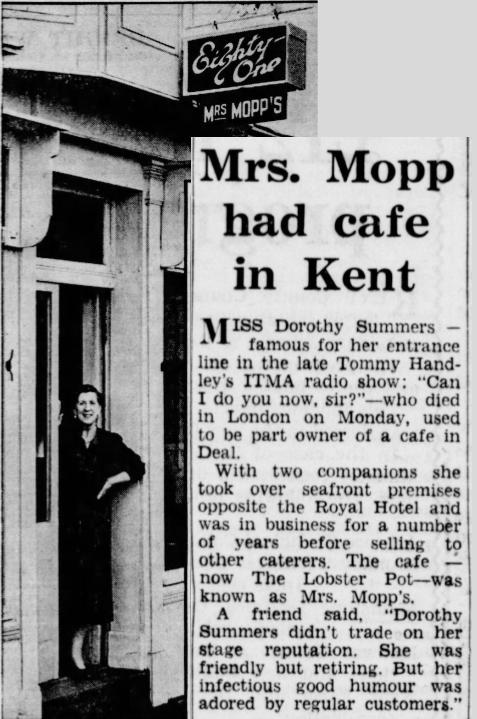
Dorothy Summers once part owned and ran Mrs. Mopp’s, a cafe at 81 Beach Street In recognition of this there is today, on a windowsill, half way to the first floor, a framed newspaper image of Dorothy standing at cafe door.
Mrs. Mopp, played by Dorothy Summers, was a character from the 1940s BBC radio show, It’s That Man Again (ITMA) in which “Can I do you now, sir?” became her now famous catchphrase.
81 Beach Street is one of our favourite restaurants and as, over the years, we have passed by the image, we have promised ourselves to look into the history of the building.
Watchmakers & Circulating Library
The earliest mention that we can find for the property is September 29 1780 when John Carter, who we presume to be the brother of Elizabeth Carter, took out the lease from the Archbishop of Canterbury’s Estate who owned great swathes of Deal at the time. No record actually survives to prove this lease but it is mentioned in the lease taken out by Richard Long on April 4 1787.
“…in consideration of the surrender of a former lease made to John Carter of Deal…”
Richard Long was born in Deal in 1759 he was the son of Stephen Long, a cordwainer by trade, and Sarah, nee Burton whom he had married in 1754. Richard did not follow his father’s trade , choosing instead to become a watchmaker. John Brice was a watchmaker in Sandwich and, after serving his apprenticeship with him, Richard returned to Deal. In 1787 he took out the lease for what was then, until renumbering in the late 1890s, 123 Beach Street. A year and a half later, in December 1788, he married Elizabeth England.
Elizabeth’s own parentage is unclear; we know that she and Richard had four children, three daughters and a son all born between 1791 and 1797. It is almost certain that they were all born above their fathers shop.
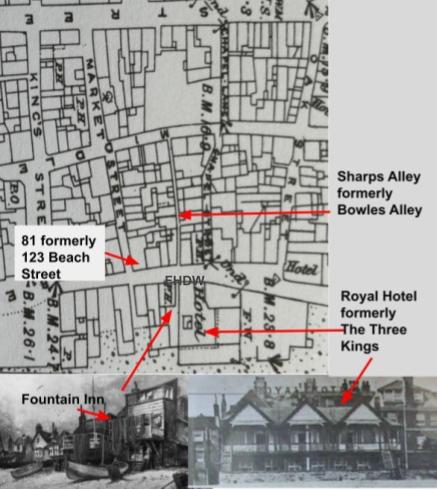
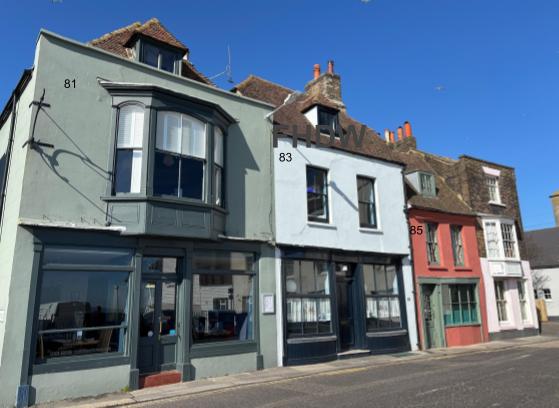
The front of the shop at the time would have probably looked more like that of 83 or 85 Beach Street. You would not have been able to see the sea from the properties windows as at that time as, sitting in the area which is now a car park, there were three buildings. The one closest to the Three Kings which was renamed the Royal Hotel in 1837, was the Fountain Inn. A narrow passageway, extending across Beach Street from Sharps Alley, then known as Bowles Alley, separated these two establishments.
While Richard describes himself as a watchmaker in all of the leases, for 123 Beach Street, and on other leases in the town, his main occupation seems to have been that of a bookseller and circulating library owner. These three businesses he seems to have run concurrently and from the same premises.
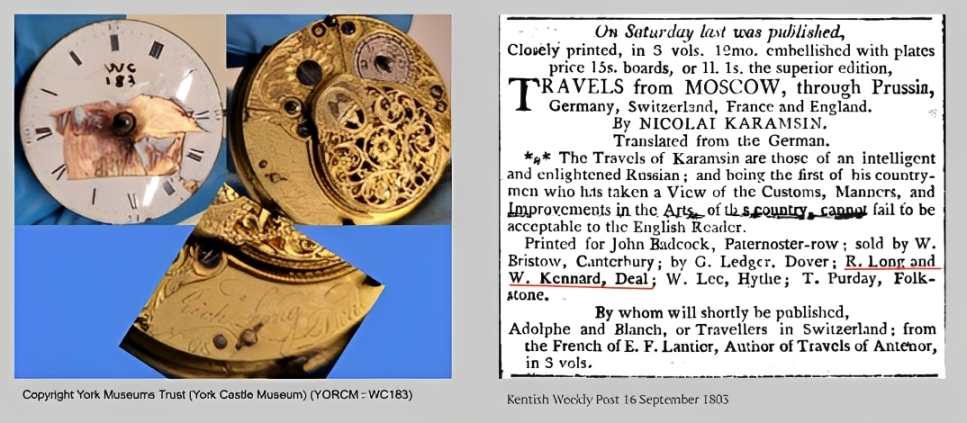
If any of Richard Long’s watches survive they are likely to be in private hands. So far we have found only one and that is just the mechanism and damaged watch face. It is held by York Castle Museum who kindly provided us with some images which include Richard’s signature. Another reference to a watch made by him was made of silver and stolen from Samuel Collett of Dover in 1792.
Richard had one watchmaking apprentice, William Kennard, in 1794. Interestingly, in 1803 there were advertisements in the Kent newspapers for publication available at various booksellers including from ‘R Long and W Kennard, Deal’. Richard may have entirely given up on the watchmaking at around this time as William Kennard as in 1800 He took on Benjamin F Christian as an apprentice bookseller.
During the mid to late 18th century copper coins were in short supply. Coins traditionally contained the value of the metal they were made from, so as the price of coin metals rose in price, the size of the coin decreased so making small coins became far too inconvenient to produce which led to a shortage of small change. So traders started to produce their own coins or ‘trade tokens’ with their own symbols or designs on them. Richard Long was just one of the many traders in Deal,and across the country, who did so. For his coin, or trade token, Richard chose to use a ship in sail on the face with the slogan ‘The Guard and Glory of Britain,’ and the Deal coat of arms on the reverse. ‘The Guard and Glory of Britain,’ was a popular patriotic slogan used as an inscription on the 18th-century British copper halfpenny coins or trade tokens. Stamped on the rim is ‘Payable at Richard Longs Library.’ Unlike today, libraries were a commercial enterprise, often referred to as circulating libraries, they rented books to subscribers, usually for annual or quarterly fees, and were the forerunners of the public lending libraries we know today. It’s not clear why Richard needed this ‘small change’ but it could be that he rented out books at a daily rate of a ha’penny.
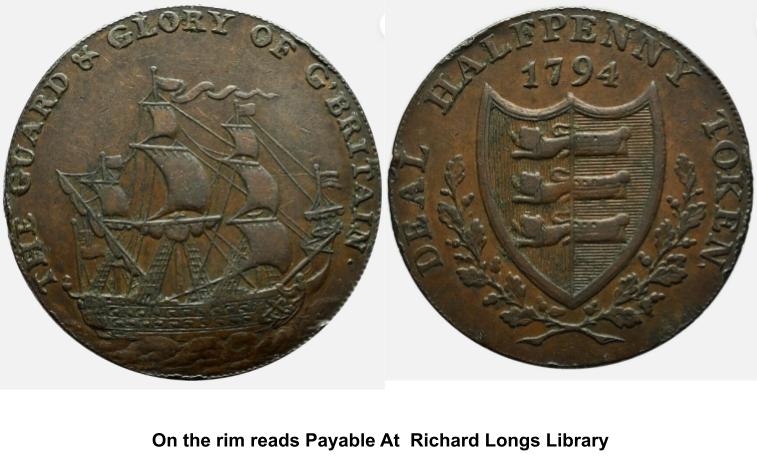
Richard Long Trade Token
The late 18th century was a time of great change; the industrial revolution created jobs but also poverty which in turn led to social unrest. Increasing disorder across the country led to rioting which started to mirror the violence of the French Revolution and caused fear amongst the propertied classes.The movement to reform parliament and the rise of radical societies, which attracted the lower classes in great numbers as they called for greater equality, brought fears of the government being overthrown. Pamphlets and books such as The Rights of Man by Thomas Paine were printed and readily available added fuel to the fire.
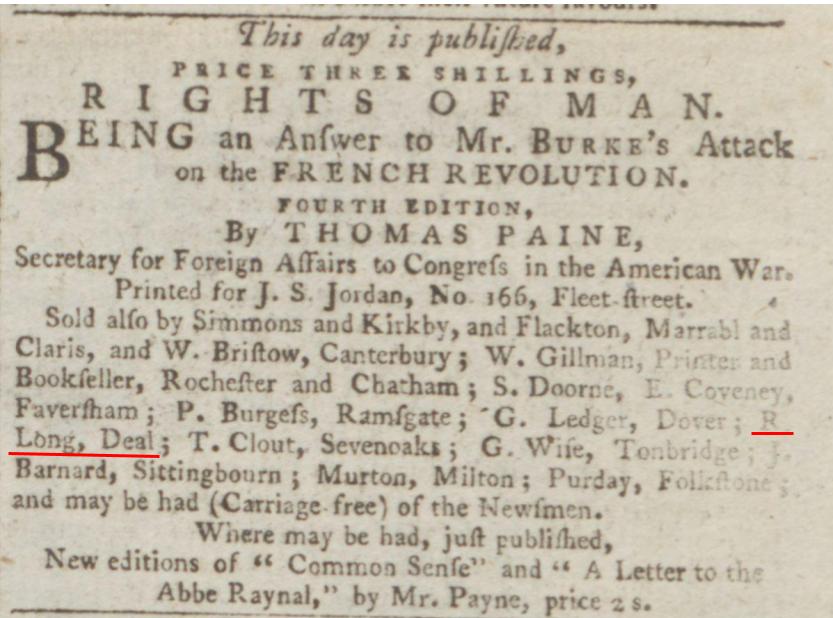
Kentish Gazette 15 April 1791
The Rights of Man was published in 1791 and sold in its thousands, including by Richard Long in his Beach Street Bookshop. In it Thomas Paine defends the French Revolution, criticises the British constitution, speaks out against the hereditary monarchy and encouraged a home grown revolution.
To try and quell the radical press, the government issued a Royal Proclamation on 22 May 1792 against ‘wicked and seditious Writings … endeavouring to vilify and bring into contempt the wise and wholesome constitution.’ Thomas Paine was later indicted for Seditious libel. He was tried in his absence, being in France at the time.
To counteract the rise of radicalism and fear of revolution, John Reeves, in 1792, with the approval of the government, formed the Association for Preserving Liberty and Property against Republicans and Levellers. From mid November 1792 ‘association meetings spread quickly right across the country.
With Thomas Paine’s book no longer on his bookshelves Richard became the Secretary of the ‘Deal Association.’ Its inaugural meeting was held in St. George’s Chapel on December 17th. With Mayor Thomas Oakley in the Chair the inhabitants of the town and neighbourhood of Deal resolved unanimously to
‘…Testify to the loyalty to the King and to associate against Republicans and Levellers….to suppress all illegal meetings and the dissemination of seditious and ill affected writings or publications…will destroy all such papers as may fall into our hands…that the civil societies there must be of different ranks and degrees of men…which we confidently affirm ours to be…’
In February 1793 Richard, as Secretary, placed an advert in the Kent newspapers warning that information had been received that ‘a foreign agent had been employed to purchase boats to use for the purpose of privateering and for purposes against the country.
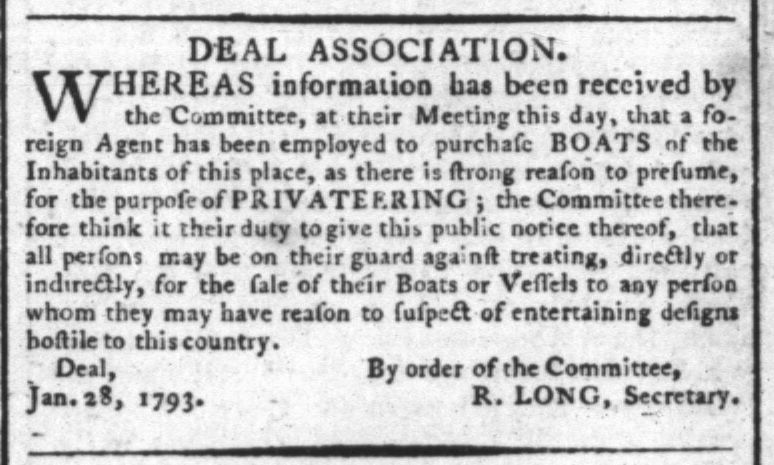
Maidstone Journal 5 February 1793
A year later it was agreed that a general subscription should be raised for the defence of the district of the Cinque Ports. Payments could be made at Mr. Oakley’s Bank and at Mr Sharp and Richard Long’s libraries. Here too volunteers could register their willingness to join the infantry or cavalry. These and other resolutions were published in the local newspapers and leaflets that were distributed ‘…to all the inhabitants of Deal…’
The dramatic and successful rise of the Associations was followed by a decline so that by the mid 1790s they had dwindled away. Perhaps they had simply done their job in helping to avert a revolution. Another threat, filled the void as in 1803 Britain feared Napoleon would invade. Two acts of Parliament were passed early in the year to raise men for home defence and both required a list of all male inhabitants. The Army of Reserve Act was passed on 6th July so that enrolment of men could happen albeit voluntarily. Not raising the numbers required the Levee en Masse Act was passed on 27 July which required parishes to list all men between the ages of 17 and 59. Richard appears in the former but strangely not the latter.
Throughout this time Richard continued to live and work at 81 Beach Street serving as a Jurat and then Mayor in 1813. During his residency he had watched the ebb and flow of masses of naval and military men, he’d seen boatmen and traders profit, including himself. In 1815, the year in which the battle of Waterloo ended the war with France, Richard Long gave up his lease which was then purchased by the bankers John May, John Mercer, William White and James Wyborn.

Dover Telegraph and Cinque Ports General Advertise 14 June 1834
Richard appears then to have moved just a few doors down to number 127 Beach Street, from where Richard seems to have weathered Deal’s post Waterloo decline. In 1834, Richard, now seventy six years old, put his business and household goods up for sale. He perhaps stayed in Deal for a little while after this but by the time of his death in 1841 he was living with his son and his family in Liverpool.
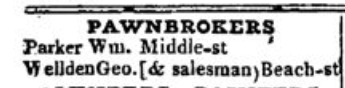
Pigot’s Directory for 1826
Pawnbrokers
John May, John Mercer, William White and James Wyborn were banking partners and they, like many other wealthy people, leased property which they would then ‘sublet.’ It appears they leased 123 Beach Street to pawnbroker George Wellden. How long George traded from there is not clear. He was definitely living on Beach Street when the 1821 census was taken and appears in Pigot’s Directory for 1826.
The banking partners in 1822 sold their lease to William Collman who, according to a document attached to the Indentured Lease, had taken out a mortgage in 1819 with upholsterer and auctioneer, Edmund Spain. This document legally recognised that the lease, while in William’s name, was actually in their joint ownership.William was a Navy Purser who was, as the name suggests, responsible for a ship’s money and accounts. Why he took out this loan by mortgage is not clear. Perhaps it was to buy the freehold of the property he owned on Lower Street, or the lease of another property in Prospect Place both of which are mentioned in his Will.
In 1824 forty-three year old William married twenty-six year old Mary Burgess in St. Leonard’s Church. It was to be a short marriage as two years later William died. In the aforementioned will he left all his worldly goods, in the hands of his executors, in trust for Mary. As such the lease for 123 Beach Street was transferred to those executors namely, William Hulke the younger, surgeon of Deal, and John Oakly Burgess banker, of Ramsgate. John Oakly Burgess was Mary’s brother and, just to keep things in the family, Edmund Spain was William’s brother in law.At some point after George Wellden had vacated 123, butcher Richard Thomas Adams moved in but by the time the 1841 census was taken the property was temporarily empty.
In 1843 Edmund Spain renewed the lease from the Archbishop’s estate in his own name, however it’s not clear who actually lived or traded from the property during the time Edmund held the lease which, following his sad demise by suicide, was passed to his wife Sarah in 1845. In 1850 Sarah renewed the lease for a further 21 years in her own name, but she sadly died in Beach Street in March 1851. This may not have been 123 Beach Street as she also, either owned or leased, 127 Beach Street the former home of Richard Long. The lease was now, as per Sarah’s will, in the hands of her executors, William Knight Woodruff, George Mercer and James Barber Edwards, in trust for her children.
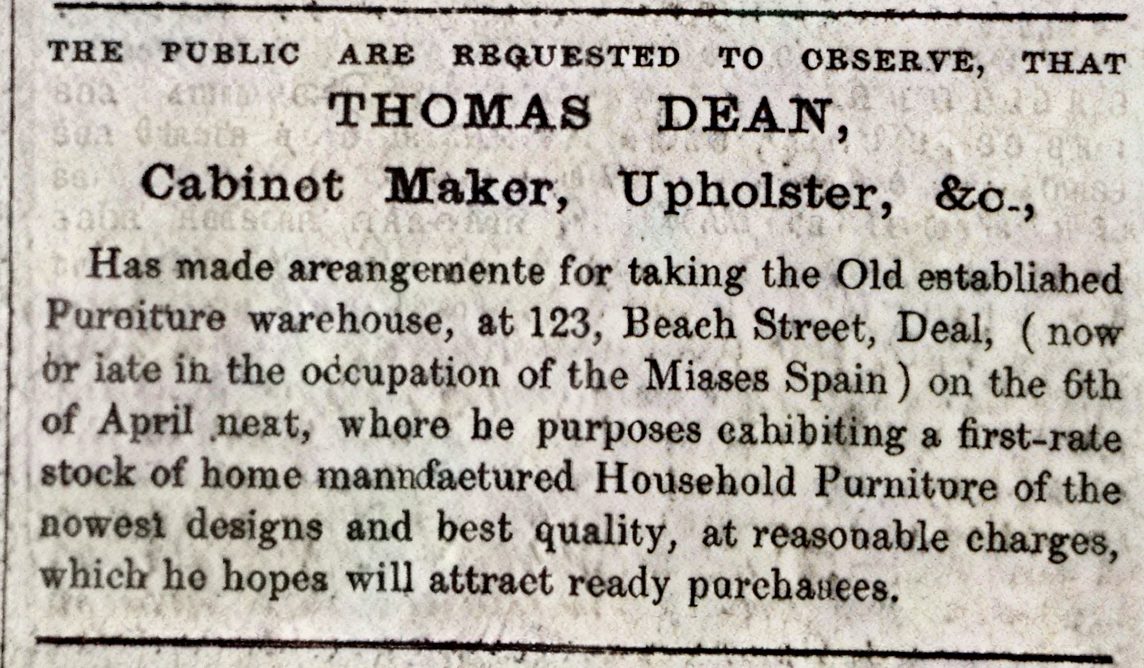
Deal Walmer & Sandwich Telegram January 27 1858
Cabinet Maker & Upholster
The 1851 census shows that Edmund and Sarah Spain’s married daughter Sarah Dean, was residing in 123 Beach Street, with her children and unmarried siblings. An advert placed in the local press, by Sarah Dean’s son Thomas, in 1858, suggests the property was used as a furniture warehouse, leading us to believe that this was its main use from 1840 when Richard Thomas Adams vacated the premises. The 1861 census shows that cabinet maker Thomas Dean, and his family, were living and trading from there.
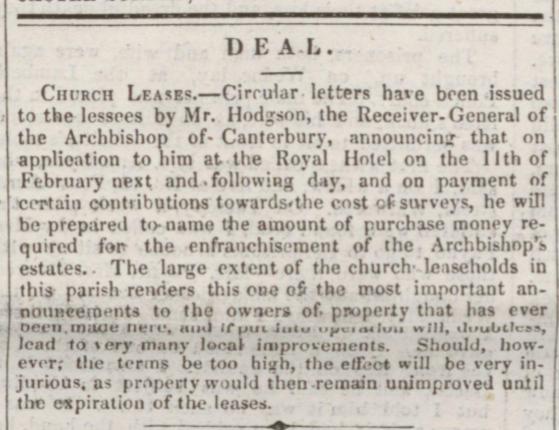
Dover Telegraph 31 January 1857
In 1853 the See of Canterbury’s Estate Act was passed which gave them the ability to sell its land and property. The executors of Sarah Spain’s will duly purchased the freehold, for £107, in 1859 and in 1864 sold the freehold to Stephen Hinds.
Hairdressers
When Thomas Dean vacated 123 Beach Street in 1864 moving to next door to 121 (now 77), James Dadds took up his short residence and traded there as a baker. Robert Aland, a London Jeweller may have moved in temporarily as a lodger before moving along Beach Street to number 158. By 1871 local hairdresser George Hayward had moved in with his family and quietly carried out business for almost twenty years. By late 1890 George had moved to 120 Beach street ( now, 75) and, at least for a few months carried out his business from 179 Middle Street but by January 1891 he lived and traded from 120 Beach Street.
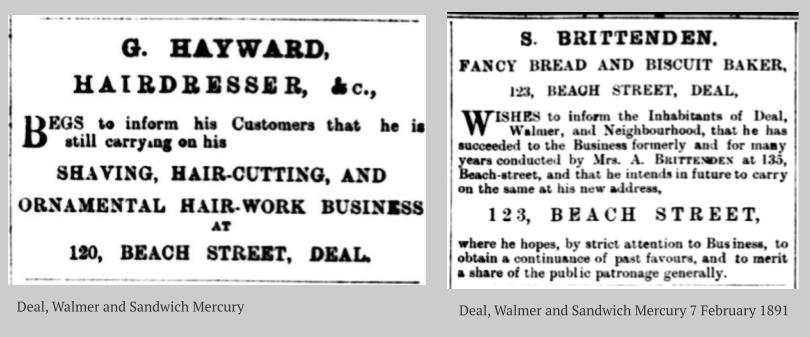
Fancy Bread and Biscuit Baker
Fancy Bread and Biscuit Baker Stephen Brittenden must have moved in almost immediately as in January 1891 he too was advertising his business. On Boxing Day 1890 Stephen married Annie Dilnot Smith, in Woodensborough, where the marriage was celebrated with “loaves of bread being suspended across the road for the bridal party to pass under”
Stephen, like many men of his time, joined charitable and social organisations. He was a member of the Ancient Order of Foresters and the Ancient Order of Druids. Both organisations were friendly societies providing members with financial and social support. He was also a member of the Deal & Walmer Carter Institute.
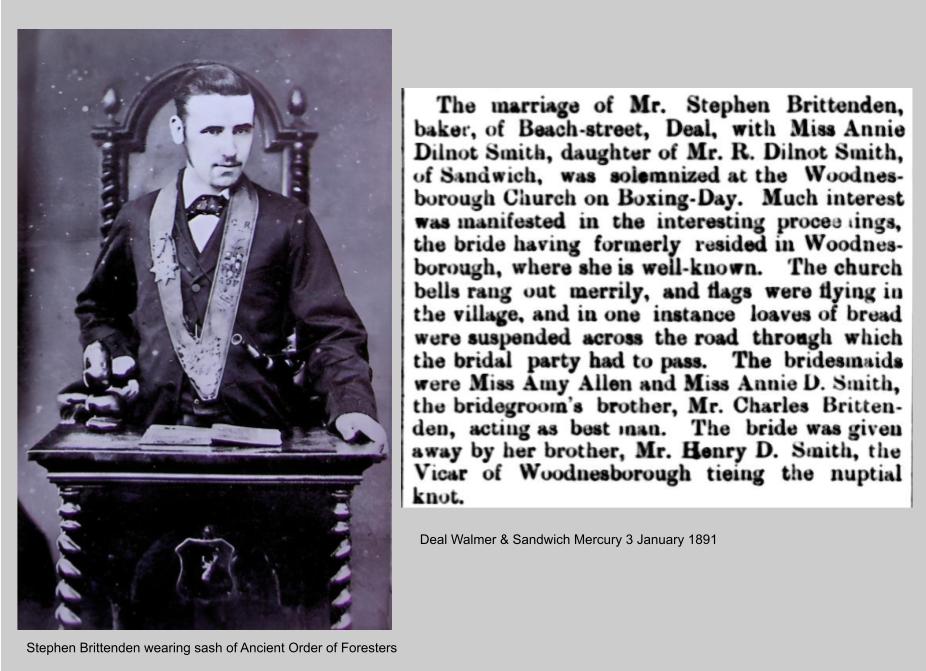
In late 1890 a committee was formed with the view to renumber many streets in Deal. With the renumbering of High Street completed in 1892, the committee then focused on Beach Street. Thus, 123 Beach Street became 81 Beach Street. The renumbering project was not an easy task, causing arguments in council over the best method, not to mention problems for local traders. What Stephen thought of this is not known but he, like every other trader, would have had to have his stationery reprinted and signage altered.
In July 1897 an accident involving a pony and cart caused the front window of Stephen’s shop to be smashed by a milk churn falling off its cart. Luckily neither the pony or anyone was hurt.
WW1 would eventually have impacted on Stephen’s trade. With the U-boat blockade came shortages of imported goods including wheat sugar and fats. While bread was not rationed the government introduced the “National Loaf,”and restricted the sale of fresh bread, and encouraged bakers to use alternative flours which were often made for an unpleasant-tasting loaf. Brittenden’s Bakery survived the war but sadly, after surviving a head wound in 1916, Stephen and Annie’s second son, Fredrick, died of influenza in Nigeria on October 28 1918. Stephen and Stanley, their other sons, both served in and survived the war.
Stephen died in early 1923 and Annie and their daughter Doris, moved to 197 Beach Street where Annie died in 1939.
In 1924 The Fountain and the three premises alongside it were purchased by Deal Corporation and demolished. 81 Beach Street now had a sea view, albeit today across the Car Park.
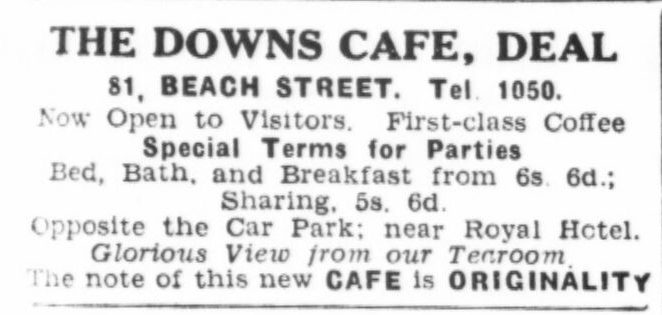
Maidstone Telegraph 27 May 1939
The Downs Cafe
It seems that after Stephen’s death and Annie’s departure the business was purchased by confectioner and tobacconist, Leonard Franklin, who lived in Park Lane, Deal, now Beechwood Avenue. However, in 1938 81 Beach Street was once again up for sale due to a decline in Leonard’s health. He died in 1943.
For a little while Mrs Florence Griffin seems to have taken over the business but by 1939 81 had become the Downs Cafe and owned by Mrs Joseska Fransika & Rev.Alfred Manby Lloyd.
When advertised in May that year, the caption read ‘The note of the new CAFE is ORIGINALITY’ it possibly was alluding to Mrs Lloyds Hungarian heritage.
The reason why Rev. Lloyd was helping his wife to run a cafe in a war time Deal, rather than administering to a flock, perhaps was due to his age, he was then in his mid sixties, but it also may have been something to do with his second marriage. As an Anglican priest, although not illegal, it was frowned upon not to marry a fellow Anglican. So , when he married Joseska Fransika Erczkovi Vollenweider, in a Roman Catholic Church, in 1934, according to Rev. Lloyd’s obituary in the Leamington Spa Chronicle, the Bishop Mervyn Haigh withdrew Rev Lloyd’s license to officiate
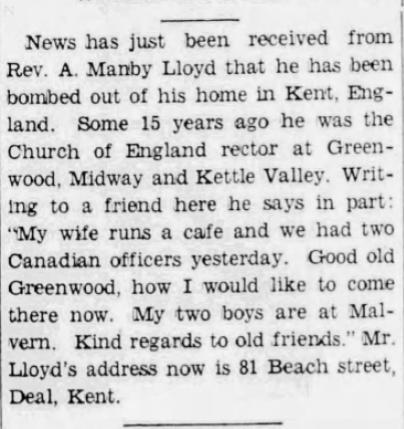
The Gazette June 19 1941
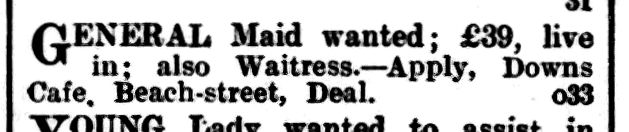
Thanet Advertiser 28 July 1939
With war clouds looming in July 1939, Mrs Lloyd was advertising for a live-in maid and offering £39 a year, and also for a waitress.
The Chamber of Trade in 1940 placed a notice in the Mercury stating that the traders listed “wish to inform their customers who have temporarily left the district that they are still anxious to serve them in any way possible. All post orders will receive prompt and careful attention and be much appreciated.” Mrs Lloyd of The Downs Cafe, 81 Beach Street , was amongst them.
In September that year Rev. Lloyd appeared before the magistrates pleading guilty for leaving a light showing. He was fined £2 for the offence. On November 2 1940 bombs landed in Deal Castle Moat and the Victoria Road area damaging houses in Castle Road including the Lloyds home at 9 Castle Road. Luckily for them, they had somewhere to go so the couple moved, temporarily into 81.

Dover Express October 24 1941
By 1941 they were again advertising for a live-in cook for a small family. As Joseska had a few months before given birth to a daughter, the cook may well have been for themselves
Rev. Lloyd died in his Castle Road home in 1950. Joseska sold 81 Beach Street at around this time, probably moving to Sussex where she died in 1977.
Mrs Mopp’s
The Downs Cafe then became Mrs Mopp’s in 1950 appearing in that year’s Telephone Directory when the telephone number was simply 713. The new owners were Dorothy Summers and her two friends and “…theatrical associates..” Dorothy Cathcart-Jones and Lilian Aston
Dorothy Cathcart-Jones was born in 1893 in Leeds, and came from a theatrical family. Her father was a theatre manager and her mother a singer. During WW1 she joined the VAD and served, as a typist, in France. She was one of the first comedians to broadcast on 2LO, the UK’s second regular radio station that began broadcasting in May 1922. During WW2 you enlisted in the WAAF. During the 1920s she worked with Lilian Aston and in 1928 they were stage managers for ‘The Young Visiters,’ at The Strand Theatre, London. The cast was made up of “..the children of the well known actors and actresses of The Strand…”
Lilian was born in 1883 and in 1921, she was living at the same address as Dorothy Cathcart-Jones, in Paddington, when both said they were Professional Singers. In 1925 she sang soprano with the Lozells Picture House Orchestra on Birmingham’s 5IT radio station. It’s not clear what Lilian did during either world wars. But she remained close to Dorothy Cathcart-Jones and post WW2 the pair set up and successfully ran a cafe, known as Filbert’s, on Stratford upon Avon’s High Street.
Dorothy Summers was born Daisy Sarah Summers in Birmingham in 1883 after leaving school she joined a Pierrot troupe then various theatrical companies and for 14 years, toured the Commonwealth. On returning to England in around 1930 she turned her talents to radio and in June 1941 she joined ITMA. It was in October that year that the nation was introduced to ‘Mrs. Mopp’ . After the war she continued to appear on radio and made several television appearances.
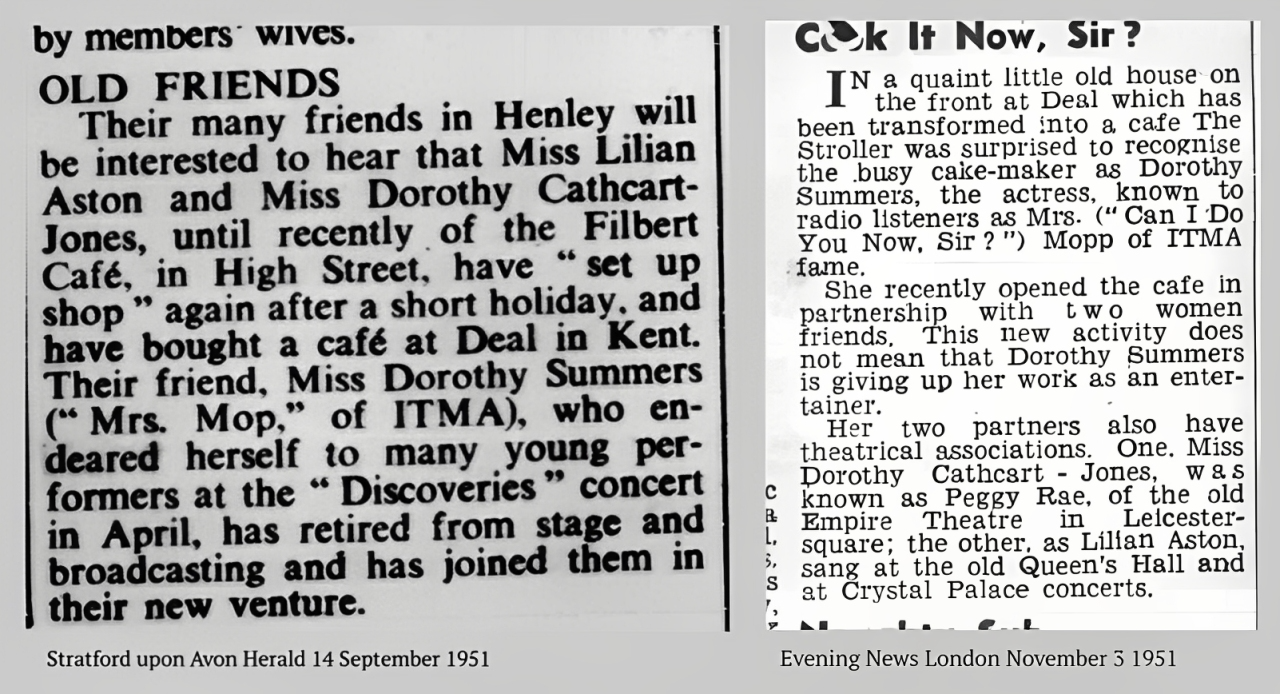
Mrs Mopp’s, 81 Beach Street, continued until 1959 when, after the ladies gave up their cafe, another owner stepped in and the cafe continued its popularity as the Lobster Pot. When the new owners took over in 2004 they transformed the popular cafe into the now highly successful restaurant offering menus of fresh, local, and seasonal dishes.
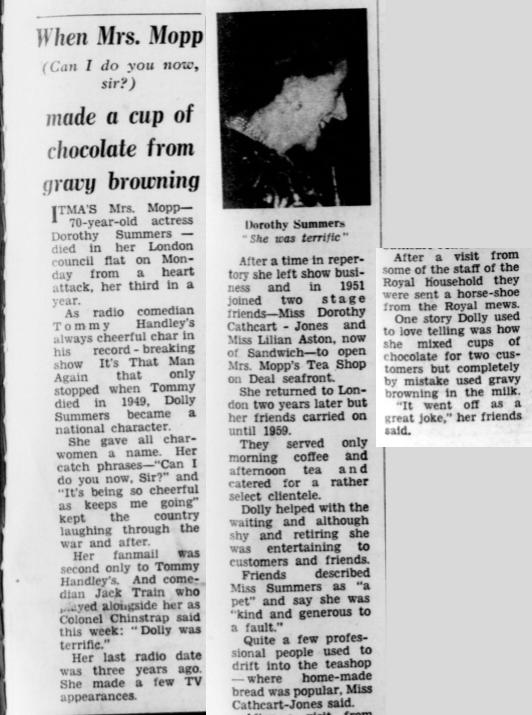
Kentish Express January 17 1964
Sources and further reading:
Newspaper image © The British Library Board. All rights reserved.
With thanks to The British Newspaper Archive (www.britishnewspaperarchive.co.uk)
https://archive.org/details/PaineRightsOfMan/mode/2up?q=revolution
The National Archives
The Loyalist Association Movement of 1792-93 and British Public Opinion
The Historical Journal Donald E. Ginter Vol. 9, No. 2 (1966), pp. 179-190
The Association Movement of 1792-3 Cambridge University Press
The Historical Journal by Austin Mitchell Vol. 4, No. 1 (1961), pp. 56-77
Electoral Registers
https://www.britishmuseum.org/collection/term/BIOG257405
Deal & District at war 1039-1945 by David G. Collyer.
The Times Tuesday, Jan. 14, 1964
A Study Of Lending Libraries In Eighteenth-Century Britain Eleanor Lochrie
http://www.britishcomedy.org.uk/