Follow us on Facebook @FHofDW
Henry Woodland Hayward
23 Lower Street, Deal
Great Mongeham
2 Adelaide Villas, London Road, Deal
Homerton House, Melbourne, Victoria, Australia
6 Leveson Street Hotham, Melbourne, Victoria, Australia
141 Victoria Street, Melbourne, Victoria, Australia
Peel Street, Hotham, Melbourne, Victoria, Australia
Patrick Street, Stawell,Victoria, Australia
Sandhurst (Bendigo)
Commercial Hotel, Heywood, Victoria, Australia
Occupation: Printer, Bookseller, Bookbinder, Piano Tuner, Organist,
Singing Teacher, Hotel Proprietor
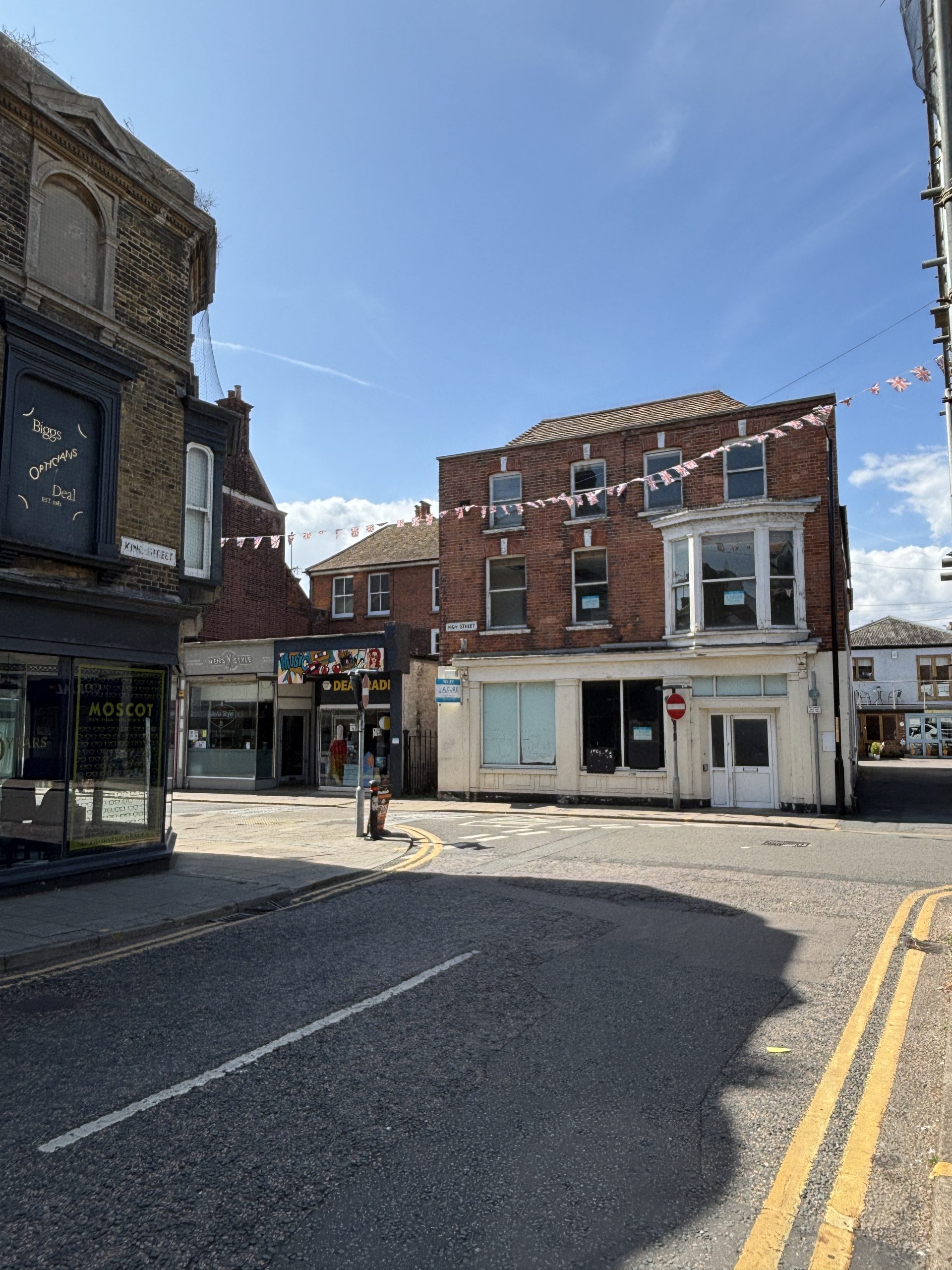
Bookseller & Printers 23 Lower Street (later 71 High Street)
Henry was born in March 1820, and baptised in the old Congregational Church on Lower Street where today the Landmark Centre stands. In May 1844, he married Jane Hammond and the newlyweds set up home in nearby Great Mongeham where, in 1845, they had their first child. By the early 1860s they had moved back into Deal where their twelfth child was born in December 1863.
Henry worked in the family business as a stationer, printer, bookbinder and seller. He grew up with a passion for music, often appearing with the Choral Society as their conductor. Amongst his other musical talents were that of an organ player and a piano tuner.
The family home was above the print and bookseller’s shop at 23 Lower Street which today stands empty but in more recent times it was the Midland or HSBC Bank.
Just eight weeks after Jane had given birth to their last child, Henry disappeared. On the morning of Saturday 6 February 1864, he left home to keep an appointment with Mrs Ralph, who lived in Sandwich and was expecting him to tune her piano; he didn’t keep that appointment. After arriving in Sandwich, at around 11 o’clock that morning, he cashed a cheque for £26, adding to the £20 he reportedly already had with him. Today £46 would be worth over £4,000 so, with the additional “…money in gold and coins…” in his pocket, Henry had a substantial amount of money on his person.
Great efforts were made to find him; a search party was sent to Sandwich and his stepbrother, placed adverts offering a reward of £5 in various newspapers, including The Times. It also appeared in the Police Gazette.
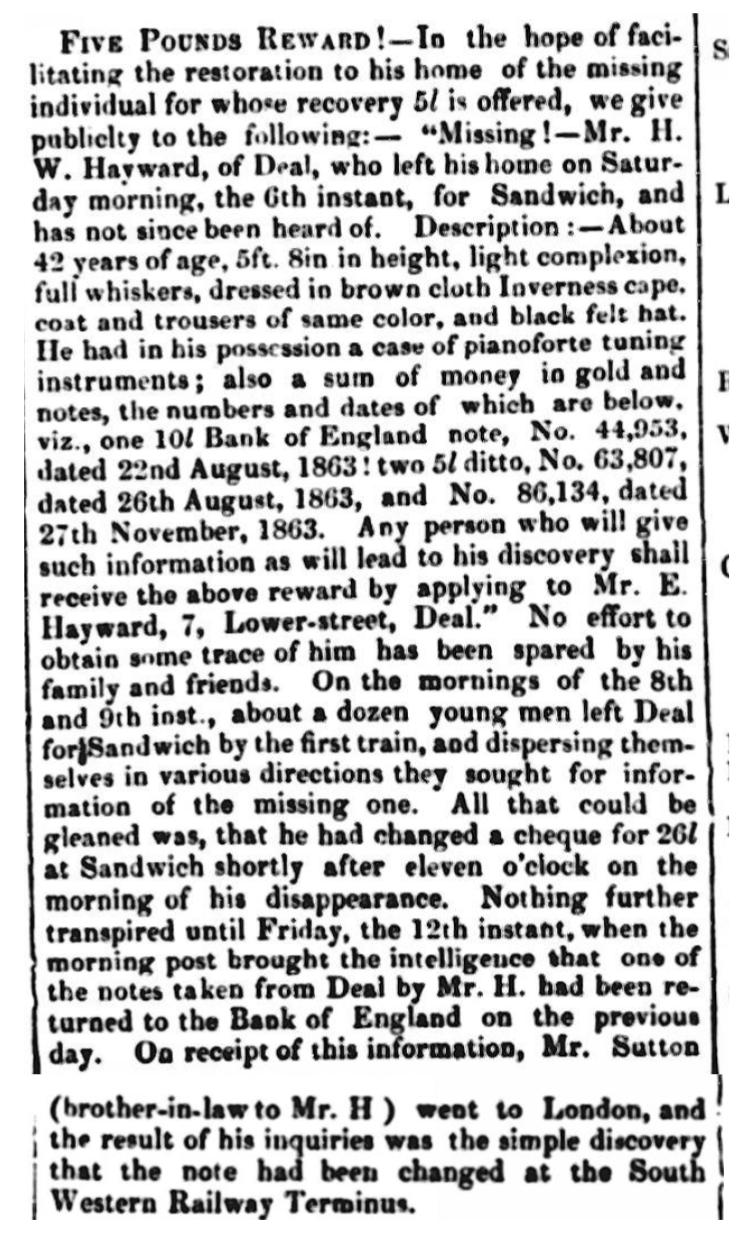
Kent Times 20 February 1864
A second similar advert was placed the following week when one of the notes, recorded as issued to him at Sandwich, was returned to the Bank of England after it had been used at the South Western Terminus. William Sutton, Henry’s brother-in-law, travelled up to London to see what more could be found about his whereabouts or movements, but nothing could be discovered.
With no more leads to follow up on, and having no idea as to Henry’s intentions and no communication from him, the family would have rallied around Jane and their children, eight of whom were all under ten years; the youngest was just two months old.
But why leave?
We know that both Henry and his father were described, at various times, as printers, stationers and booksellers, whose business address was 23 Lower Street; this was also Henry’s childhood home and continued to be that of his parents, Thomas and Susannah. The 1861 census describes Henry as a ‘Stationer employing two men and two boys’. While his father Thomas is recorded as ‘Formerly Bookseller’, by 1871 Thomas appears to have taken the business over again as he is described as ‘Print master employing 2 men and 1 boy’. Could Thomas’s continued presence have contributed to Henry’s disappearance? Was there a father and son or other family conflict? Did he feel guilty about the print shop accident that resulted in fourteen-year-old Edward Collins having his finger amputated in September 1863? Did his passion for music contribute in any way to Henry walking out of his home and not returning? In short, no one knows why.
Henry did eventually turn up, not in England, the UK or even in Europe, but in Melbourne, Australia! How he got there remains a mystery.
Years later a family history, published in the journal of the Genealogical Society of Victoria, says that Henry told his family that he had suffered amnesia brought on by a “…forceful blow to the head, either accidentally or more likely deliberately… and shanghaied and thrown on a ship bound for Australia…” However, as the writer says, “…this has never been proved…”
For us, the amnesia story doesn’t bear up under scrutiny.
The big question is: why did he cash a cheque for £26, when he already had over £20 in his wallet? What did he need the money for? Could it be getaway money?
If it was Henry who used the banknote at the South Western Railway Terminus, was it to purchase a railway ticket and if so, to where? Whether it was him or not, at some point he boarded a ship, but where from, and where did he stay before the voyage, and how did he survive when he finally arrived?
All we know with absolute certainty is that on February 6 1864 he left home and was seen in Sandwich, where he cashed a cheque. Then in May 1865, he placed an advert in The Melbourne Argus giving his address as Homerton House, South Yarra, offering his services as an occasional organist. Homerton House at this time was a boarding house for ‘professional gentlemen’.

Two months earlier, in March 1865, in the same newspaper, there was an organist and choirmaster seeking employment living at the same address. This too surely must be Henry! Added to which, in June 1865, Henry is a witness to a legal notice, placed in the same newspaper, for the bankruptcy of a cobbler living nearby.
These adverts lead us to consider that Henry’s disappearance was a planned escape. If there was any loss of memory, he certainly knew by March or May 1865 his name and that he was an organist.
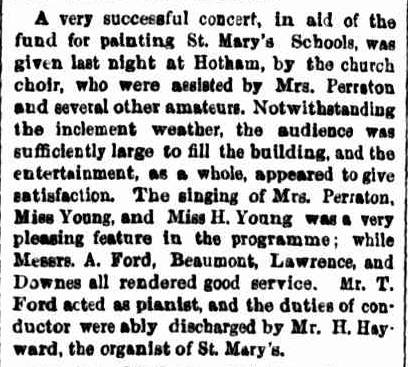
The Argus August 15 1866
A year later, in January 1866, Henry was registered as a singing teacher. He must have had some training or passed a board to prove this.
Henry at some point after his arrival, perhaps through his 1865 adverts, became the organist at St. Mary’s church in Hotham, now named North Melbourne, and in August 1866 his conducting skills were praised following a concert in aid of St. Mary’s School.
The family history referred to earlier says that Henry started to recover his memory while standing on Collins Street, Melbourne, watching workmen unload a heavy piece of machinery. Recognising that this was an envelope-folding machine “…it triggered some memory deep in his subconscious…” so he struck up a conversation about its operation with the men and workers of the new owners, the Melbourne printers and publishers Sands and McDougall.
There is some plausibility to this story. Being a stationer and printer, the machine was familiar to Henry. He may even have owned and therefore operated one in the family workshop in Deal. At the very least, following its exhibition in the Great Exhibition of 1851, the machine would have been promoted and advertised for sale to businesses such as the Haywards. Henry may even have visited Crystal Palace and viewed it there.
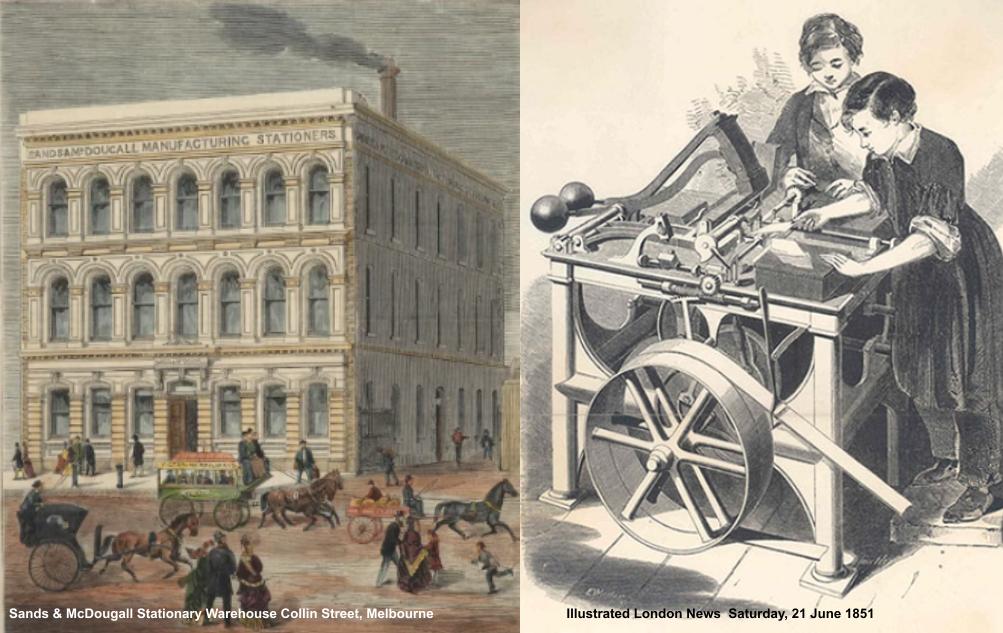
The family history also says he was subsequently employed by Sands and McDougall and, “…through their help and generosity was able to contact his family and make arrangements for them to join him…”
So far we have not been able to locate records to prove Henry’s employment or even involvement with Sands McDougall.
More questions arise. Could it be that Henry simply recognised the machine, which brought back thoughts of home and his family, and could he not have written home to Jane or his family himself? Yes, the cost of a voyage for the family would be high, approximately £88 for three adults (aged over 12 years old) and seven children by travelling steerage, but probably just affordable if they sold all their belongings, both of which they eventually did. So did he need Sands and McDougall’s help?
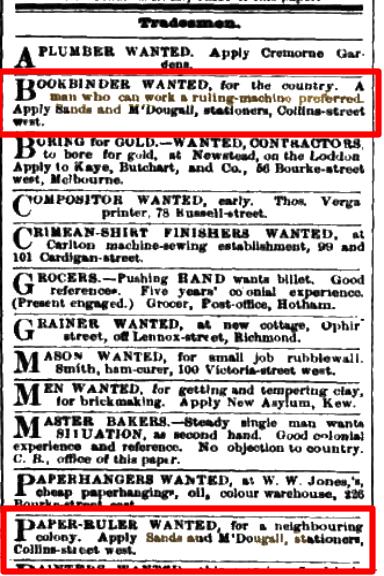
The Argus January 20 1865
In January 1865, Sands and McDougall were seeking a bookbinder and paper rulers. Both these Henry could do. So did these adverts prompt Henry to visit the company on Collins Street, and it was then that he saw the envelope-making machine? Or was he in need of employment and had applied for the jobs advertised?
Whether it was Henry, or an intermediary, who first contacted Jane, we know that in May 1866 Jane, with their nine youngest children aged between fourteen and two years old, boarded Glendower, a passenger and cargo sailing ship in London bound for Port Phillip, Melbourne.
We don’t know what they took with them, but we found a tantalising auction advertised in November 1865 that includes ‘100 VOLUMES OF BOOKS’. Could this be Jane selling off the contents of her home? Henry was, after all, a bookseller by trade.
Coincidentally, in 1861 he placed an advert in ‘The Bookseller’, a monthly literature and advertising publication, offering for sale ‘Rawlinson’s Herodotus vol. 3’. In the very same magazine, the then Kenny & Sands, who a few years later became Sands & McDougall, are also mentioned in an article about street directories, for which they would later make their name.
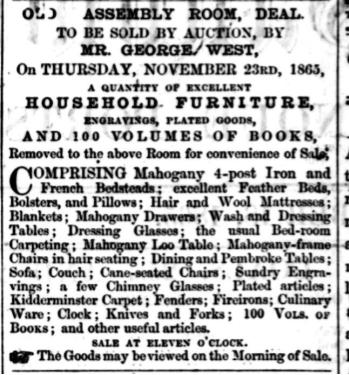
Deal Walmer & Sandwich Mercury 18 November 1865
If he were indeed employed by Sands and McDougall, he did not remain with the company for long as by 1871 he is listed in the directory, printed by Sands and McDougall, living at 141 Victoria Street as a singing teacher.
According to another family history source, the two eldest sons, Herbert and Harry, worked their passage on board the Essex, departing London in August 1866 and arriving in Hobson’s Bay that November.
When the 1870 Sands & McDougall register was published, Henry was listed as living at 6 Leveson Street. If this is the residence that the whole family of thirteen, or just some of them, lived in from 1866 is not known. By around January 1870, and as shown in the 1871 directory, they had moved to 141 Victoria Street. It was here Henry and almost the whole family ended up in Melbourne’s City Court in March 1871.
It appears that for the first thirteen months of living there, Henry had been paying his rent on time to the landlord, Thomas Swanson. A dispute then occurred and Henry, with his “…large and vigorous…” family, was accused of assaulting two men, one of whom was the landlord’s son, James Dick Swanson.
According to the court reporter, Henry had “…been paying his rent regularly to his landlord, and everything was going on in a satisfactory manner…” Then the landlord’s eldest son, George Swanson, contacted Henry to say that he now owned the property and to stop paying his father, the aforementioned Thomas Swanson. Not quite knowing what to do, Henry consulted a solicitor who told him to continue paying the rent to Thomas Swanson as no legal document had been provided. However, not wanting to get involved in a family squabble, Henry told both father and son that he was “…perfectly willing to pay his rent as soon as they could settle their dispute as to who should receive it…”
Seemingly the Swanson father-son dispute continued with letters and warnings being sent to Henry from both the Swansons, demanding that he pay the rent to them. Ignoring these, warrants were issued from both, which had to be served in person. Henry and his family decided not to allow themselves to be in a position to accept the warrant and “…securely barricaded…” themselves into their home. Eventually, a bailiff gained entry, but this was not well planned as, being alone and needing to “…go out of the house for a few minutes…”, presumably to answer a call of nature, he was duly locked out!
Eventually, on the morning of 16 March, James Swanson and an “…obliging friend…”, George Dainty, used a ladder to get onto the first-floor balcony via a window. They either, depending on whose version you believe, pushed open or broke the window and entered the Haywards’ home. The youngest Hayward daughter, observing their entry, raised the alarm and her father, older brothers and her mother raced up the stairs to confront the invaders who, according to them, “…were set upon and treated in a most violent manner…” Jane was accused of seizing George Dainty by the throat and pushing him into a conveniently full bath of water; this she resoundingly denied.
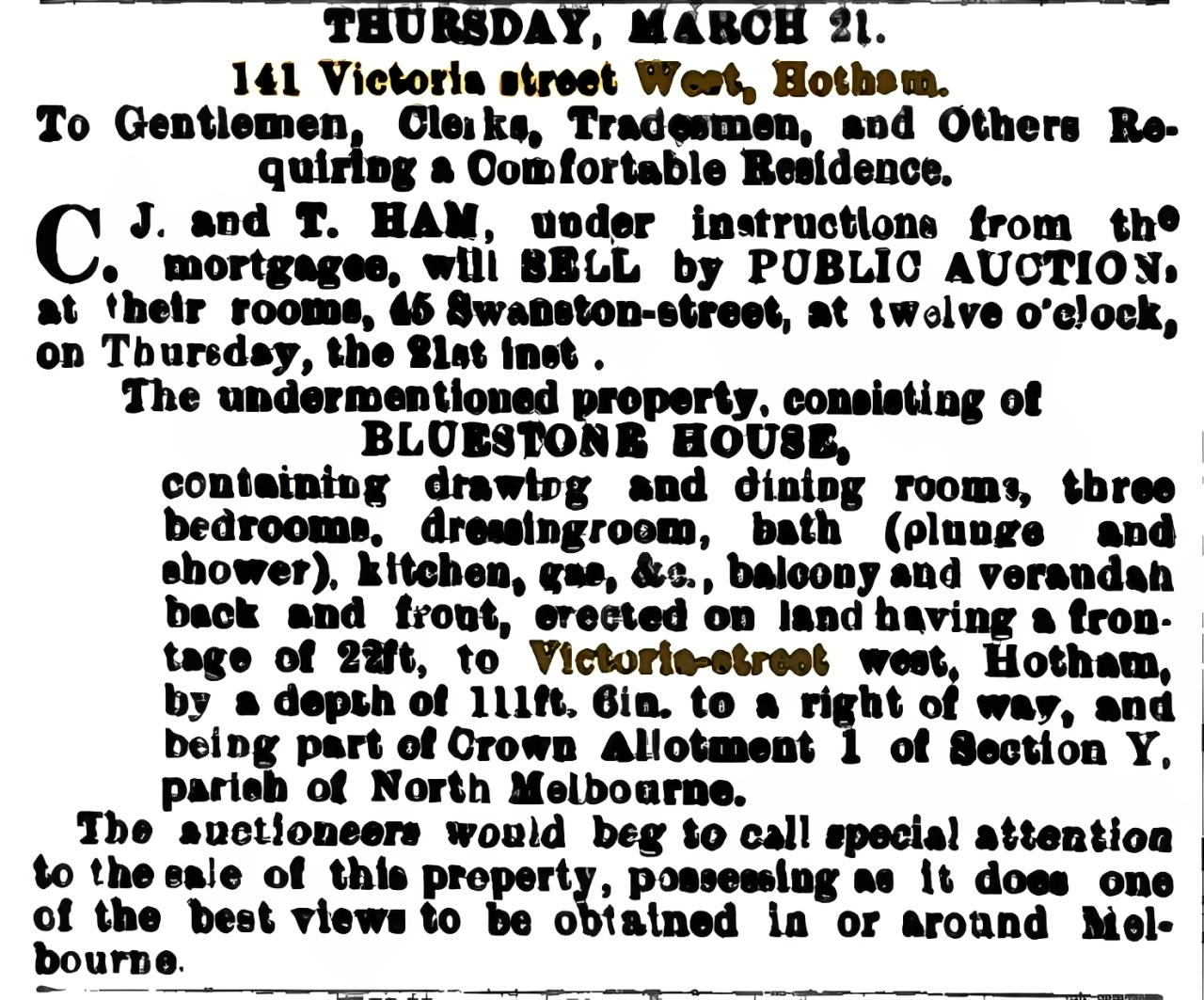
March 16 The Argus 1872
In his summing up the Magistrate said this could all have been avoided if Henry had been properly instructed, and if Thomas Swanson had taken the legitimate course of summoning Henry for overdue rent, instead of trying to gain entry and possession “…in a most improper manner…”
The case was dismissed, sent to arbitration and James Swanson ordered to pay £2 2s in costs.
To continue to live in the house would have been difficult enough following the dispute, but with the senior landlord living right next door, it would have been more than difficult. Henry, Jane and their family moved to Peel Street, perhaps before March 1872, when 141 Victoria Street was put up for sale.
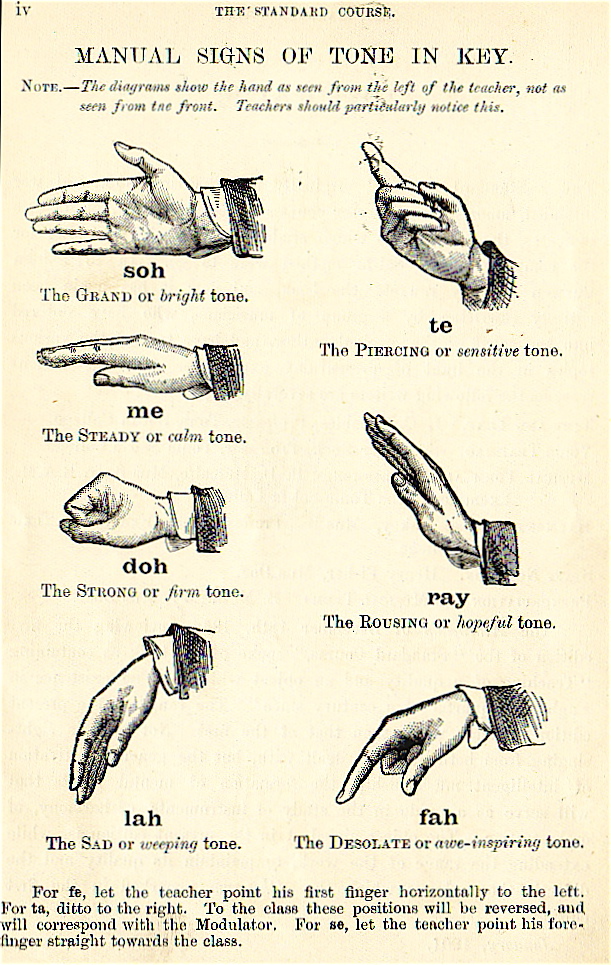
Curwen’s tonic sol-fa notation. It was used in the famous song in the Sound of Music
Soon afterwards they moved to Stawell, a gold-mining community 145 miles north-west of Melbourne, where Henry had secured himself a position as teacher of music at the Pleasant Creek and Ararat Common Schools. He taught using the Curwen hand/rhythm signs developed to help children and adults learn to sing. Henry’s stepbrother Edward, from at least 1858 in Deal, also used this system when teaching at the Carter Institute. It is best remembered today from its use in the musical The Sound of Music, with Julie Andrews and the von Trapp children singing the song “Do-Re-Mi”.
Perhaps, since arriving in Australia, this was the first permanent employment bringing in a regular income. We know from a list of newly appointed teachers, printed in Melbourne’s Weekly Times in April 1875, that Henry’s salary was between £250 and £400 a year. The only downside was that it was a peripatetic position.
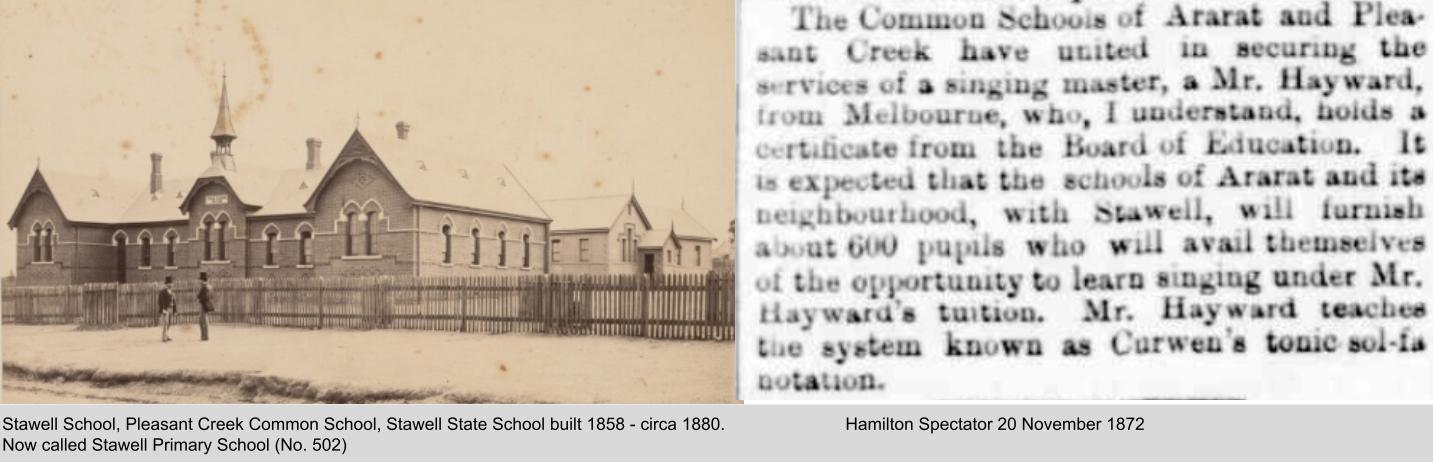
To supplement what seems to have been a part-time position, he also offered private singing lessons and piano tuning in Ararat, which was 25 miles south of Stawell. With that railway line not opening until 1876, Henry may have had his own horse or travelled by the Cobb & Co. mail coaches, which offered a regular service to and from Ararat and the gold diggings at Great Western and Stawell (Pleasant Creek).
If he did travel by Cobb’s mail coach, it is unclear exactly how much this would have cost as most advertisements of the time say “price on application.” As a regular traveller, he may have been able to negotiate a price. Once in Ararat, he may also have had to pay for two or three nights’ board and lodgings, perhaps in the Bull and Mouth Hotel.
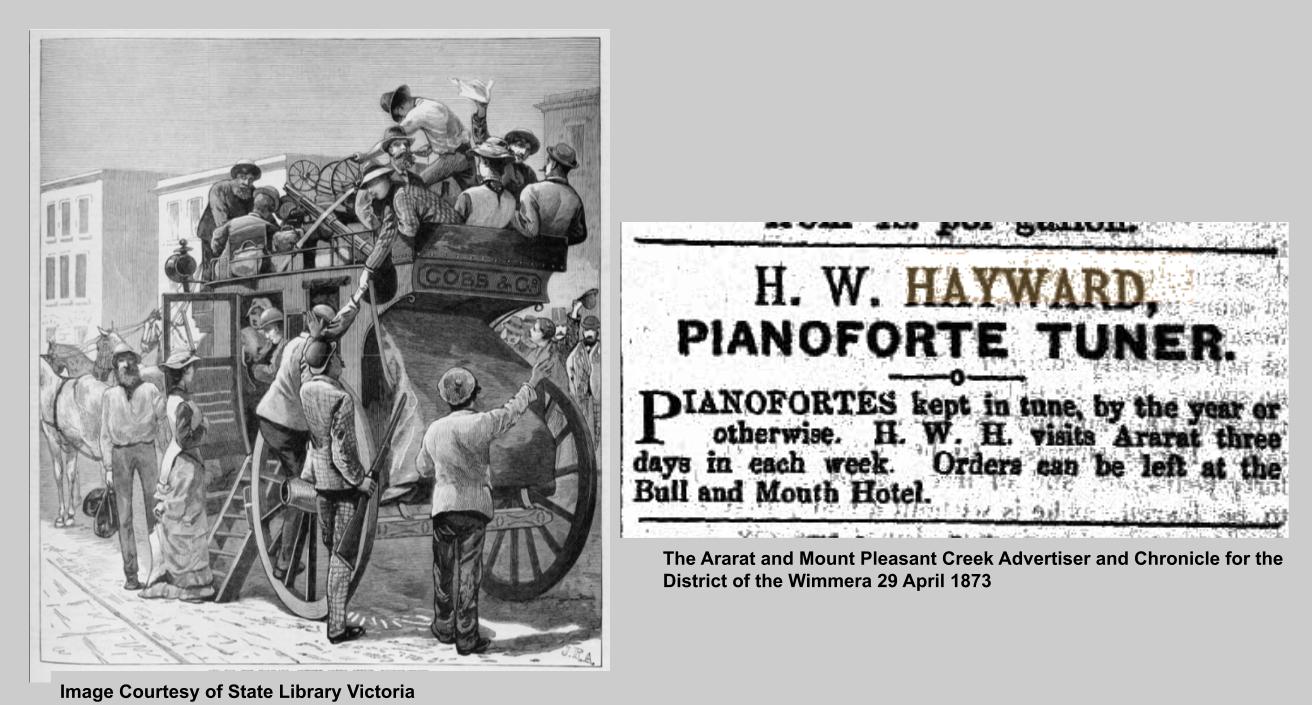 The 1874 rate book for Stawell shows that Henry and his family were living in Patrick Street. Stawell School was in Barnes Road, so at least that was within walking distance.
As in Melbourne Henry continued to give and take part in concerts.
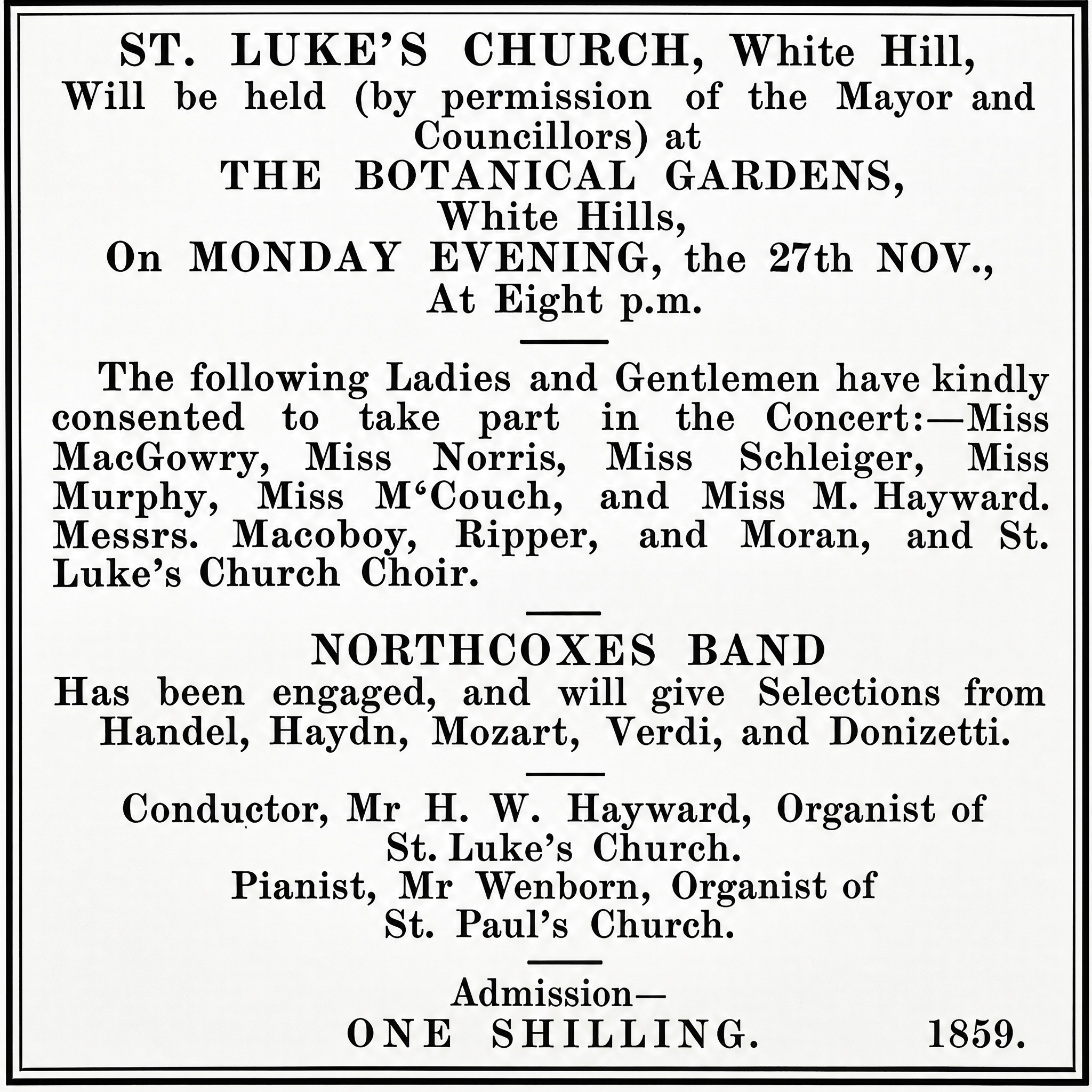
24 November 1876 Bendigo Advertiser
While living in Sandhurst, Henry and Jane would have received the news that Edwin, their third eldest son, had died just months after his marriage. If they attended their son’s wedding is not known, but Hammond, their next youngest son, did and was a witness.
By September 1877 Henry had moved to Sandhurst, which from 1853 until 1891 was the official name of Bendigo. Here he became that district’s singing master. However, by early 1878 Henry had moved again, this time to Heywood, some 200 miles west of Melbourne.
It is also in Heywood that in April 1878 Henry declared himself insolvent with liabilities of £162 15s. 9d.
The insolvency announcement in the newspapers gives lack of paid employment and sickness of himself and family as contributing factors to his mounting debts. It is not clear who else was ill, but we know that Henry had started to become seriously ill in the months before the move to Heywood. That and the cut in teachers’ salaries brought in by the Minister of Public Instruction in around 1877 probably account for the reasons behind the move to Heywood, where his eldest son, Herbert, was living and working as a teacher.
In October 1878 it was announced in the newspapers that a compromise had been agreed regarding teachers’ salaries and that compensation would be paid to those affected. Henry was one of those to benefit from this and therefore was able to clear his debts. In July 1879 he received £163 3s. 9d.
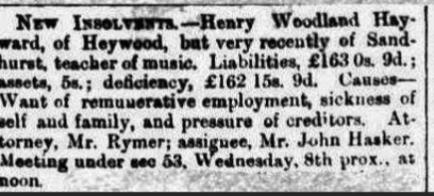
Bendigo Advertiser 29 April 1878
His debts cleared, Henry looked for a position that perhaps meant he no longer needed to travel. The solution came in the form of the Commercial Hotel in Heywood. The Portland Guardian dated November 27 1879 announced that Henry was applying for the licence, which was granted to him on December 12th.
Sadly, this change of occupation and the hope of a settled life was to be very short-lived, as on December 5 1880, Henry died of kidney and heart disease.
His sudden death meant an inquest had to be held. The Magisterial Enquiry was held before the local Justice of the Peace, Robert C. Miller, on the 7th and 8th of December at the Commercial Hotel, Henry and Jane’s home and business.
Jane’s testimony says how on the morning of December 5 1880, after sitting outside with her for a while, he went into the hotel to “…do his usual work…” At around 9 o’clock, Jane was called into their bedroom by a servant who had found Henry in pain and asking for his medicine. Her husband, she said, had been “…suffering from a disease of the kidney and heart for the last twenty-four years…” and that “…the attacks had become more frequent over the last eighteen months…the painful spasms over the heart lasted from ten to twenty minutes….” The last time Henry was “…attended by a medical man, Dr Atkinson of Sandhurst…” was thirteen months ago, and it was he who had prescribed him some medicine which “…usually relieved him instantly…”
She said how she had given her husband his medicine, which did not stay down and was “…immediately vomited up…” He was, she said, “…dead in 25 minutes from the first attack…” and was “…conscious to the last. He appeared to think he was dying and wished for me to stay with him, which was contrary to his usual practice when attacked, as he always wished me to leave him alone…”
Francis Rumble, the servant who had found Henry in pain, had known and possibly had been in Henry’s employment for four years. He stated how he had found Henry in pain and that he had “… asked me to measure his medicine…I poured it into a small bottle kept for that purpose…” He then called Jane and left the room. Returning soon after, he “…saw him die in his wife’s arms…”
Doctor Henry E. Brewer was called in to give evidence as to the cause of death. After reading the notes from Doctor Atkinson, he concluded that Henry had died of natural causes and no post-mortem was necessary.
Henry’s death certificate states that he was buried in Drumborg Cemetery, Drumborg being the old name for Heywood, on December 7th 1880, meaning that he was buried almost immediately after JP Miller had accepted Doctor Brewer’s conclusions and his death certificate was issued.
Having died intestate, Jane had to then deal with the courts of probate and administration.
In total, Henry was owed £238 8s. 9d., but his liabilities were £434 12s. 11d.
The person he owed the most money to was his son, Herbert. The £135 15s. 6d. could suggest that, in his parents’ time of need, he had lent them the money to help set them up in business. It was Herbert who also registered his father’s death.
Jane died in 1901 and is buried in Melbourne General Cemetery. Coincidentally, the funeral left Collins Street, the very street on which Henry, some seventeen years before, had supposedly regained his memory.
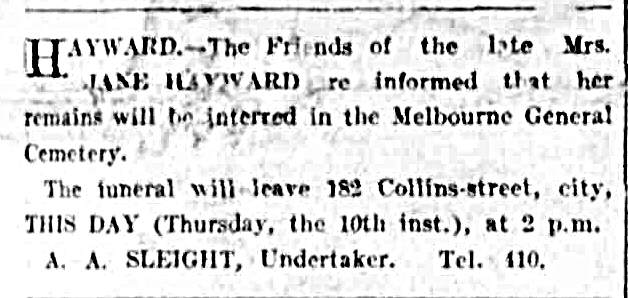
The Argus January 10 1901
| Name | Born | Baptised | Married | Died | Buried |
| Henry Woodland Hayward | March 21 1820 Deal |
May 28 1820 Congregational Chapel, Deal |
Jane Hammond May 2 1844 Congregational Chapel, DealBorn 1822 DealDied 1901 Melbourne |
December 5 1880, Commercial Hotel, Heywood, Victoria, Australia | December 7 1880 Drumborg Cemetery Heywood |
The Children of
| Name | Born | Baptised | Married | Died | Buried |
| Herbert | 1845 | 1 Dora Maria Henry 25 March 1880 Hamilton Victoria, Australia2 Charlotte Mary Davis December 27 1888 All Saints Church, Geelong, Australia |
December 12 1912 Beecroft Australia |
Rockwood New South Wales, Australia | |
| Harry | 1847 | Sarah Jane Masham December 28 1875 St Mary's Church Hotham, Victoria, Australia |
April 25 1939 Hillside Parade, South Camberwell, Victoria, Australia |
Colac Cemetery, Colac, Victoria, Australia | |
| Woodland | 1849 | ||||
| Edwin | 1851 | Mary Ann Pearce Collings February 17 1876 St Mary's Church Hotham, Victoria, Australia |
May 26 1876 South Yarra, Victoria, Australia |
Old Melbourne Cemetery, Melbourne, Victoria, Australia | |
| Hammond | 1853 | Cecila Letitia Jane Burke May 16 1888 St Andrews, Brighton, Victoria, Australia |
September 5 1932 Caulfield, Victoria, Australia |
Brighton,Cemetery Victoria, Australia | |
| Woodland | 1855 | 1 Agnes Holt Travis April 12 1882 St Mary's, Hotham, Victoria, Australia2 Sarah Annie Travis. November 2 1904 Violet St, Essendon, Victoria, Australia |
February 28 1944 Gosford, New South Wales, Australia |
February 9 1944 Northern suburbs Crematorium, Sydney, New South Wales, Australia |
|
| Jane Elizabeth | 1857 | James Edward Denison November 25 1884 St Mary's, Hotham, Victoria, Australia |
July 14 1942 Surrey Hills, Victoria, Australia |
July 16 1942 Crematorium, Fawkner, Victoria, Australia |
|
| Harriet | 1859 | William Charles Wallis March 28 1883 St Mary's, Hotham, Victoria, Australia |
May 14 1915 Charles St, Footscray, Victoria, Australia |
May 17 1915
|
|
| Julia Margaret | 1859 | Frank Patrick Collins
October 8 1883 |
December 11 1915 Armadale, Victoria, Australia |
St Kilda, Port Phillip City, Victoria, Australia | |
| Ellen Annie | 1861 | Charles Hewett Walwyn April 13 1914 St Mary's, Caulfield, Victoria, Australia |
March 24 1928 High Street, Preston, Victoria, Australia |
March 26 1928 Coburg Cemetery, Victoria, Australia |
|
| Susannah Emma | 1861 | Charles Cornwall Keene November 9 1885 St Mary's, Hotham, Victoria, Australia |
September 8 1933 Preston, Victoria, Australia | Kew Cemetery Victoria, Australia | |
| Alice Mary | 1863 | Thomas Slack January 2 1888 Essendon, Victoria, Australia |
February 9 1955 Bendigo, Victoria, Australia |
February 10 1955 Fawkner, Crematorium, Victoria, Australia |
Census
| Year | Address | Name | Relationship | Occupation |
| 1841 | 23 Lower Street | Henry | Head (parents away) | Bookseller |
| Harriet | Sister | |||
| Thomas | Brother | |||
| Mary | Sister | |||
| Susannah | Sister | |||
| William | Brother | |||
| Alfred | Brother |
Census
| Year | Address | Name | Relationship | Occupation |
| 1851 | Great Mongeham | Henry | Head | Stationers Assistant |
| Jane | Wife | |||
| Herbert | Son | |||
| Harry | Son | |||
| Edwin | Son |
Census
| Year | Address | Name | Relationship | Occupation |
| 1861 | 2Adelaide Villas, London Road, Deal | Henry | Head | Stationer Employing teo men and two boys |
| Jane | Wife | |||
| Herbert | Son | |||
| Edwin | Son | |||
| Hammond | Son | |||
| Woodland | Son | |||
| Jane Elizabeth | Daughter | |||
| Harriet | Daughter | |||
| Julia Margaret | Daughter | |||
| Ellizabeth S Williams | Servant | House Maid | ||
| Catherine Rigden | Servant | Nursary Maid |
Trade and Street Directory
| Directory and Year | Trade or Occupation | Address |
| Kelly's Directory 1862 | Bookseller | 23 Lower Street, Deal |
| Sands Directory 1870 | 6 Leveson Street Hotham, Melbourne | |
| Sands Directory 1873 | Music Teacher | Peel Street, Hotham, Melbourne |
Rate Books
| Year | Profession | Qualifying Residence |
| 1874 | Teacher | Patrick Street, Stawell, Victoria |
| 1875 | Teacher | Patrick Street, Stawell, Victoria |