Follow us on Facebook @FHofDW
Henry Foster
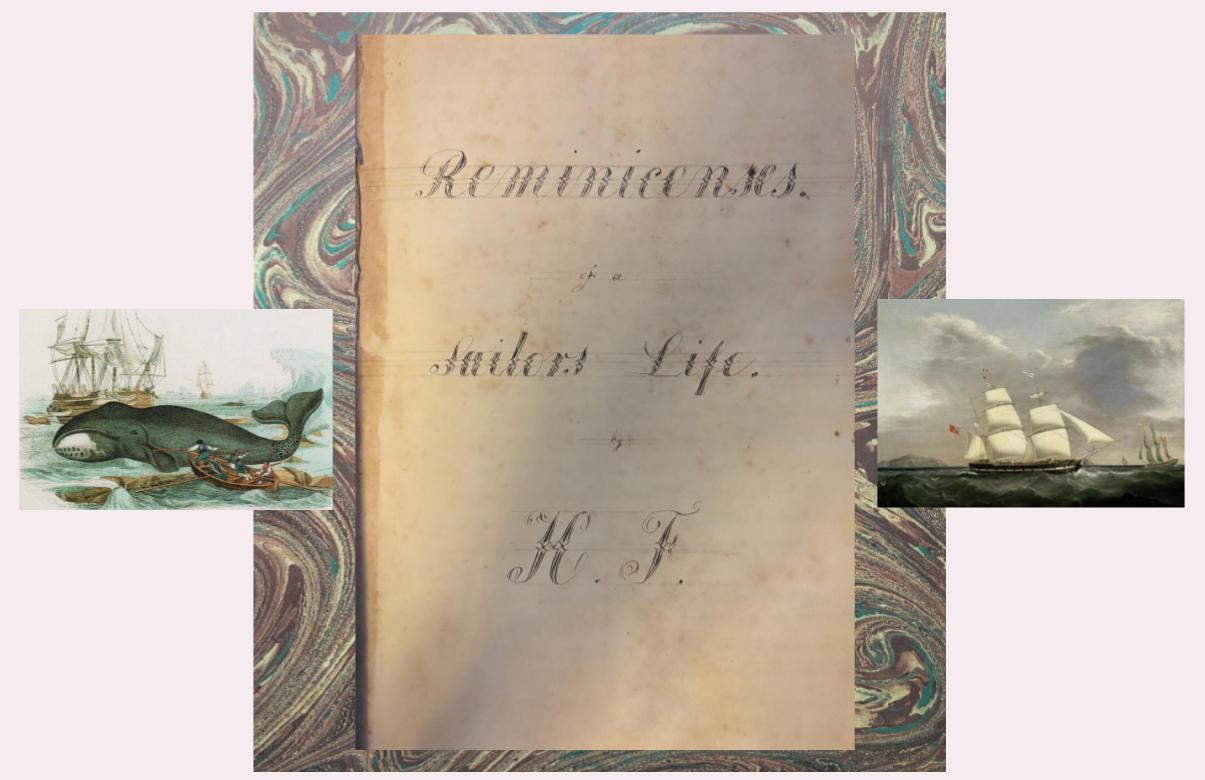
Reminicenses of a Sailors Life
Part 1
Introduction
We were contacted by Sally Bunday who had found an old ledger amongst her late father’s books. The first seven pages, she told us, appear to be the beginnings of a memoir titled ‘Reminicenses of a Sailors Life By H.F.’ It contained some historical details but virtually no genealogical information. Could we help to discover who H. F. was, saying “… I would love to hear anything which might help my ‘needle in the haystack’ search..” ?
Loving a challenge, of course we said we’d help.
H.F. had written that he was born in a small port in Kent into a large family; he had a brother who had gone to sea, and was aboard the USS St. Louis Frigate, when he died in Rio de Janeiro; two sisters and a brother emigrated to America, one to California, the others to Illinois; he’d attended a small Naval School; there were problems with the lighthouse on the Goodwin Sands; how he left Deal with his father on the Mail Coach to Margate to take a boat to London; he was indentured, in January 1840, to a George Lyall, the owner of ‘Sussex’, a South Sea Whaler; the Master of Sussex was G. Hammer; he left London in 1840, returning in 1844.
By looking into and confirming these details, we found that H.F. was one Henry Foster, who had indeed been born into a large Deal family in 1826, who had then spent his life at sea.
How Henry Foster’s ledger had ended up in Sally’s father’s possession she didn’t know, but on finding no ancestral connection to him, she very kindly offered it to us. We, of course, gratefully accepted.
On receiving this thick and heavy ledger, we found those seven pages to be full of details of a life gone by.
Delving into the internet, we found an article about Henry Foster in Cassell’s Family Magazine dated 1896. Further research brought us to a thesis, written by Rachel Utting, in which she cited two further documents by Henry. ‘Recollections of a South Sea Whaler by Henry Foster,’ which had been published and bound together with ‘Memoir of James Anderson by G. Newman, in 1877, the other ‘Reminicenses of a Sailor’s Life’ held in the collections of Dartmouth College, New Hampshire, USA.
We are very grateful to Rachel Utting as she kindly shared her partial transcription and copies of ‘Reminicenses of a Sailor’s Life’, enabling us to discover much more about the remarkable life of Henry Foster.
In all his writings, Henry was, at times, been careful not to mention certain names, but clues in the text have meant we have been able to reveal who he refers to. Along with deciphering his handwriting and his obvious use of place names as they were at the time, and the nautical and whaling terms, Henry truly sent us off on a voyage of discovery.
One of the reasons we and Sally thought that H.F. was from Deal was the opening paragraph of the ledger. “…I was born at a small seaport town in the beautiful county of Kent …much famed for its brave and intrepid boatmen…situated not far from the dreaded Goodwin Sands…” The mention of the sinking of the Iron Caisson on the Goodwins to provide a solid foundation for a lighthouse.
The Iron Caisson and ‘The Light for all Nations’ Henry Moses The Iron Caisson 1841 Artist Henry Moses visited Deal in the early 1840s, making sketches of what caught his attention. This sketch of the Iron Caisson, stranded by the old wooden Deal Pier, would eventually be sunk on the Goodwins to enable foundations to be laid for ‘The Light for all Nations’ lighthouse. When ‘The Light for all Nations’ was almost completed, Mr Bush, his wife and son took up residence for a few weeks in 1845. According to Byng Garrie, this was the only time that anyone “… especially any lady…” had actually lived in a structure on the Goodwin Sands. Light of All Nations & North Calliper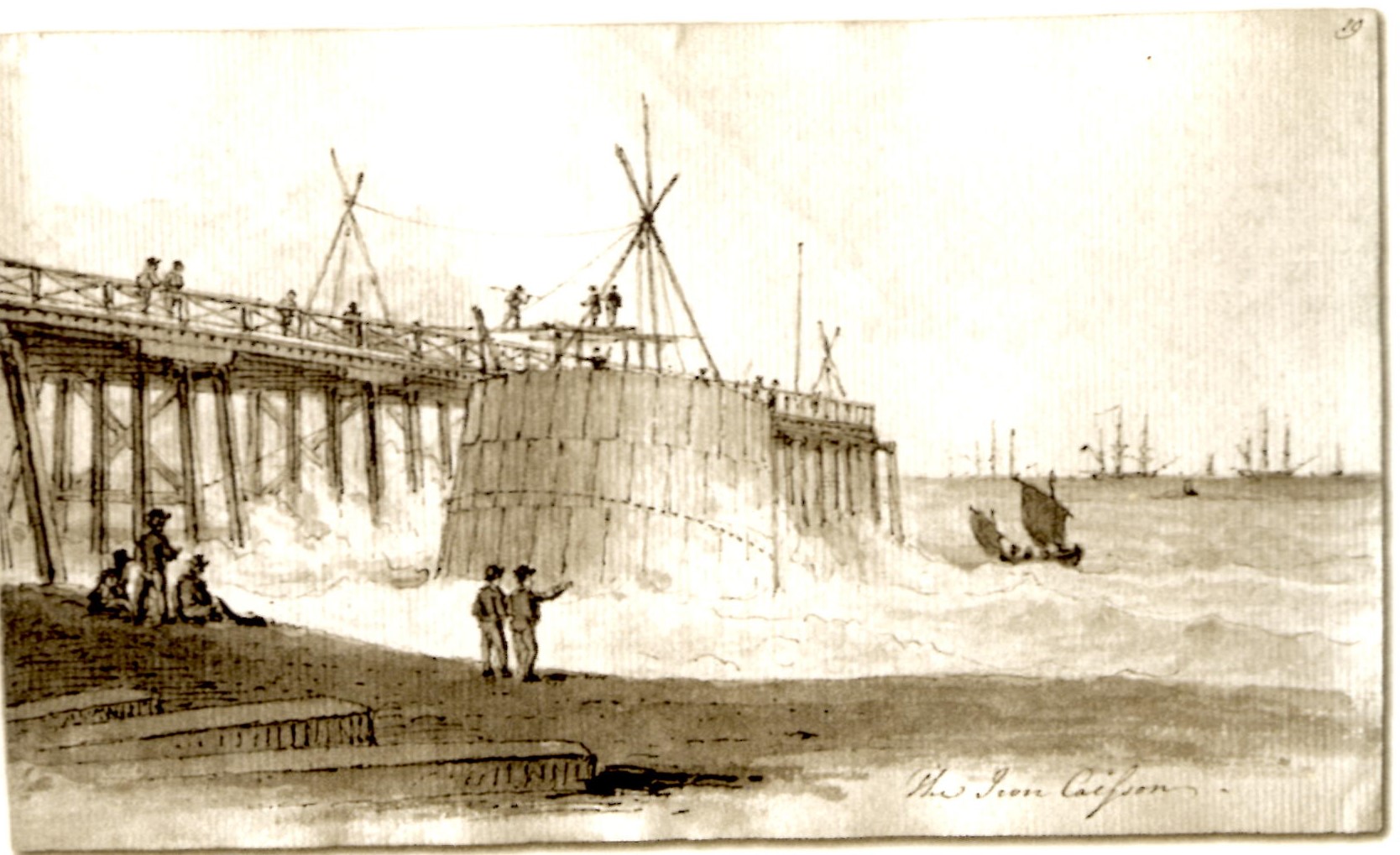
According to G. Byng Gattie’s Memorials of the Goodwin Sands, and the newspapers of the time, the Iron Caisson was designed by civil engineer William Bush and built in Deal’s Naval Yard, from where it was launched in October 1841, and towed from there by the steam ship ‘Monkey’ heading for the North Calliper on the Goodwins. Unfortunately, it ran aground near Sandown Castle. A vessel named ‘Shearwater’ was brought in to tow it back to the Naval Yard. However, the Caisson didn’t make it that far and sank near the old wooden pier.
After suffering severe damage in a storm, it was later raised and taken in pieces to the Naval Yard where it was reconstructed. Once the work was completed, in July 1842, it left the Naval Yard towed once again by ‘Monkey’ to its appointed destination.
Initially, the construction work on the lighthouse went well, but on the night of 15 October, during a terrific storm, a vessel laden with timber hit the Caisson with the loss of all hands. Reports of the Caisson being destroyed proved false, and guided once again by Mr Bush, the construction of the lighthouse began again.
During calmer weather, hundreds of people visited the construction, but it was soon to be halted. Trinity House ordered it to be taken down. The position of the lighthouse proved to be a badly chosen one, having been erected in the middle of the Sands where, instead of warning shipping, it acted as a beacon “…inviting approach, instead of warning them off…”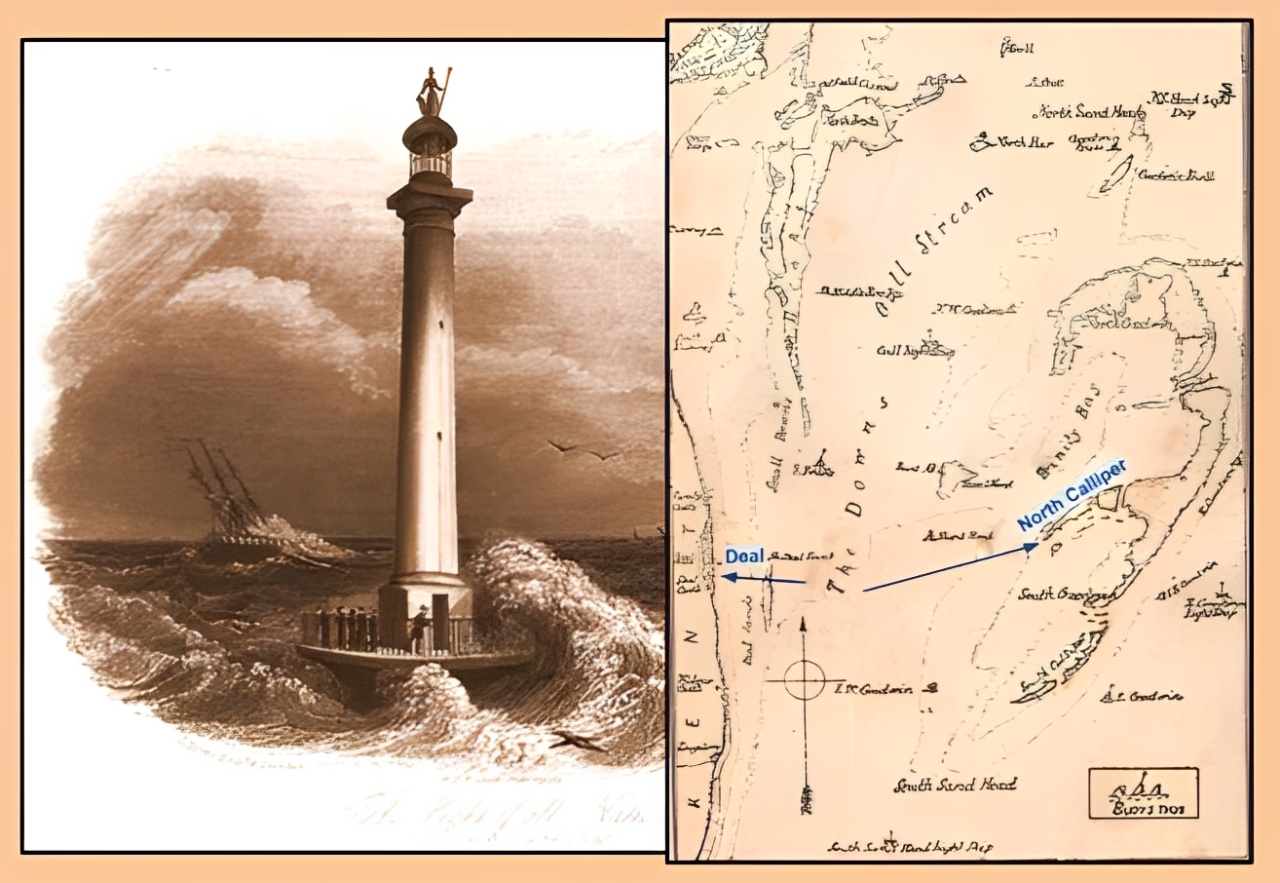
So who was Henry Foster?
Henry Foster was the sixth of nine children, five boys and four girls, born to Stephen and Sarah, née Bullinger. They had married in 1816, and by 1831 their family was complete. Stephen made his living by the odd mixture of being a hairdresser and toy dealer, and we know in 1822 he leased 189 Lower Street from the Archbishop of Canterbury’s Estate, where he set up home and continued to run his businesses. The original building, now 46 High Street, still stands and is now occupied by Costa Coffee. We even know that in 1833 Stephen employed local painter and glazier, Henry Cavell, to paint the front of the premises a ‘shade of green’ and to ‘write on the (door) jambs’, and to replace some glass in the warehouse. All of which cost him £1. 4s. 4½d.
Henry writes of the great kindness shown by his parents to all their children, which made up for the lack of “…worldly goods…” From his happy childhood he remembers a ‘snow house’ built with the help of their mother in their yard, and of the coffee she made them to drink while sitting inside it. Such memories were often recalled by Henry during the nights and days of long watches at sea.
Although the family was large and money often short, Stephen and Sarah provided their children with all the opportunities available to their limited resources, including an education.
We assume the Foster siblings attended Deal’s Wesleyan School. This school was originally situated on Duke Street, but from around 1833 a new purpose-built school was opened in Union Road, so it is likely that Henry would have at least finished his early education there.
While not compulsory at the time, attending a day school, even a charitable one, still came at a cost as children often contributed to a family’s income. From ‘Reminicenses…’ we know he was “…taken from school to assist in the business at home…” which he thoroughly disliked.
Among the items on sale in his parents’ shop, he found an abridged edition of Robinson Crusoe that so fascinated him that he “…perused and reperused…” coming to know it off by heart. If the young Henry knew of the author’s representation of Deal in ‘The Storm…’ which Defoe published in 1704, he does not say.
If I had any Satire left to write. Incensed by the slurs made upon the town, according to Stephen Pritchard, the Mayor and Jurats of the town wrote a letter to the publishers complaining of the “…scandalous and false representations cast upon the towns inhabitants…” Stating that if the person responsible for allowing the “…libelous article…” to be printed was not named, they would proceed against him in a Court of Law. One of the signatories was Thomas Powell!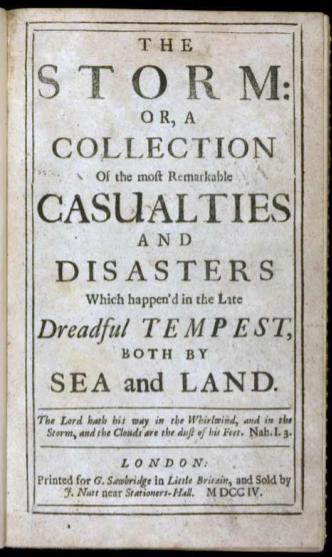 After a massive storm which wreaked havoc right across the country in 1703, Daniel Defoe asked for written contributions of people’s experiences. Sixty of these were then included in a book, ‘THE STORM:..’ which he published anonymously in 1704.
Whether all the accounts published were genuine or if he made any of them up is hard to say, but he did say “…most of our Relators have not only given us their Names, and sign’d the Accounts they have sent…”
The account from Deal bears the name Thomas Powell, who was Mayor of the town at the time. It casts him in a favourable light and as the only man of the town concerned for the safety of the passengers and crew of the ships trying to ride out the storm in the Downs. Defoe concluded his book with a poem and, in reference to Deal, he wrote:
Could I with suited spleen indite,
My verse should blast that fatal town
And drown’d sailors’ widows pull it down;
No footsteps of it should appear,
And ships no more cast anchor there.
The barbarous hated name of Deal shou’d die,
Or be a term of infamy;
And till that’s done, the town will stand
A just reproach to all the land.
One day when Henry was helping his mother to scrub out a bedroom, he clearly remembers suddenly throwing the scrubbing brush into the pail, splashing suds all over the place and telling his mother that he was going to sea. “…and so you shall if you wish …” she replied, “…only do not swamp the whole house.”
Sarah must have seen her son’s potential, as he writes “…the first thing my wise and practical mother did was to persuade my father to let me follow my bent.” Agreeing with his wife, Stephen duly applied to the Superintendent of the Nautical School on Broad Street.
The twenty-four pupils at the school were admitted at the age of 13, but somehow Stephen persuaded them to admit Henry, who was then only just 12 years old. A year later, in 1838, Henry sat the Navigation exam, coming first in his class. Such was his determination to go to sea, he took to studying Marine Surveying and Constellation Charts in the evenings.
Apprenticeship on Sussex a South Sea Whaler
An unnamed gentleman residing in the Deal area used his influence to gain Henry an apprenticeship on a South Sea Whaler named Sussex. So it was that in the early hours of Tuesday, January 14, 1840, Sarah woke her son, not knowing when, or indeed if, she would see him again. He knew his mother may have had a sleepless night and that, for her, this was the second time she’d said such a goodbye: five years earlier she’d bid farewell to William. After they had breakfasted, Stephen, feeling the same emotions as his wife, knelt with his son and “…earnestly commended him to God…” Then, just before 3 am, Henry left his home accompanied by Stephen to board the Mail Coach to Margate. The memory of that morning remained with Henry all his life.
The most likely route was via Sandwich and Canterbury. Once at Margate, Henry writes they embarked on the Royal Adelaide, which he describes as “…an old river boat…” An advert, dated January 1840, shows that a regular Steam Packet Service was run to London Bridge from Margate every Tuesday and Thursday by the ‘Royal William.’
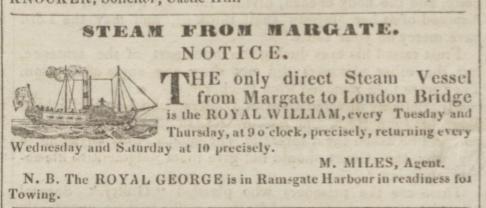
Dover Telegraph 18 January 1840
The steamer ‘Royal Adelaide’ was not included in this service until April that year! However, in the ledger, Henry acknowledged that there may be some errors, writing “… I think it needless to apologise, for any errors in composition of these notes, which are written from memory and perhaps not strictly in chronological sequence, as there has elapsed… a period of more than 53 years…”
William Foster William, Henry’s eldest brother, was one of the first boys to be a pupil at the Nautical School. Before going to sea in 1835, he gave his younger brother a much-used ‘Epitome of Navigation’ by John Hamilton Moore. This was one of the most useful and prized books Henry said he owned. William served as a Bombay Branch Pilot and later on board the American frigate St. Louis as a Petty Officer. Although no records have been found Henry writes that he died while on board and in Rio De Janeiro. This was probably in around 1851 when the St. Louis returned to America. The Springfield Daily Republican 14 July 1851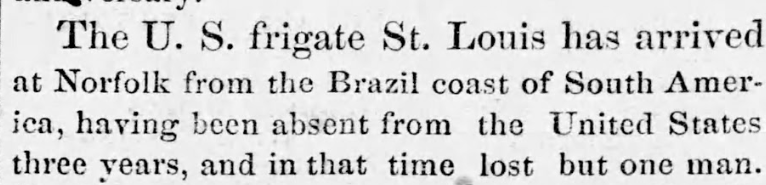
Arriving in London at around four in the afternoon, they made their way to a lodging house on Cheapside’s Broad Street, Henry, all the while taking in the sights of this, his first visit to London. The noises of the buses, cabs and costermongers all contributed to the “…confusion of sounds, not at all melodious…”
The next day they went to Winchester House on Old Broad Street, the home of George Lyall, where Henry signed his apprenticeship papers becoming “…bound for four years in the barque Sussex sperm whaler…”
He and his father then took a wherry to London Bridge East County Docks, now called the South Docks in Rotherhithe to meet Captain Hammer on the Sussex.
“…I am a bit of a physiognomist…” writes Henry, meaning he at least thought he was a good judge of people, and was favourably impressed by the Captain “…who would give confidence to the most suspicious individual…”
After saying their goodbyes, Stephen made the return journey to Deal and Henry, left to his own devices, as his apprenticeship did not start until the next day, started to explore the ship and generally getting into mischief and attracting insults and curses from his now fellow boatmen that, while admitting he deserved them, he was astounded by the many adjectives he had not heard before.
Rowland Rowland, the chief mate, soon took him in hand, keeping him occupied. Cooking was not allowed on board while in dock so the Captain left orders with the landlady of the Dog and Duck inn to supply Henry with food and drink during the few days the ship was being made ready.
At around this time Henry would have first met James Anderson, who was then an Ordinary Seaman on Sussex. James and Henry were to become firm friends until James died in 1872 when Benares, the ship he was master of, was wrecked and sunk in a severe storm off the Loochoo Islands of Japan. It was James’s brother-in-law, George Newman, who wrote an account of his life and who approached Henry to contribute to it. ‘Memoir of James Anderson’ by George Newman and ‘Recollections of a South Sea Whaler’ by Henry were published and bound together in 1877. James Anderson’s body was never recovered.
At Sea
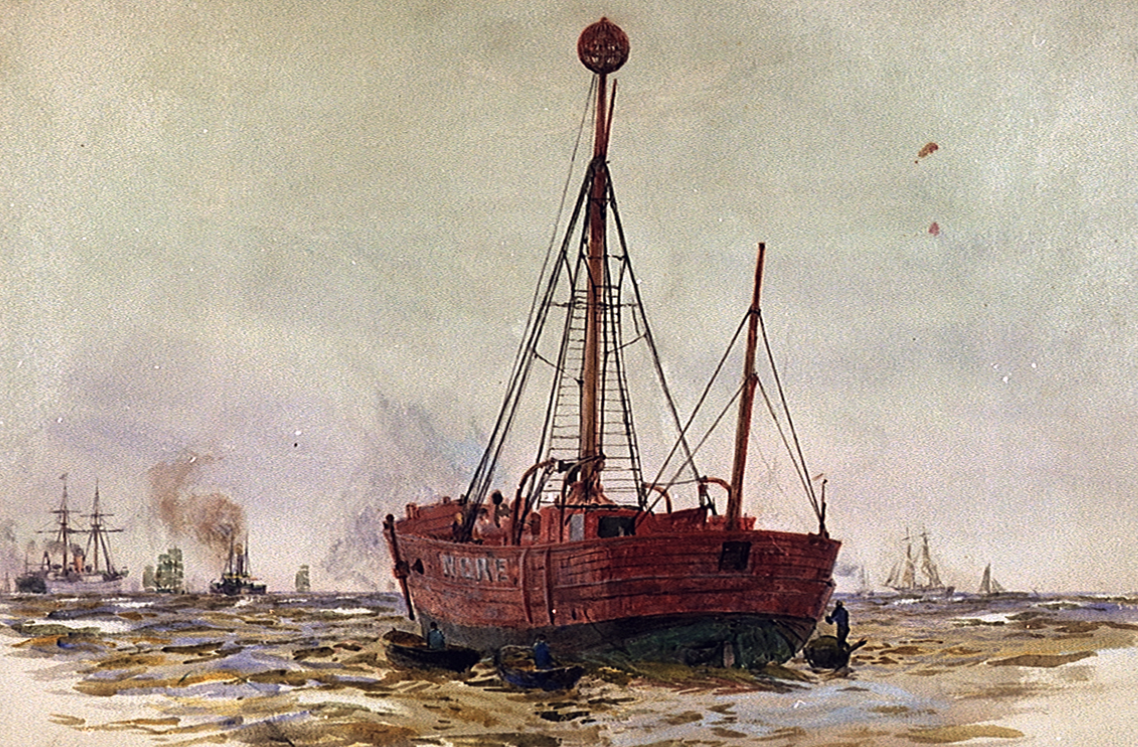
Drawing of the Nore lightvessel by William Lionel Wyllie circa 1900
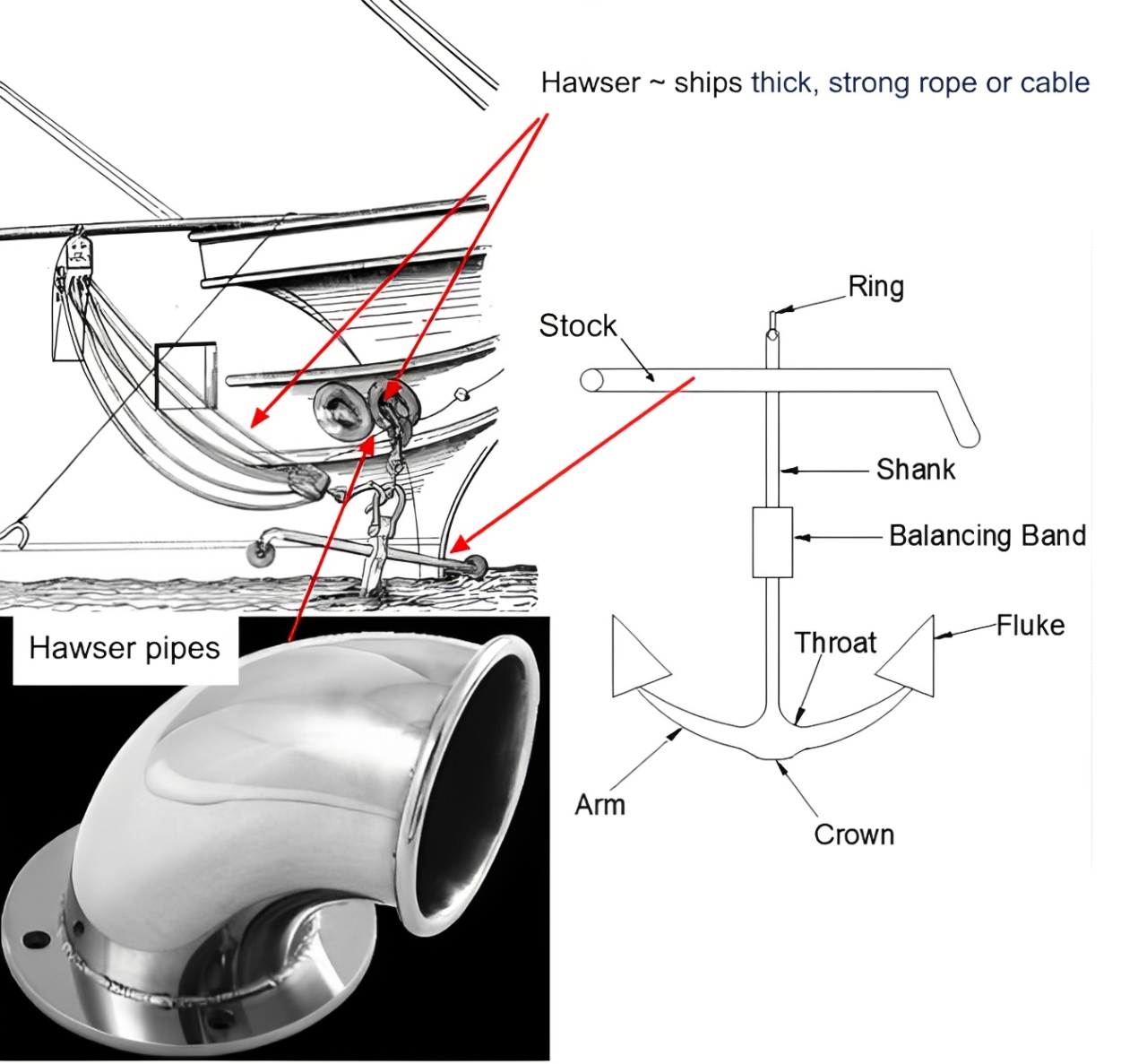
On leaving the East County Dock, Sussex, towed by a tug, they proceeded to Gravesend. Their departure was not an easy one; having reached the Nore Lightship, they had to wait out a gale in which they lost anchor stocks and hawse pipes, causing them to return to Gravesend.
 While awaiting a fresh departure, the Captain went ashore and bought two ferrets to deal with the ship rats. Set loose on board, the ferrets gravitated to Henry and his fellow apprentice, Cornelius Mason. Clearly, with no rats on that deck, they found it more comfortable with the boys and were often found snuggling up with them in their bunks. They were soon relocated and put down in the lower hold, and apparently, they were not seen again!
After successfully departing the Thames Estuary, Sussex made its way to the Downs, arriving on 29th January. Here, they spent some time awaiting a ‘fair wind.’ A few days later, they proceeded along the coast, but on reaching Beachy Head, the weather was so bad that they retreated back to the Downs, arriving safely on Friday, February 7th.
Three days later, on February 10th, Queen Victoria married Prince Albert of Saxe-Coburg and Gotha, in the Chapel Royal at St. James’s Palace, London. The weather, even in London on that day, was of heavy rain and fierce winds. The inclement weather continued until the end of February, and Henry writes: “…While laying there (in the Downs) the Queen’s Marriage took place, I will remember the 5 weeks at Deal in honour of the event…”
Stephen Foster During this time, Stephen and a younger son took the opportunity to visit Henry, where they found him assisting the steward clearing out a cabin. So content was he that he did not want to go ashore then, or later, while they waited for a fair wind. Sadly for Henry, this was the last time he saw his father. With no means of receiving personal letters, or indeed any form of communication, other than brief messages from passing ships, he would not have known that two years later, Stephen took his own life. Henry does not mention the manner of his father’s death, but on the evening of May 4, 1842, his body was found in the Sand Hills of Sholden. He had cut his throat. There is no indication given at the inquest as to the circumstances that led to this tragic event. Kentish Gazette 10 May 1842.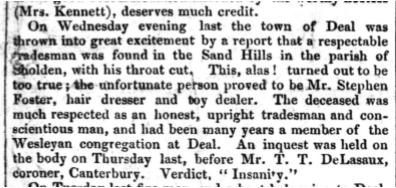
According to Lloyd’s Shipping Intelligence, the wind finally veered to an east-north-easterly direction, and the merchant fleet of hundreds, riding in the Downs, all set their sails and left the safe anchorage, a sight that we today can only imagine.
The Sussex was among one of the first to get underway, and as the wind had freshened, they maintained 12 knots until reaching the Lizard. They continued on to the Bay of Biscay when they were again caught in a severe gale. Initially frightened, Henry soon became used to the severity of this gale, which lost them one of the four pigs, kept in the between decks, when a cask of potatoes fell on the poor creature.
One morning, 300 miles from the coast of Madeira, Henry rose to see the rigging looking “…quite red…” This was something that often occurred at that latitude when the wind would blow the sand from the coast of Africa to land on any surface in its way. From Madeira, they sailed on, arriving at the Cape Verde Islands, calling at Brava for fresh provisions. This was to be the first foreign soil that Henry had ever stepped onto. Although fresh fruit and vegetables were purchased, Henry could not see where they had been grown as the island, to him, was mainly rock and steep hills down which the inhabitants would run “…at top speed…” and he marvelled how they never cut their feet. Four Bravan men were hired to “…pull the mid-ship oar…”
Taking their leave from Brava, they proceeded to Trinidad, but first they had to cross the equator where the Sussex crew members, who had not ‘crossed the line’ before, had a narrow escape from the typically over-boisterous ceremony that often involved the dunking and shaving of the sometimes unwilling victims. Luckily for Henry, and his fellow line-crossing virgins, Captain Hammer supplied the ringleaders with bottles of ‘grog’, which restored order and brought some merriness.
Just before reaching Trinidad, a cry of “Sail Ho!” announced the sighting of a brig from Brazil that was bound for Liverpool. The Captain’s boat was lowered and sent with an invitation for the brig’s captain to have supper on board the Sussex. Most of the Sussex’s crew took the opportunity to write home. We don’t know if Henry did so, but it is a nice thought that Stephen and Sarah may have received at least a small message from their son telling them of his adventures, if not simply to say he was happy and safe.
Henry inserted in his ‘Reminicenses…’ the occasional drawing, and the first is of the Nepean Rock, the sight of which must have impressed and stayed with him over the years, as he drew it on a later voyage to India.
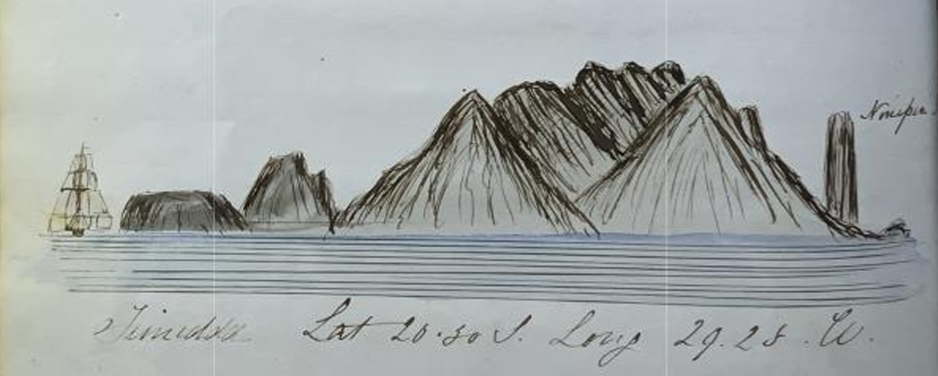
Nepean Rock
From Trinidad they sailed south along the coast of South America and into stormy weather. Although, as Henry points out, the term ‘cyclone,’ was not used then, he does say, looking back, that it is the appropriate description for the weather they experienced.
In the dead of winter, heading south into the “…land of the storms…” Sussex battened down. Hatches were closed, all except one of the boats was stowed, and the masts, sails and rigging were made ready for the expected gales.
The first to hit them came off the River Plate (Río de la Plata), which, although prepared for, still took them by surprise and, with the cabin deadlights (shutters) not closed, the cabin nearly filled with water. “…I think I never saw the rain falling in such torrents as it did upon this occasion…” Henry remarks, also saying how the Sussex showed them what it could do as it “…rolled…” through the storm. While following the order for “…All hands to close-reef the topsail and store the fore sail…” one of the men miraculously escaped death, if not serious injury, after falling into the belly of the sail he was sent aloft to reef or take it in. A sea then hit the rudder, causing young James Anderson to be knocked right over the wheel.
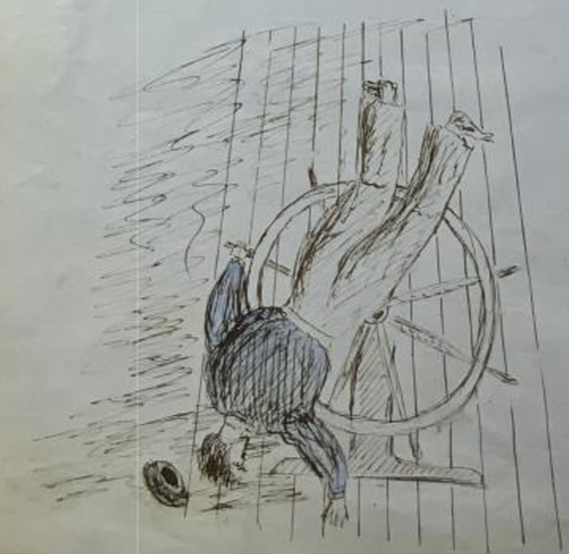
James Anderson going over the wheel
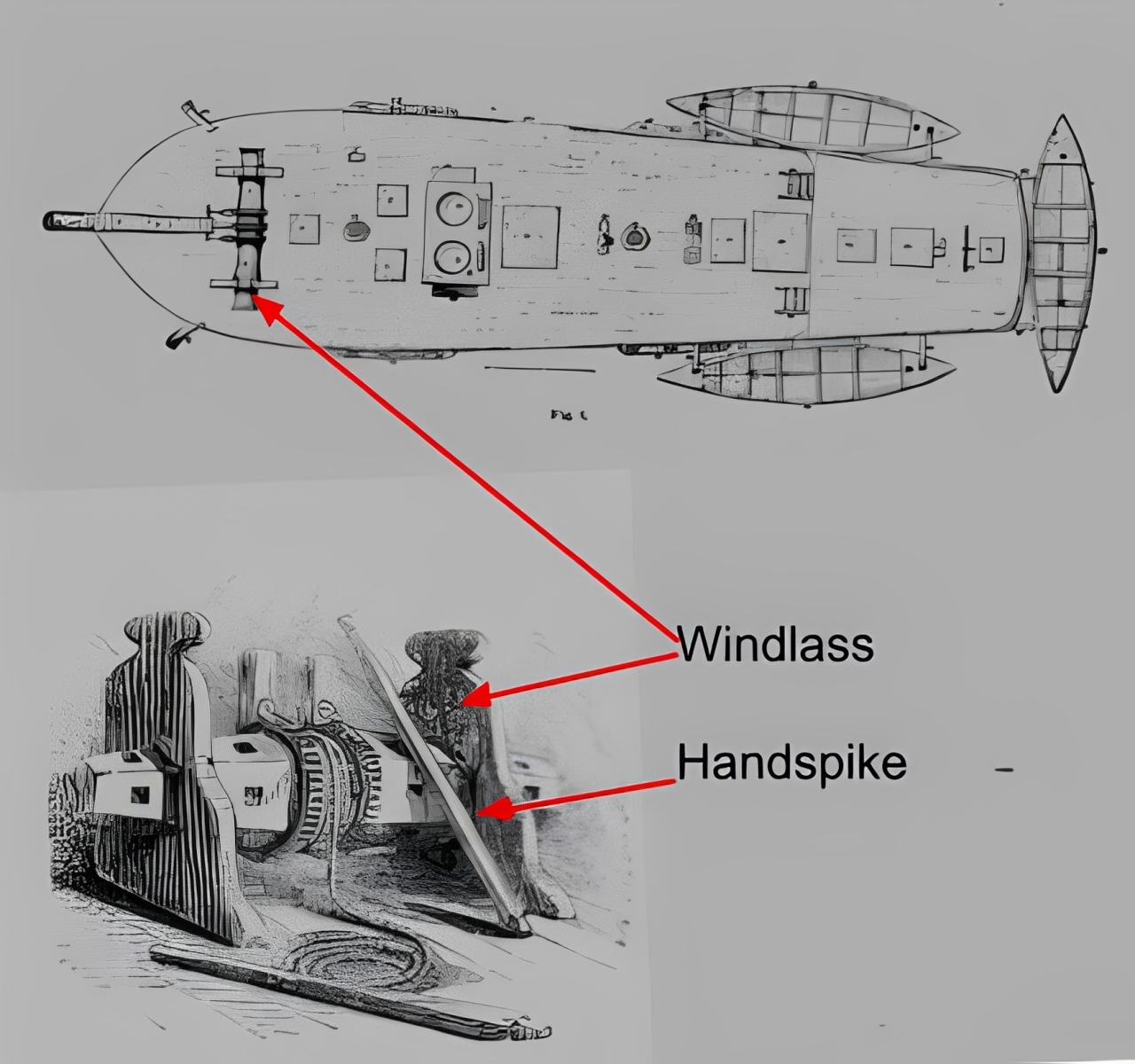 The storm eventually abated, and they eventually reached Cape Horn in around April 1840. Throughout the next eight weeks, they battled other storms which prevented them from proceeding around the Horn and up the coast of Chile. Due to the extreme weather, long periods of watch were required and made by all. It was due to the severity of the cold during this time that Captain Hammer lost his sight, luckily regaining it after a month. He, like many mariners, brushed with serious injury or even death, and Henry was no different. It seems that at about the same time that Captain Hammer temporarily lost his sight, Henry almost lost his life.
He’d been sent by the ship’s steward to get the ingredients for ‘pease pudding’. The weather was atrocious with a ‘…tremendous sea running…’ He’d reached the windlass when he saw a heavy wave coming towards the ship. “…so I dropped everything…” he said and rushed towards a handspike that was in the windlass. As the wave hit, it took him and the handspike right overboard. Luckily for him, Cook had seen the incident and “…rushing out of the galley as the vessel gave a lee lurch…”, caught hold of Henry’s shirt-collar and pulled him into the galley. Henry gained no sympathy from his near drowning but was reprimanded “…for going along the lee side which was against orders…”

(left) Cape Pidgeon (right) Mother Carey’s Chicken
Throughout ‘Reminicenses…’ Henry describes the flora and fauna that he encountered on the often remote islands he was able to visit during the four-year voyage. In a time without the highly detailed coloured photography, and moving images, we are so used to today, some of what he saw must have seemed extraordinary to him. While waiting for the weather to change, Henry writes of Cape Pigeons (Cape Petrels) and Mother Carey’s Chickens (Storm Petrels) and the Albatross. The pigeons, he says, are very handsome; all over black and white marks on the wing are very beautiful. The ‘chicken’ is quite black and about the size of a sparrow but with webbed feet.
The Albatrosses he described as “…a noble bird on the wing, no matter how rough the weather…he sits perfectly at his ease and seems to defy the very elements…” The crew, he says, would amuse themselves by catching them with hooks, so he would have been given the opportunity to see their 17-foot wings and snowy white breast and its powerful beak. One Albatross, perhaps not pleased with having Henry tease it by waving his hat at him, used its beak and tore off its crown, leaving Henry with the ring of its brim in his hands.
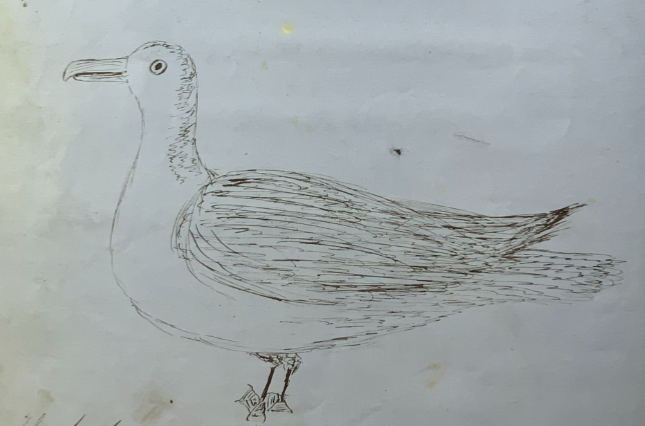
Albertross
One clear day, while waiting off the Cape, whales were sighted. Not wanting to miss the opportunity, two boats were lowered, but they “…did not strike…” and soon yet another gale blew up! Then, after eight weeks of waiting, the wind changed and they were finally able to put the Horn behind them. As they travelled up the coast of Chile, they moved into better weather, putting in at the Juan Fernandez Islands. Henry described these as “…the celebrated islands…” perhaps referring to the fact that in 1704 Alexander Selkirk was marooned for four years on Isla Mas a Tierra; he being the supposed inspiration for the character in the much-loved book of Henry’s, Robinson Crusoe, by Daniel Defoe. Isla Mas a Tierra is now actually named Robinson Crusoe Island.
The waters around the islands were so clear that you could easily see the fish taking the hook. Once they had caught all they wanted, some men went ashore where they gathered fresh mint that grew in abundance and was used to make tea. After drinking coffee made from dried and roasted peas, this, Henry comments, was a welcome and refreshing drink. Continuing along the coast of Chile with the “…atmosphere being exceedingly clear…” he was able to admire the Andes Mountains which were 90 miles inland, and during the night the sky was full of stars. They finally reached the offshore ground which was spread over 400 miles from Chile’s Valparaiso to Panama, where, depending on the season, large quantities of whales were to be found.