Follow us on Facebook @FHofDW
Henry Foster
Reminicenses of a Sailors Life
Part 2
Catching and the Processing of Whales
It is at this point in ‘Reminicences…’ that Henry describes the whale boats, the equipment they carried and how whales were caught, killed, butchered and how their blubber was boiled.
“…I am sure if anyone was to see the whole of the gear belonging to a whale boat they never would credit the boat could stow it to leave room for the people to move in the boat…”
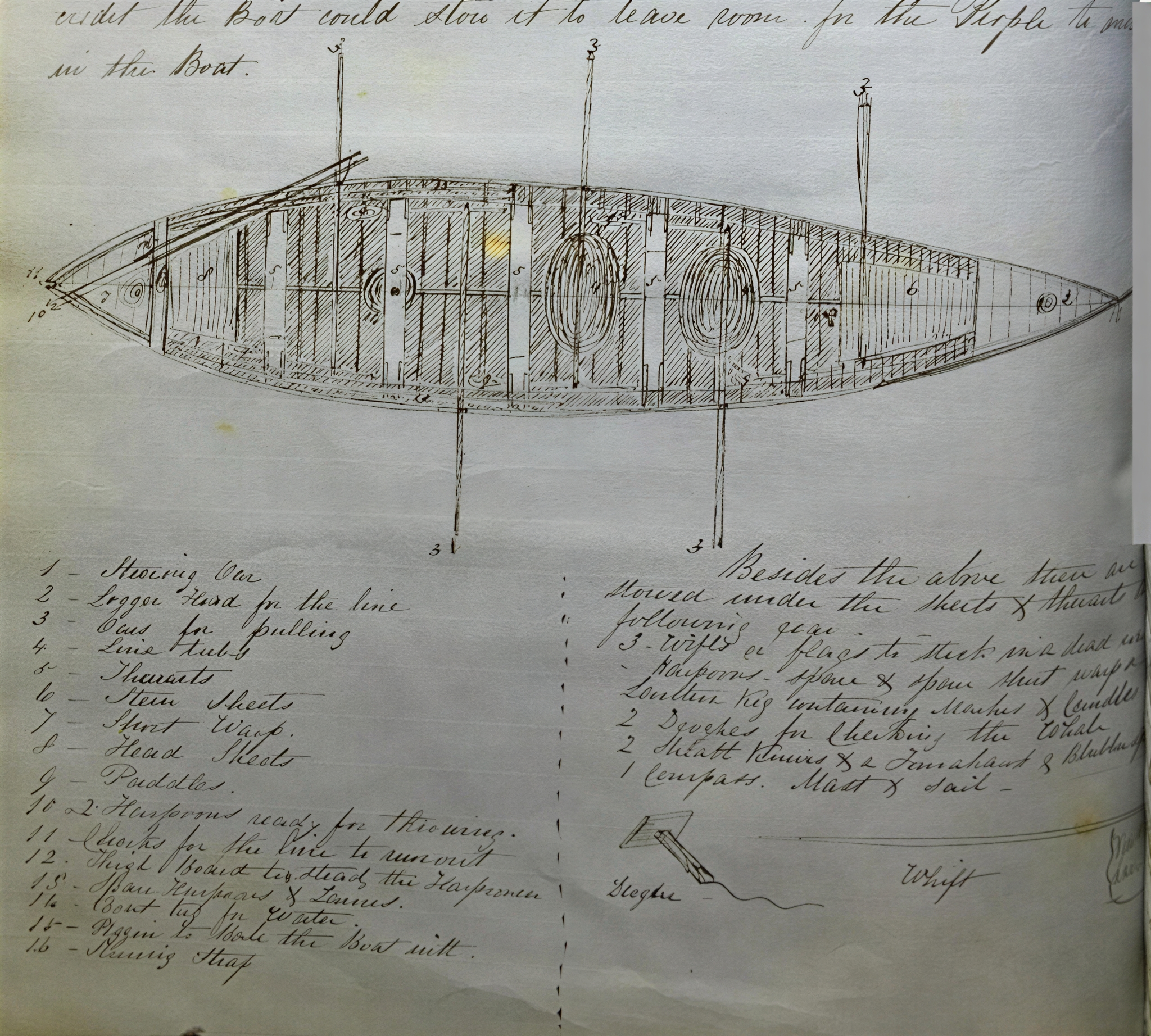
Whaleboat
Henry helpfully supplied a labelled drawing of a whaleboat and that of a Sperm Whale.
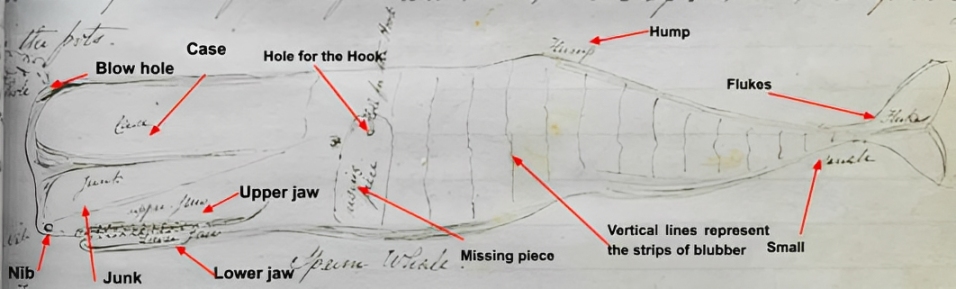
Sperm Whale
The ‘Case’ is a vast reserve containing spermaceti, which is a waxy substance found in the head of sperm whales. It is bailed out in buckets and boiled and stowed in separate casks marked H; it is used for making candles.
The ‘Junk’ is a solid wedge-shaped piece which extends right through the head, just over the upper jaw.
The vertical lines represent the strips of blubber as it comes off the whale in about 20 feet length and from 5 to 6 feet wide according to the thickness of the blubber, which varies in a large whale from 6 inches to 2 or 3 ft near the hump, which is the thickest part.
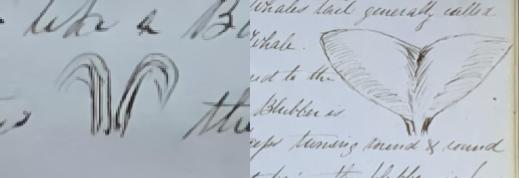
Whale Spout & Tail
The main targets of The South Sea Whalers were the Sperm and Right Whales. The masthead man would be set to watch for the spouts of whales, and the experienced could identify which type of whale by its spout. The sperm whale’s spout Henry describes as low, like a bush, and the Greenland or Right whale goes to great heights like a fountain with two holes.
Whales vary in length from about 35 feet to 90 feet. The sperm whale, when he goes down, throws his tail out of the water, which is called turning flukes, and can stay down for 20 to 30 minutes. Sometimes the whale jumps, or breaches, out of the water and may be seen from nearly 20 miles away. Henry writes, though he did not see it, that “…Very often they go in schools of 200 or so but they are generally small, lone whales are generally very large…” an unimaginable sight today!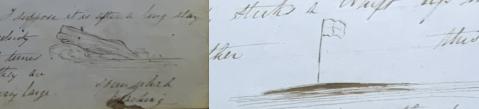
Whale & Wheft
Whale ships were sometimes fortunate enough to get into a school of up to 10 whales. When that happened, as soon as a boat had killed a whale, a wheft, or flag, was stuck in the dead whale before they gave chase to another. This made it visible to the ship, enabling it to steer to and pick up the dead whales.
When the boats killed a large whale several miles from the ship help would be required to get the whale back to the ship. This is done by the whale boats clapping on to each other by passing a rope through a hole at the end of each boat. They are then able to tow the whale to the ship at about 1 or 2 miles an hour, but when a whale is worth nearly £1000 it is some encouragement for men to work as they are generally being paid by the share. If this happens at night, the ship keepers keep burning shavings and oil in a large ladle to guide the boats in.

Towing a dead whale back to the ship
While the whale boats chased and towed in the whale, the ship keepers, that is those left onboard, usually the cooper, blacksmith, carpenter, cook, and the steward, got the chains and cutting gear ready to start processing the carcass of the whale. “…By the time the boat’s crew gets the whale alongside, it may be imagined they are pretty hungry, and if there is any possibility of cutting a few steaks of the whale under the blubber, there is no time lost in procuring them. They are capital, eating chopped up with salt pork and onions and fried, being the youngest in the ship I usually got the job to chop the sausage with sauerkraut and keep the frying pan well supplied…”

From The young Nimrods in North America a book for boys (1881)
After the whale was secured to the starboard (right) side of the ship, the crew erected a cutting stage (plank platform) above it ready to start cutting the blubber from the whale. If the ship was in a rolling sea, this could be a very dangerous operation as it put a great strain on the rigging (which on whalers is much larger than other ships on that account). Adding to the danger was the fact that the ship would also have been made top heavy as the riders, or upper tier of casks, and anything else in the hold, would have been brought up and placed on deck enabling free access to the ground tier of casks.
“…On board the ship is the cutting in gear, several large fluke ropes to pass around the whale’s tail which is nearly 20 feet wide in a large whale. The rope is passed into the bow port and secured to the bowsprit head and gradually slacked away as the blubber is taken off similar to pairing an apple, as the whale keeps turning round and round till it comes to the tail which is hove in with the last piece…”
The whole ship’s crew worked during cutting of the blubber as it was heaved up and lowered down the main hatch into the blubber room where it was cut into small pieces, called horse pieces, each weighing 30 lbs. They were then minced, or cut, into thin slices and hauled on deck ready to go in the boiling pots.
The 1st and 2nd mates on Sussex worked on the cutting stage, cutting the blubber from the whale. The crew then used the windlass to heave up the whale around as the mates cut into the blubber. Another windlass was then used to heave up the cut pieces.
The carpenter was employed to grind spades; these were wide, flat, often 20 foot long-handled, oar shaped spades for cutting blubber, as they are frequently jagged by striking a bone.
“… The pole of a spade is about 20 foot-long. I was generally employed turning the grindstone and killing sharks between whales with one of the spades, I killed hundreds in that way. It is astonishing the number of sharks that called together during cutting in, the water is literally thick with them. I have known them in one night to eat so many holes in the blubber that it would hardly hold together to be heaved in…”
It usually took a day or two to cut up a large whale, and another two or three to boil it. The boiling was carried on night and day so that at a distance the ship appeared on fire.

South Sea Whalers boiling blubber / Boats preparing to get a Whale alongside, by Oswald W. Brierly, 1876 Source State Library of NSW a128893
The night watch was divided into two seven-hour watches, from 6pm to 1am and from 1 am until 8am, which is more convenient than the ordinary sea watch of 4 hours. This gave time to wash the grease off “…with which one generally gets well besmirched before the watch is out…”
“…The 1st watch generally cooks something in oil before resigning the duty and anyone that has not had such a supper can’t imagine how nice it is to have seen a large albacore (longfin tuna) 40lbs weight boiled in about 5-minutes with a lot of onions and sweet potatoes on a soaked biscuit done in the boiling oil. It really used to go down first rate (I don’t know if it would now, probably not) we did not require any sauce at any rate. Pancakes and fritters are delicious done the same way….”
The brick furnaces and pots installed on whaling ships were called ‘tryworks’, and on each side of these were 2 copper tanks, or coolers, to catch the oil as it ran out of the boiling pots, aided by the roll of the ship. Removing the residue scraps was called ‘boiling out’, and this was skimmed off with a copper strainer and thrown into the large tub with holes in it so as to drain off remaining oil. This was then reserved for fuel to boil out the blubber, so in effect each whale was fuel for another. This reduced the amount of coal the ship had to carry.
The cooper, and his mate, bailed the oil out of the coolers (tanks) into casks, calling for help when they were full, to roll them aft where, chocked and lashed, they remained, often for several days, until the oil was cool enough to be transferred, via a canvas hose and a funnel, to the casks in the hold.
Stowing day was a busy time for everybody, especially the first part of the voyage, because the ground tier of casks, that is the bottom layer of stored and stacked casks, had to be filled first. These were always stored fore-and-aft, which is the furthest forward and furthest back of the ship’s hold.
As larger ships with a more efficient means of ‘whaling’ were brought in, many whales neared extinction and since 1986 it has been banned by most countries. But, in 1840 sailing ships, such as the Sussex, with their double-ended whaleboats, pulled by the sheer strength of its oarsmen, were what the whales faced.