Follow us on Facebook @FHofDW
Henry Foster
Reminicenses of a Sailors Life
Part 3
Captain Newby
Three weeks after leaving Juan Fernandez, Sussex reached Chatham Island, which had been named in 1793 after the First Lord of the Admiralty, Lord Chatham. Today the island is known as San Cristobel, and due to a small lake of fresh water it was well known to voyagers, including whalers. Soon after its annexation by Ecuador in 1832, it was the first island of the Galapagos to be settled. Henry mentions two other islands of the archipelago: Charles Island (Floreana Island), which was then an Ecuadorian penal colony, and Island Albemarle (Isabella Island).
It was only five years earlier that Charles Darwin had visited these islands, collecting, researching and describing the flora and fauna; it was here that he developed his Theory of Evolution. Henry does not mention the tortoises that so intrigued Darwin, and of which he remarks how the convicts regularly ate tortoises and that whaling ships and pirates often took them: one such ship carried off 700 Floreana tortoises to eat while at sea. In the journals of Captain Robert Newby (see below) there are several mentions of ‘taking turpin’ and tortoises to eat in the coming months of his voyages. By 1846 the race was extinct.
Henry wrote that huge terrapins and turtles “…are of an enormous size, weighing from 7–9 cwt…” Green Turtles were to be found in abundance, and Henry describes both these creatures as “…excellent eating no matter which way they are cooked …” Of the terrapin he also says that when first caught they have a quantity of cold water “…which was delicious drinking…” and that the sailors, when thirsty, would chase and kill them just for the water. Despite there being water, it was perhaps not always easy to find on the islands, as Henry reports “…there is none to be obtained…” The perfectly round, hard, white-shelled turtle and terrapin eggs were also in abundance and probably taken as food. Like Darwin, Henry also mentions the numerous birds, iguanas and the seals and fish in and about the island’s rocky coastline.
During their stay at the Galápagos they were in the company of Conway, another whale ship Sir Andrew Hammond, the Captain of which, Robert Newby, was also from Deal, and a great friend and old shipmate of Captain Hammer’s “…a great deal of gamming, that is, visiting each other’s ships…” took place.
Captain Newby wrote that the ‘visit’ took place in July and that at the time the Sussex was ‘clean’, that is, they had no barrels of whale oil.
Newby also says they landed on Lee Bay on Charles Island in June, where they got 23 barrels of potatoes and 1,000 cobs of Indian corn. These were probably grown by the convicts of the penal colony. Newby also fumigated the ship as they had a rat infestation. Repairs were also made to the ship before moving on to the other islands in search of three men who had deserted in a whaleboat, taking with them some valuable whaling gear. We don’t know if he found the three deserters, but it was during this search that Sir Andrew Hammond met with the Sussex. This voyage for Robert Newby was not going well. Before the desertion, he’d had other problems with the ship leaking and the crew not following orders and pumping the ship, leading to arrests in Sydney and less skilled crew being employed. There were also cases of sickness, including venereal disease. His problems were to increase after leaving the Galápagos, but we will get to that story very shortly.
After spending a couple of months cruising around and visiting the islands of the Galápagos, Sussex set sail for Tumbes on the coast of Peru, where they anchored at the mouth of the river to take on wood and casks of water. By this time, they had been at sea for nine months without entering a port, exceeding the maximum six months as stated in the ship’s articles. Obviously, this could not always be avoided and sometimes caused a disgruntled crew. The morning after Sussex had arrived at Tumbes, a boat’s crew took one of the boats and ran away. This was obviously planned, as they took all their belongings with them. They were Peter Moon, the armourer, boatsteerers John Morris, J. Thompson and Thomas Champneys and Jose Abs. “…and a good riddance it was as well, they were a piratical lot of rascals…”
If they had waited, they would have received, with the rest of the crew, three days of liberty with their lodgings paid for by the captain. The lodgings, though, Henry writes, were very poor with only the floor to sleep on in rooms full of mosquitoes which “…bitting terribly the marks of which I had twenty six years later…”
Henry belonged to the starboard watch and just as they were steering off from the ship they spotted a lone whaleboat approaching them from the open sea. This, as Henry put it, “…exacted curiosity…” as there was no land in that direction for over 600 miles. As the mystery whaleboat approached, they were surprised to see Captain Robert Newby amongst its crew.
According to Captain Newby, the boat’s crew had fastenedto a whale, but his ship, Sir Andrew Hammond, was lost to sight. With only 10 lbs of biscuits and only a little fresh water, plus the 1 lb of wax candles always carried to show the whereabouts of the boat at night, it was decided to steer for South America hoping to encounter a ship on the way. After two days, they were met by two local boats who carried them to Puno in Southern Peru. Here they heard their ship was in Payta, in northern Peru, so they decided to set out to rejoin their ship. It was on this journey north that they were spotted by the men of Sussex’s starboard watch. Sussex had anchored off Tumbez and the men had been preparing to go ashore. Captain Newby and his crew were by then half starved and “…were too weak to pull…” Captain Hammond took them on board and agreed to take them to Payta to rejoin their ship.
While gathering supplies, Henry and his watch mates traveled up the river, where crocodiles and alligators were sunning themselves on the banks, and the overhanging trees were full of chattering monkeys. Leaving the boat behind, they had to walk for about four miles through orange trees to reach the nearest town. This Henry describes as a desolate place, choked with sand and thousands of lizards running around. The only architectural feature he remarks upon was a large cross close to the church. Exploring, he met some other boys from an American Whaler, and while they chased the lizards, the men of the ships were enjoying their liberty by getting drunk. The scenes of this drunkenness, writes Henry, were “…too horrible to relate…” Aquardiente was the name of the ‘abominable spirit’ which they imbibed, causing those under its influence to be more like infuriating beasts than men. Henry tries not to judge these men, but it is obvious from the way he had written that perhaps seeing drunkenness in his home town and his Methodist upbringing had turned him against drink.On the way back to the ship, the crew, still drunk, decided to call in on a plantation to get more grog. Leaving Henry in the boat, he decided to amuse himself by trying to catch fish with a lance. Unfortunately, he saw several alligators swimming towards him and, knowing that they could easily take a small boy, such as he was, he got ready with his lance. Just then, he heard a splash of oars, and on looking up, he saw Captain Hammond and a crew rowing towards him, looking very angry for putting himself in such danger. Captain Newby soon calmed the situation, and once the crew of Henry’s boat had been called back, they all returned to the ship.
The men from the American whaler informed them that Sir Andrew Hammond was still lying in Payla, to which they soon set off to reunite Captain Newby and his boat’s crew with their ship. They had been absent from their ship for 72 days, and the crew had sold items from the ship in his absence. In an attempt to retrieve the items, he approached the British Consul, who he says did nothing. Leaving Captain Newby to his problems, Captain Hammond directed the Sussex to the whaling grounds and “…commenced looking for whales in a zeal most earnest…”
The first whale they caught was on a Sunday, and although Henry, being a dedicated Methodist, felt that the Sabbath should be maintained, he realised that there were few Whalers who kept it. With hindsight, he was later able to say that those few who did keep the Sabbath made as good a voyage as others. He goes on to say that he had no doubt that although they broke the Sabbath, they were no doubt conscious of it, explaining that although the Lord gave the people Sunday, “…there is no mention made of Christians keeping the Sabbath in the New Testament that I am aware of…”
By far, Captain Newby was not the only master of a ship with a disgruntled crew. The strength of character and experience required to lead men living in what, after all, is a relatively small box floating in a vast expanse of sea, is a skill few people have and cannot be underestimated. Dealing with those who were working at times under extreme circumstances, often with poor or reduced food rations, which was the thing crews complained of most, and handling each situation was a balancing act between compassion and discipline. Plentiful food did not always equate to healthy nutrition, and its monotony was also a cause for discontent. This discontent with strong-minded men with an axe to grind led to difficult situations on board, as happened on the Sussex after they left Tumbes.
The three ‘rascals’ who had deserted at Tumbes had to be replaced, so Captain Hammond, with a limited choice of skilled men, took what he could, and the three replacements were men who had deserted from an American Whaler. They were experienced whale men, but they turned out to be worse than the men they replaced, as they were, according to Henry, “…an educated lot of villains…” and most likely joined Sussex as a means to get to another island or port. It was soon after they had got in amongst the whales that these men showed their true colours. One morning, Henry found a letter addressed to the Captain, lying on the companion which he immediately took to him. The letter expressed dissatisfaction with the provisions and the discipline of the ship. After reading the letter, Captain Hammer called and read it to the mates, and it was then decided to muster all hands on deck, where they were asked who had written the letter. The name of Benson was given by one of the crew, who Henry describes as “…the most useless fellow I ever saw on board ship…” The letter apparently named most of the crew, so Captain Hammer told all the crew who agreed with the letter to walk over to the port side. Twelve out of the twenty-four did so. The remainder claimed their innocence, professing they knew nothing of the letter until it had been read to them. Then one man, named William Wallace, stepped forward and told of how he had seen Benson creep out while the others were asleep and damage the meat and sometimes throw it overboard to make the crew dissatisfied. Benson was immediately cuffed and put in the cabin store room. Of the other men, they were told to go about their duties if they chose; only four decided to do so. This left the ship short-handed and too dangerous to continue with the voyage with the mutineers on board. Captain Hammond made the decision to sail to Resolution Bay on Tahuata Island, one of the Marquesas Islands, where he would land the mutineers. In the end, seven men were put off the ship: William Benson, W Newton, J Washington, J Crompton, Charles Patten, Peter Clifford and John Thomas. If the islands had been British, the men would have been arrested, imprisoned and charged with mutiny, but at the time there were only two English missionaries.
In ‘Reminicenses…’ is a picture drawn by Henry of two of the islanders. The men and women he describes as having “…external beauty…”; the women with natural feminine grace and the men of gigantic proportions who were tattooed all over their bodies, depending on their rank in the community. The chief “…had not one part of his body that was not a deep blue colour…” All hairs were plucked from their bodies, including their eyelashes.
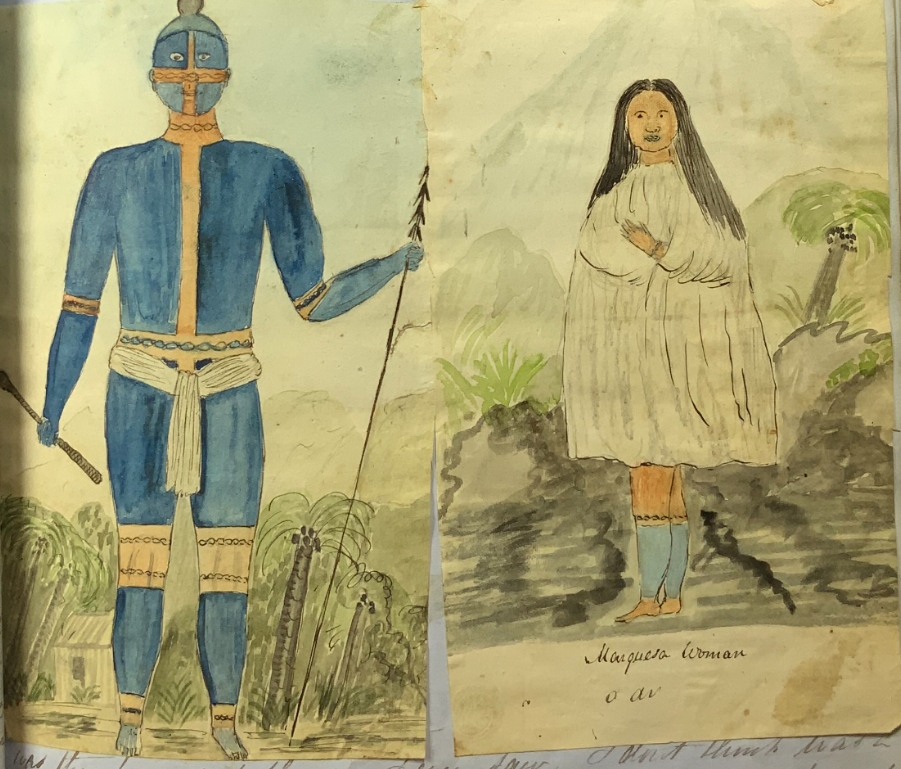
Marquesa Man and Woman
The islanders were, though, constantly at war with each other and, according to Henry, were cannibals. This may account for the little success in converting the islanders and why, a year later, they were taken over by the French, who treated the natives with “…abominable cruelty burning their villages…”
Reprovisioning with wood and water, they also took on board one British runaway sailor, a man from the Azores, and six natives from the region. They headed for Dominica Island, now called Hiva Oa. Here they obtained fresh provisions; this proved a little difficult as the surf proved too dangerous for the boats. By anchoring the boats some distance from the shore and sending a native to swim with a rope to fasten to a coconut tree, presumably they used the rope to haul themselves on shore from where coconuts, plantain and pigs were bartered for and swam back to the waiting boat. Five pigs in all were purchased for the price of an old tower musket. Henry was left in the boat while the others went ashore and soon was surrounded by “… a lot of old women…” admiring his complexion, which to them must have seemed very fair, despite him being quite dark compared to the rest of European crew who had nicknamed him ‘Darky’. One of the crew, who could speak their language, returned to the boat and when he realised what the women’s intentions were, he remained in the boat. In ‘Reminicenses…’ Henry remarks “…I have often had time to imagine since what sort of career mine would have been had the old woman succeeded in carrying out the intentions…!”
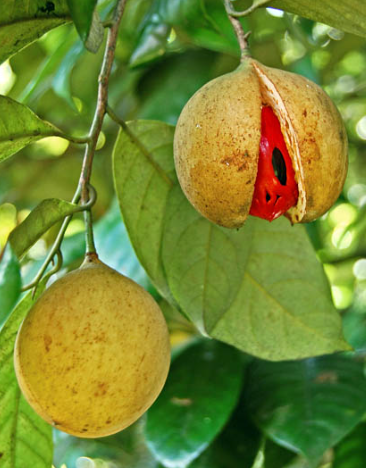
Nutmeg
After leaving the Dominicans, they continued their voyage westward, towards the Navigator Group of Islands called Samoa, taking any whales they encountered on the way. At Tutuila there was a safe, deep anchorage from where Henry admired the ‘magnificent’ scenery. Going ashore he saw, amongst the beautiful foliage of the island, he was amazed to see nutmegs growing. He found the natives to be most hospitable, suggesting this was due to the efforts of the missionaries and how safe they had made the islands by converting the natives to Christianity, who “…would put any part of England to shame with their orderly conduct and morality…”
Marks, the ship’s steward, whom Henry describes as ‘black’, as a Malayan, absconded on this island and was replaced by an American who he found to be the most conceited fellow he’d ever met. This ‘conceit’ coloured his opinion of Americans, especially as another American named Smith was taken on at the same time, and he Henry describes as not only useless but cruel after seeing him torture a chicken; he went as far as to tell him that if he’d been big enough he would have thrashed him. Henry doesn’t tell us Smith’s response but, he says, just a few weeks later Smith received what “…seemed like retribution…” when he got caught in a line and killed by a whale.
The third crew member taken on from Tutuila was a man named John Brown. His whaler, a ship called Hope, had been wrecked; the rest of the crew decided to make their way to Australia, leaving him on the island. This was a man young Henry took a liking to, writing that he was “…the smartest sailor I ever knew.…” He taught Henry how to swim and dive like a fish.
From Tutuila they made for and landed at Boscowan of the Keppel Islands, just off the eastern coast of Australia. Here they took on provisions including yams, and again Henry remarks upon the friendliness and good looks of the islanders. Next they made for the island now known as Nukunonu, but was then called Duke of Clarence Island. Captain Hammond had visited here thirty years before when it was virtually uninhabited; since then, the population had grown quickly. This puzzled Henry as it was 400 miles from any other land. These ‘new’ natives came out to Sussex in large canoes laden with coconuts and fish which abounded there. From Duke of Clarence they headed for the Kings-Mill Group which are a chain of sixteen atolls and coral islands, also known as Gilbert Islands.
These islands gave no safe anchorage, so they cruised among them for about ten months, during which time they took 20 whales. As always, Henry took notice of his surroundings, and later recorded what he saw and thought about the islands and their inhabitants, writing “…The principal island for trading being Byron’s Island (Nikunau Island), the men go quite naked; the women generally wear a small apron of seaweed, but some go quite naked. They don’t tattoo, but they fight terribly with shark’s teeth spears, and the wounds they inflict on each other are horrible to see. They spend most of their time in the water, in consequence of which some of their skin becomes rough, the skin hanging in flakes all over them, giving them a most repulsive appearance…”
The only thing that grew in abundance was coconuts. From the trunks, the islanders built their houses, roofing them with the leaves, from which they also made “…beautiful matting…”
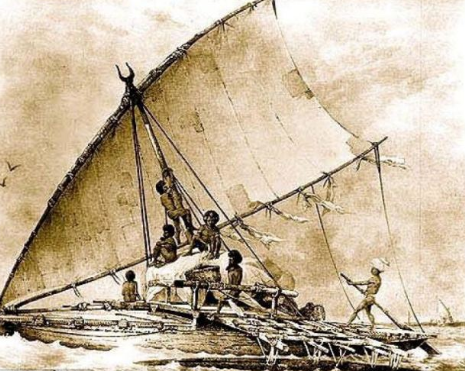
Canoe with outrigger
Their canoes Henry describes as being ingenious and extraordinary, as they were made by sewing hundreds of pieces of wood together with lines made of the husk of the nut. They are very narrow with an outrigger that goes out 10 feet from the hull, which, as one side is straight and the other round, is 16 to 20 feet long. The sails were triangular and also made of matting.
Henry remarks that the islands had never been visited by the missionaries “…as it was hardly possible for a European to live there…”
Here Captain Hammond took on another three or four men, two who later jumped ship. It seems that men who had jumped ship or even some who had been shipwrecked used the whalers as a means of what today we would call ‘island hopping.’ These hardened men would accept work on a ship knowing that they would have a reasonable amount of food and drink, often working as little as possible until they found an island that took their fancy and simply absconded. As maintaining safe crew levels and gaining reliable crew in such waters Captains often had little choice but to take on these men.
It was while visiting Drummond’s Island, now Tabiteuea, that Henry read about, or maybe even read the book, ‘The Wreck of the Corsair’ by William Reney. The Corsair was a whaler on which at least three of the crew came from Deal. In December 1834, Corsair approached Byron’s Island where they were visited by several canoes of the natives who supplied them with coconuts. Chief mate William Reney, the author of the book, was also impressed by the stature of the men, saying they were “…tall and well proportioned with ferocious countenance, nearly black and quite naked…” but they did not attempt to land “…owing to the barbarous disposition of the natives…” Soon after leaving Byron’s Island and nearing Drummond’s Island, Corsair hit a coral reef. Not able to save the ship, the four boats were lowered with six men in each, leaving the Captain and a few others on board to try and save the ship. The following morning, realising all was lost, they signalled for the boats to return; only three did so. It was presumed, with no signs of wreckage or bodies, that they had been lost to the sea. Another boat was lowered from the ship and the four vessels with their crews made their way ashore. Here, Captain Venables, the ship’s surgeon and several other crew were, in Henry’s words “…severely handled by the natives and several lost their lives…” It was later to be reported as a massacre. Henry does not say if he knew all the men from Deal, but one of those listed by William Reney was Thomas Bowbys, with whom Henry was later to sail.
Before leaving Gilbert, or the Kingsmill Islands, for Japan, Henry experienced Kava. This is made from a plant similar to horseradish and made by the young girls chewing it, then mixing it with water, then straining it. It is exceedingly bitter, looks like soapsuds, and is intoxicating. When handed round to visitors, it was considered to be rude not to accept it. It was here that Henry had another brush with death when he narrowly escaped a shark.
After a day of boiling blubber, he decided to jump overboard to wash off the oil and smuts that covered him and everyone else during the filthy process. Knowing that boiling blubber attracted sharks, you have to wonder why he took the risk. A shark was soon spotted and “SHARK!” was shouted out in alarm. Henry had left a rope to pull himself back on board, but the Captain, not realising Henry was in the water, had hauled that up. Henry, realising his rope was not there, started to scream in panic. A line was thrown to him, but it was too greasy to get a grip on. Luckily for him, there was a knot at the end, and this saved him. The shark did not give in easily and, as he was hauled up, it seemed to follow him out of the water. Then, not wanting to give up its prey, the shark remained by the ship until a Marquesan crew member jumped overboard and on top of the shark, frightening it away.
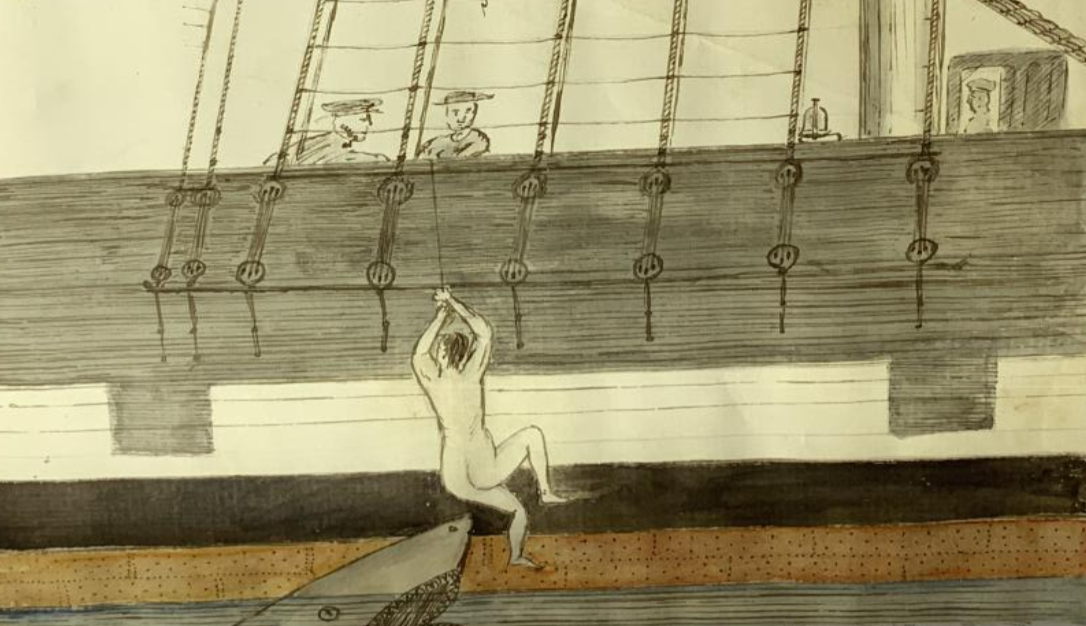
The tale of Henry’s lucky escape was to be told and retold by James Anderson, who had viewed the whole episode from the mast head. Henry later wrote, perhaps to his embarrassment, that “…James Anderson has since then told the story to his wife in my presence, and stated that, seeing the whole affair as he did from aloft, he thought it impossible that I could escape the jaws of that savage monster…”
After a while, they reached the Japan whaling ground. Here they experienced a typhoon that left Sussex almost on its beam-end for six hours with Henry and James Anderson spending most of that time clinging to bulwarks. Taking stock afterwards, they were lucky to find that there was no damage to the ship or losses of the barrels of oil on deck.
While five hundred miles off the coast of Japan in search of whales, Henry found himself in a boat when a large black object was seen. Giving chase, with James Anderson as harpooner, it proved to be an enormous trunk turtle who appeared to be asleep. The poor unsuspecting animal was quickly harpooned but “…the monster seized the rope attached to the harpoon, and nearly severed it with his bill but we quickly dispatched it with a lance and towed him back to the ship…” Henry once again set pencil to paper, drawing this massive creature which he says was seventeen feet from nose to tail and weighing nearly two tonnes. Years later Henry would write to the Leisure Hour, a monthly magazine, describing the trunk turtle and sending a sketch, possibly a copy of this one, that he had made at the time.
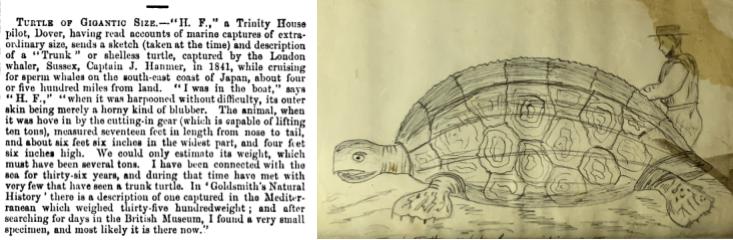
The Leisure hour; an illustrated magazine for home reading March 1876 & Henry’s drawing of a Truck Turtle
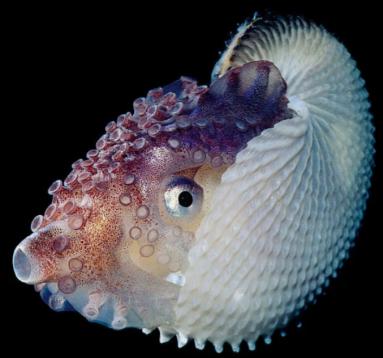
Paper Nautilus or Argonaut
Here, also, he saw numerous large fish named Albacore and Bonito whose shoals were so thick they could easily be seen from the masthead. Taking time off, the crew fished and then traded with the natives, for which they received 50 barrels of potatoes and 20 of onions. Small paper nautilus, which are a type of octopus, the females of which secrete a paper-thin eggcase, were also in abundance in the area.
Leaving Japan, they headed for the Hawaiian archipelago, where, at Maui, Henry writes of water so clear that even at 14 fathoms he could see the anchor chain all the way down to the seabed. On reaching Honolulu, with its large harbour, they were met by forty other whalers and several merchantmen. At the time, there was only one pilot, a Scot named Alexander Adams, who had lived in Honolulu since 1811. After becoming an intimate friend and confidential advisor to King Kamehameha, he was entrusted with command of the king’s fleet of six assorted ships, mainly purchased from their owners in exchange for sandalwood. One, the Forester, purchased from John Jacob Astor, was under the command of Alexander and sent to sell sandalwood to the Chinese in 1817.
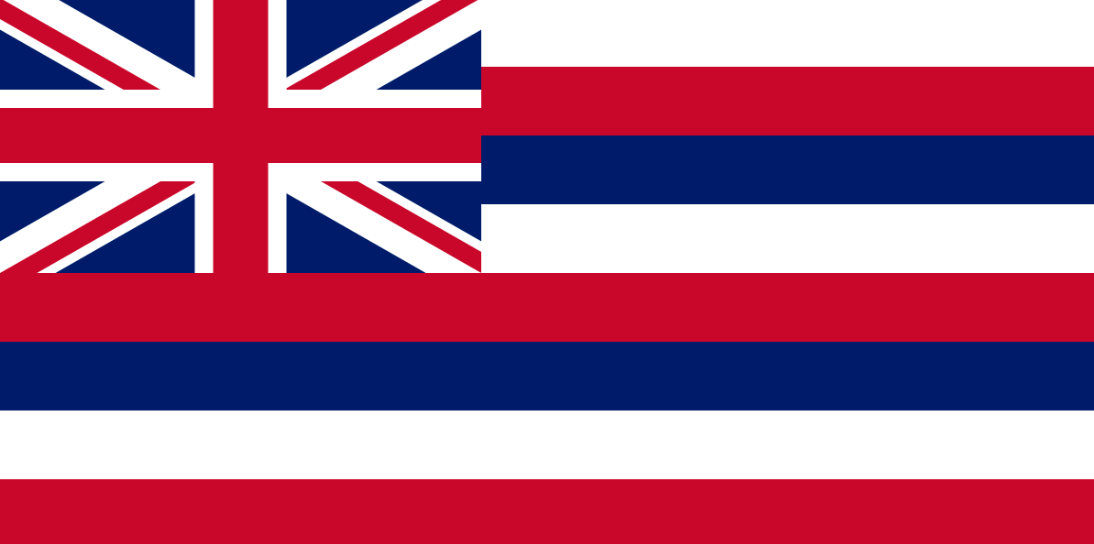 Prior to this, Hawaiian vessels flew the British Union Jack, but with the sandalwood trade increasing, a new flag for Hawaii was needed to avoid any confusion, particularly with the Americans. Alexander Adams was amongst the men, with King Kamehameha, who designed the Hawaiian flag. The British flag was incorporated into the Hawaiian flag as, apparently, Alexander said “…if we don’t pledge allegiance to Britain we may all perish…” This flag is still the island’s flag today.
On his return, Alexander became the first regular pilot for the port of Honolulu, a position he held for 30 years. Entrance to the safe anchorage of Honolulu Harbour was through a gap in the coral reef. Sussex would have hailed Alexander, who kept a lookout for new arrivals, would then row out to them, pulled by a crew of natives, and as he passed the ships in the harbour already safely anchored he would “…ordered them to send 1 or 2 boats to assist in towing the ship in…” Henry describes this experience as one of the “…prettiest sights he ever saw…” with 25 whaleboats at the bow towing the Sussex in.
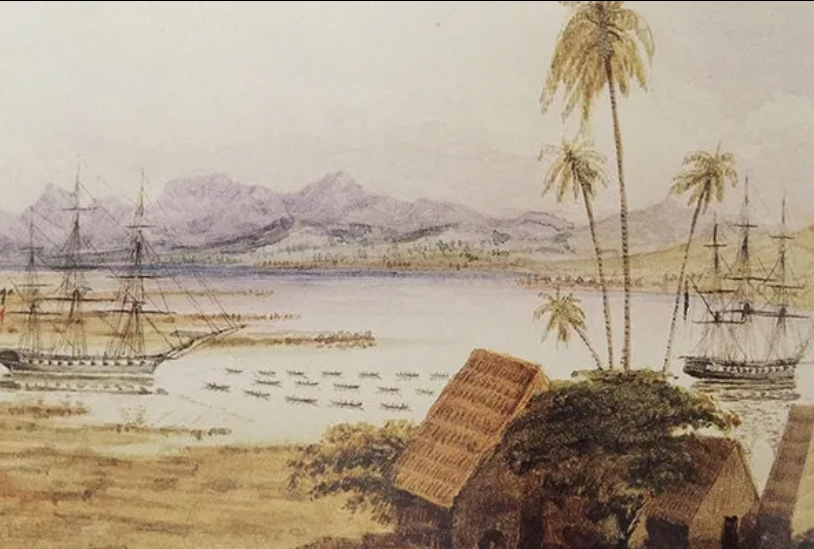
Honolulu Harbour Ships pulled by canoes Henry Walker 1843
Once safely anchored, Henry sought out Captain Wright of the Elizabeth, who had joined Captain Hammer onboard the Sussex. Letters from home were rarely received, but Henry had in his possession one for J Thomas, an able seaman from Deal, who had left London on the Elizabeth. Henry soon found that J Thomas had run away. By the time Henry wrote this in ‘Reminicenses…’ a mail service of sorts had been established due to the emergence of trade between the islands and California. The identity of J Thomas remains a mystery.
After releasing and taking on replacement crew and refitting the rigging, the Sussex made the return journey to the Marquesas. Here they tried to put the Marquesas crew ashore, but the French had taken possession of the island and placed a man-of-war ready to intercept any shipping wanting to enter Resolution Bay. Concerned that arms would be taken ashore, the French captain ordered soldiers to board the Sussex and take up position on the main deck. Captain Hammer immediately went over and boarded the French man-of-war, demanding their removal, threatening to throw the soldiers overboard if his demand was not acceded to, which it was. Henry wrote of his desire to know “…what progress they had made in civilisation since the French rule…” The islands are still a French territory. Henry went on writing about his Christian beliefs, which were very strong. For a young man, from a small coastal town, brought up in the Methodist faith, meeting, seeing and experiencing such extreme differences in culture to his own seems to have left him with an even stronger conviction in the Bible’s teachings.
One of the mutineers, William Benson, was still on the island and, as a French speaker, had managed to find himself in the position of interpreter to the French Commander. This made for some awkwardness for Captain Hammer, but he was obliged to make the best of the situation, especially after the Sussex’s doctor and a Boatsteer had an altercation on shore and were clapped in irons and placed onboard the French corvette. It was agreed that Henry, and another apprentice, would take them their meals. Far from feeling threatened by this, Henry describes it as “…gratifying …as it made a bit of a change…” Once they had made ready for sea, the prisoners were returned.