Follow us on Facebook @FHofDW
Henry Foster
Reminicences of a Sailors Life
Part 8
Cinque Ports & Trinity Pilot
After purchasing charts and books, the next three months were made up of studying and holidaying. Eventually he was called for examination and passed, becoming a Trinity Pilot on December 23, 1856. Mr Shepherd, the Deputy Master at Trinity House, told him he had “…passed an excellent examination and might consider myself in a berth for life, as he assured me it would always be a living…” ‘Reminicences…’
Mr Shepherd In 1856, the Deputy Master of Trinity House was Captain John Shepherd. He was also a Vice President (V.P.) of the Royal National Life-Boat Institution (RNLI) Trinity House Trinity Pilots Trinity Pilots have existed from around 1514, with the Corporation of Trinity House having the exclusive right to licence pilots on the Thames from 1604. Pilots are examined and licensed but not employed by the Corporation of Trinity House. To qualify for a licence, a pilot had to be British, have several years’ experience as a watch-keeping officer of a ship, hold a foreign-going Master Mariner’s certificate (or Naval certificate of service) and be under 35 years of age. His licence was then renewed yearly when his general health, eyesight and knowledge of local waters were tested. 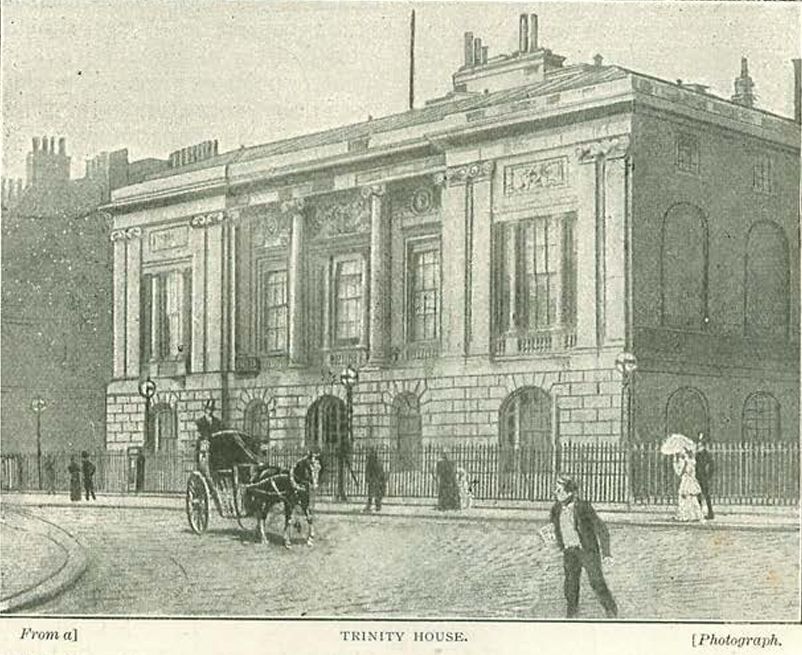

Dover Chronicle January 2 1867
When Henry passed his Trinity Pilot’s examination in 1856, he was thirty years old and had been at sea for seventeen years, had been a mate on foreign-going ships, and a master on his most recent voyages.
Apart from a few scarce remarks made by himself or others, Henry has not left us any real first-hand information about his life as a pilot. So what follows is pieced together from various sources.
The usual pattern of progress for Trinity and Cinque Ports Pilots was to start in Margate or Ramsgate, where pilots manned the offshore cutters. As vacancies occurred, pilots were moved up to Deal and to Dover. The 1861 census records that in Margate there were two pilots and three in Ramsgate. In 1867, the Dover Chronicle printed a list of Dover and Deal Trinity and Cinque Ports Pilots.
Henry spent his first year as a pilot in Margate where Mary gave birth to their first child, a son whom they named Harold, in May 1857. He then spent two years in Deal where, in 1859, a daughter was born. By 1860 they were in Dover where two more daughters and two sons were born.
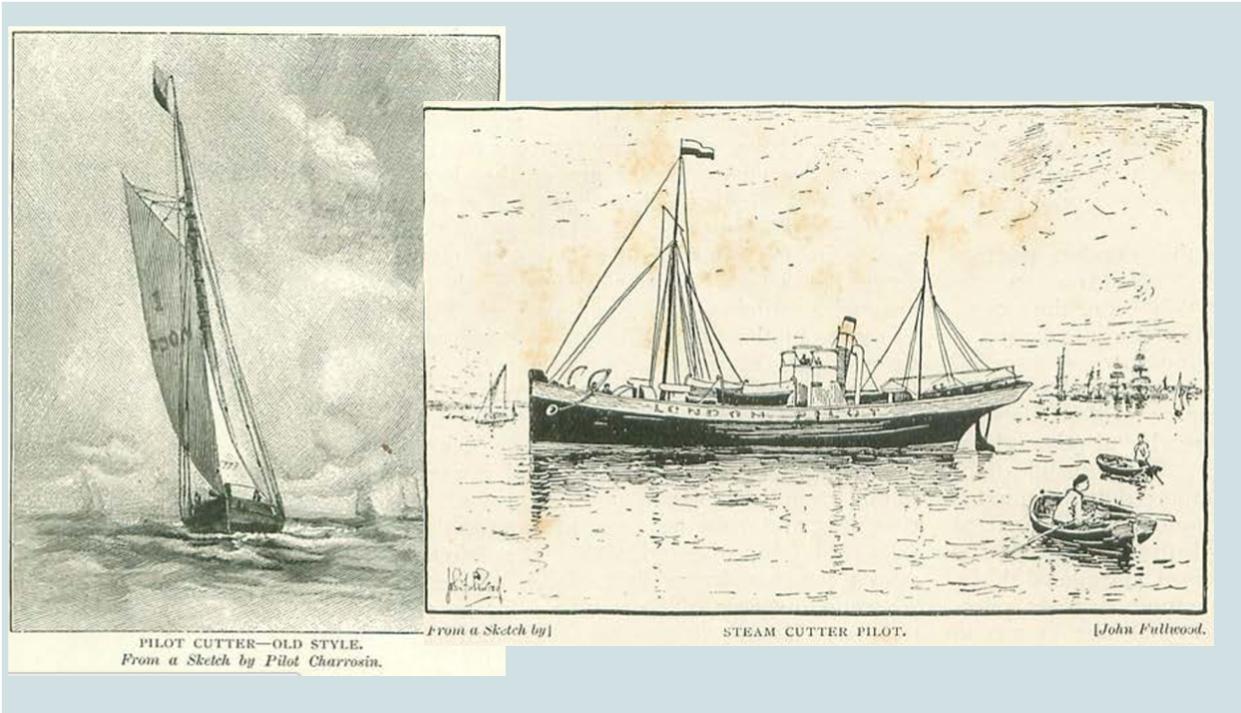
Pilot Cutters
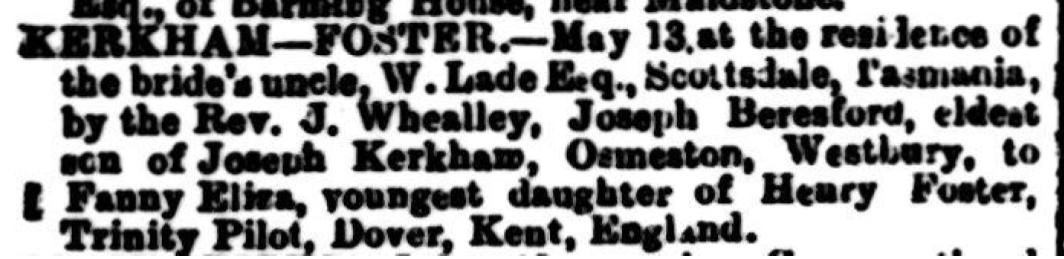
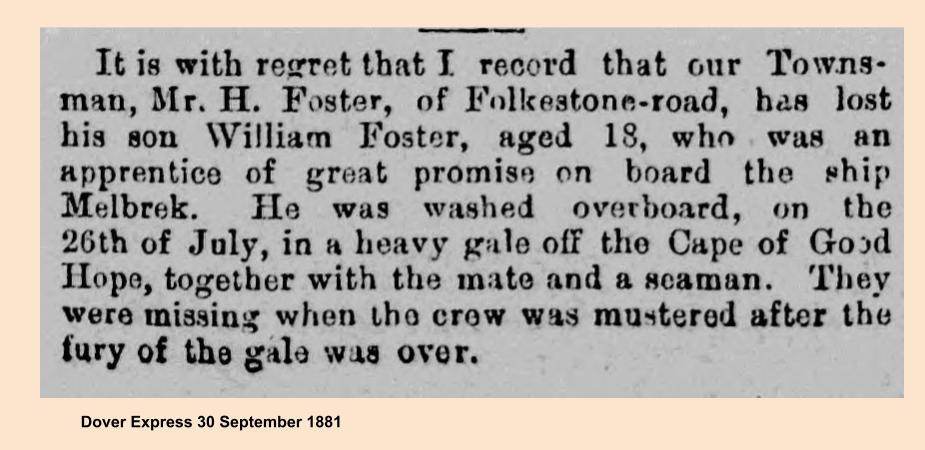
Harold Foster was born in Margate in 1857. He gained his Master’s certificate in 1879 and in 1881 he married Mary Newing Millen. Sadly Mary died in 1891, leaving Harold to bring up their daughter, Ethel. In 1896 he married Mary A. C. Rowe. After making voyages to Australia in the 1890s, Harold emigrated with his family to Australia, in 1901, settling in Petersham, NSW, where he gave up the sea to become a clerk. Ethel remained in England and lived for a while with her aunt Christiana Belchamber. Harold died in 1929 and Mary in 1952. Mary Amelia Macpherson nee Foster Mary Amelia was born in Deal in 1859 and named after her aunt Amelia, known in the family as Milly. Milly was the sister who had first greeted Henry home in 1844 and whom, after her emigration and death in America, he never saw again. Mary Amelia Foster became a teacher and, by the time she was twenty-two, she was running her own school. At the age of thirty, she gained a scholarship at Bedford College, London, from where she graduated with a BA in 1892. Moving to Leeds, Mary became actively involved in socialism and the trade unions. After her marriage to newspaper reporter Fenton Macpherson, in 1896, the couple moved to Paris, where their socialist activities led to Fenton being expelled from France. They later set up home in Blackheath. Mary, with other Labour members and social reformers, sat on the platform during the celebratory meeting held for Keir Hardie, the founder of the Labour Party. Among them were the women’s suffrage leaders, Mrs Charlotte Despard, who spent her early years growing up in Ripple, and Mrs Emmeline Pankhurst. Mary continued to support women and the Labour cause right up until her death in a road accident in 1933. When Fenton died in 1940, he gave £1,500 to the Newspaper Press Fund to provide a pension for the widow of a daily newspaper reporter or sub-editor and, to Bedford College, the sum of £1,500 to fund a prize for an annual essay competition. Christiana Belchamber, nee Foster Christiana was born in 1860 and named after her mother’s sister (who married Benjamin Franklin Foster, Henry’s brother). She married Sidney Charles Belchamber in St George’s Church, Southwark, in 1885. Sidney had gained his first mate’s certificate in 1882 and at the time they married he was still a mariner. However, he suffered sunstroke around this time which left him partially blind for the rest of his life. Christiana, like her sister Mary Amelia, became a teacher and in 1881 she was a governess to the Millen family living in Deal. John Bullock Millen was also a Pilot and it was to his daughter Mary Newing Millen that her brother Benjamin Franklin married in 1881. In 1891 the Belchambers were living in Dover, running a small boarding school. By 1901 they had moved to Lavender Hill, Battersea, and set up a laundry service which, according to the census, they jointly managed. Sidney died in 1940 followed in 1952 by Christiana. Fanny Eliza was born in Dover in 1862 where she lived with her parents and trained as a milliner. Aged 23, in 1886, she emigrated to Tasmania, sailing on the steamship Garonne. She may have gone to live with her aunt Sarah Hudson Clark and her husband William Lade. It was from their residence that she married farmer Joseph Beresford Kerkham in 1891. The couple remained in Tasmania where Fanny Eliza died in 1918. They had no children. Dover Express 24 July 1891 William Clark was born in 1864 and was named after his mother’s father. William followed his father and brothers into a life at sea. Sadly, William drowned after being washed overboard during a gale in 1881. William Clark Foster Benjamin Franklin was born in 1866 and named after his uncle, the printer, who had emigrated to America. He followed in his father’s footsteps and was apprenticed in 1880. He gained his Second Mate’s certificate in 1885 and his Trinity Pilot’s Licence in 1896. In 1905, he married Mary Jane Bartlett. He had an interest in local politics, was involved with the Dover Sea Scouts and served in the Merchant Navy in WWI. He died in 1925 and was outlived by Mary Jane who died in 1942.

Pilot Houses
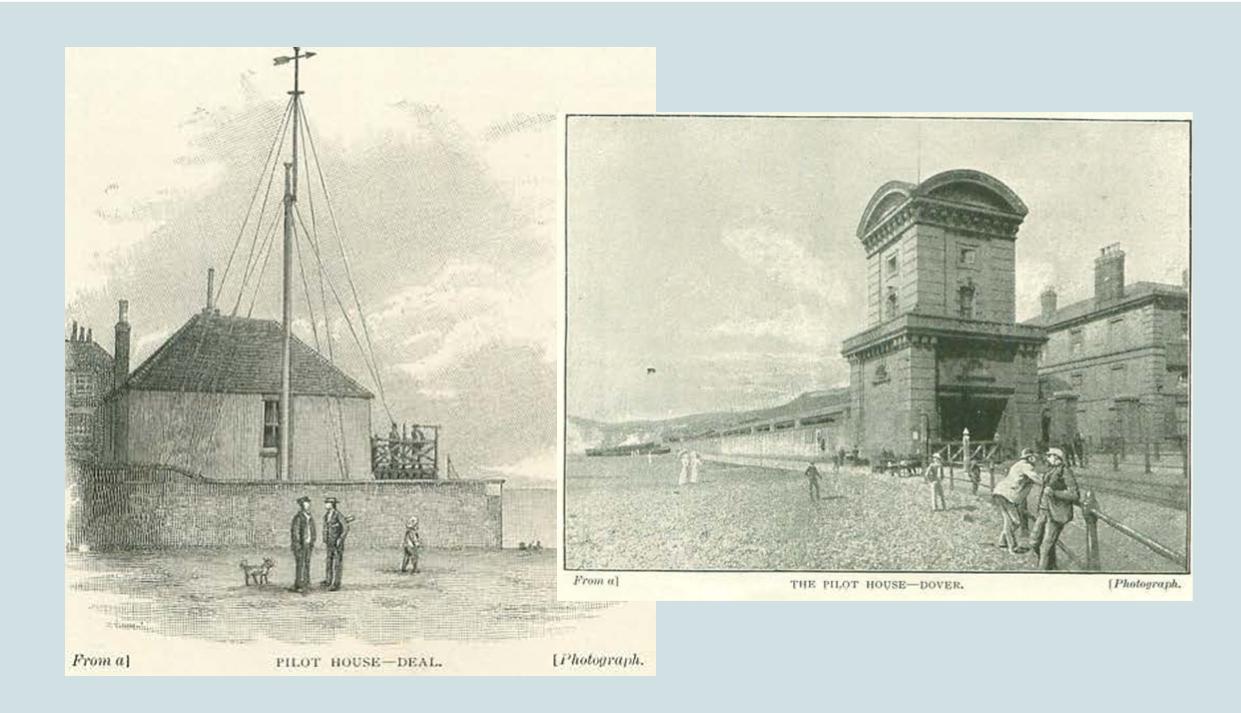
Deal and Dover both had Trinity Pilot Houses, from where Henry, when on duty pilot, would watch for shipping requesting Pilots.
A request was signalled during daytime hours by the flying of a Union Jack on a white background, known as a pilot jack; it was still in use up until 1970. At night-time a blue flare was sent up. Both types of signalling required a pilot on shore, or on a pilot cutter, to keep a lookout for.
Pilot Houses, and cutters, had a rota of men on duty night and day. The Pilot House at Dover had bunks for those waiting to be called out and a lookout room that gave a clear sight in all directions with the use of telescopes or binoculars.
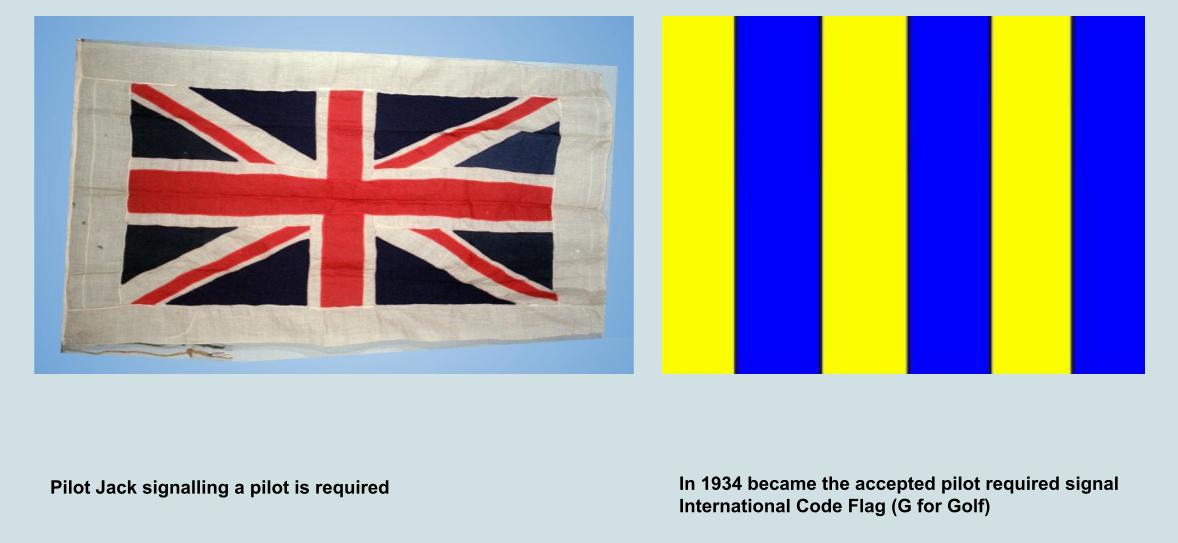
Pilot required Flag
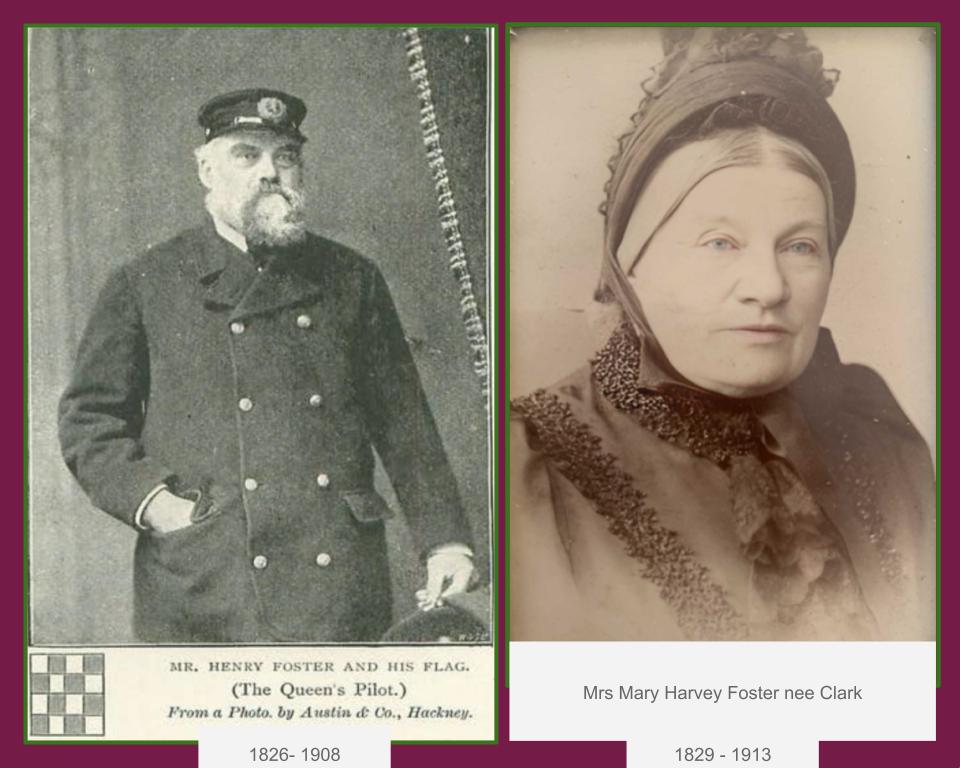
Once on board a vessel, a pilot was required to fly two flags. A red and white ‘pilot onboard’ flag and the pilot’s own personal flag, which was hoisted below the pilot flag. In Henry’s case, this was an easily recognisable design of blue and yellow squares.
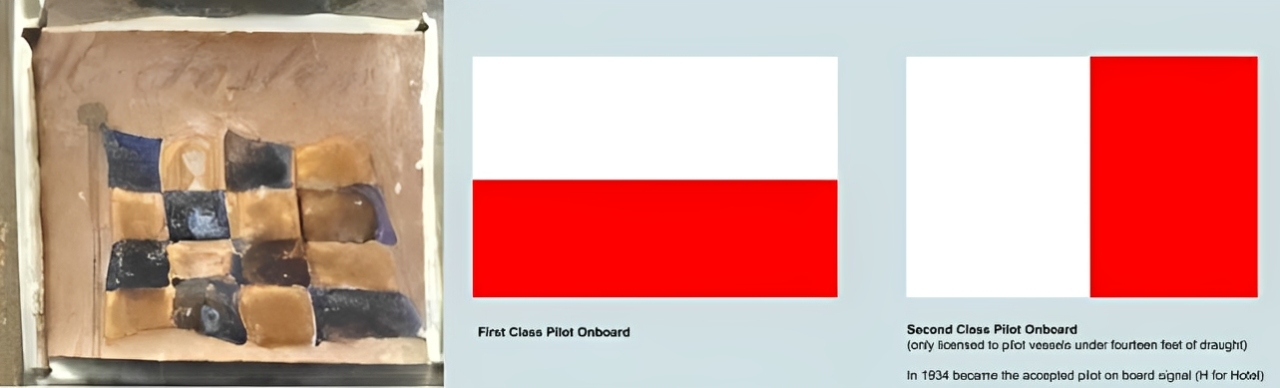
Henry adopted the flag with alternating yellow and blue squares. Deal Museum Pilots Flags DMO-50337
The styles of ‘pilot on board’ flags were in use at least from 1808. White over red entered maritime law in the 1808 act dealing with pilotage. It fell out of use in 1934 when new International Code Signals were introduced. White next to red was used to indicate a second-class pilot and was certainly in use by the mid 1800s when it appeared in William Henry Stanton’s original autobiography written in 1861 and later published as The Journal of a Deal Pilot. In 1934, white next to red became the accepted ‘pilot on board’ flag.
Henry and William Stanton would have known each other and quite probably would have known of each other’s stories.
‘‘Reminicenses…’ was written and ended in 1873, by which time Henry tells us that he had “…Piloted 520 vessels of all sizes and rigs…” He’d had only one serious accident when he’d been driven ashore in a heavy gale in 1862. Quite rightly, he was proud of the fact that he’d never had a complaint made against him, especially as “…very many ships have strong Masters…”
With no misdemeanours or notable actions as a pilot, there is little evidence of his daily life as a pilot. Only one mention of him at work was found in 1864 when on the morning of July 4, he was on the look out at the Pilot House in Dover, when he saw a barque coming from the direction of Folkestone. She was painted green with a white water or Plimsoll line around her. This was the Fernando whose master, according to the Canterbury Journal of July 1864, had refused to take on board pilots on his way up from Dungeness Point where a Deal Pilot Cutter was stationed then again at Hythe, where a Dover Cutter was stationed. On arriving at Dover, pilot assistance was accepted and Henry was taken on board from where the pilotage cost, to London, of £13 7s, had been paid. It is not stated whether Fernando’s master, J M de Akaiba, was trying to save what amounted to 8s, by not taking on the pilots before reaching Dover or not, but, this cost him a total of £2 in fines.
Pilotage Charges With boarding charges of £2 5s, vessels were charged by station and its size. Calculated by the vertical distance from the waterline to its deepest point, this is called the draft. From Rates of Pilotage, with Deductions for Steam, Between London and Dungeness. On and After 5th November, 1862 Rates of Pilotage, with Deductions for Steam, Between London and Dungeness. On and After 5th November, 1862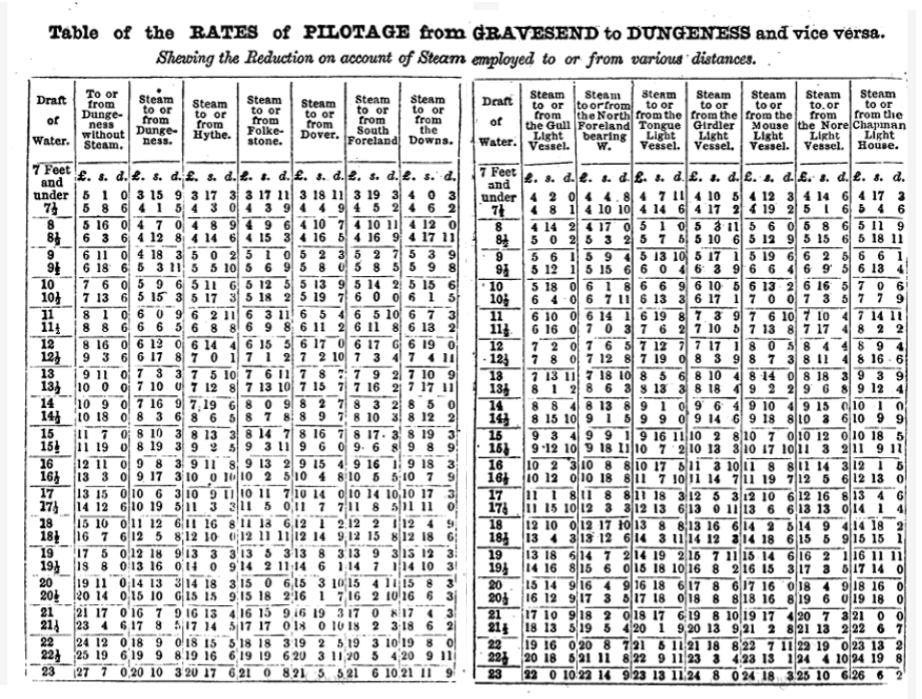
In 1887 Henry was engaged as the Queen’s Pilot, a position he held until he retired in 1899. Articles written about Henry after his appointment, despite it being just a small part of his piloting career, always refer to him as ‘The Queen’s Pilot.’ The royal yacht HMY Victoria and Albert, a 360-foot steamer with a crew of 240, was launched in 1855, was and remained in service until 1900 a year.

The royal yacht HMY Victoria and Albert
Henry in Print
In 1876, Henry was contacted by George Newman, the brother-in-law of his old friend James Anderson. George was asking for his memories of their voyage on Sussex. Henry duly replied, and this was then published in 1877 with the Memoir of James Anderson by G.Newman, as ‘Recollections of a South Sea Whaler’

The publication of his story perhaps led to him being invited to give talks. One such, in 1879, was to the Dover’s Young Men’s Society. His talk, titled ‘A Voyage Around the World’ was aided by charts “… graphically described his life at sea…
In this ‘Recollections’ Henry tells of an incident that does not appear in ‘Reminicenses…’ It is also repeated in Cassel’s Family Magazine’s article titled ‘The Queen’s Pilot’ in 1896 and a newspaper article in 1904. During the typhoon that led to Henry and James Anderson clinging to bulwarks in the Japanese whaling grounds, Captain Barnett, on the whaler Eleanor, badly injured his leg. Depending on which version you read, the Doctor either wasn’t on board or refused to amputate; the carpenter was called for and was ordered to cut off the crushed and mangled leg. During his recovery, the Captain had a lathe brought to his bedside on which he made his own wooden leg. Whether or not Henry actually met the Captain, as was written in Cassel’s version, is not certain, especially as in Recollections he says he had heard the story from Eleanor’s carpenter and chief mate.
This incident, along with those definitely experienced by Henry were later woven into William Henry Giles Kingston’s last book ‘Peter Trawl : or, The adventures of a whaler.’
Peter Trawl
William Henry Giles Kingston spent his early life in Oporto, Portugal, where his father had a business. Being educated in England led to him experiencing many voyages to and fro. His father’s business and social connections brought him in contact with seafaring men, whose company he enjoyed. Later, as an author of adventure stories for boys, he would often seek out such men and visit ports and seaside towns for inspiration. He must have met Henry on a visit to Dover, and it seems likely that the two struck up a friendship. William was one of the founders of The Missions to Seamen and his stories were full of adventure with moral and christian values, so the two men undoubtedly got on. This acquaintance led to William writing ‘Peter Trawl : or, The adventures of a whaler’; it was published a year after his death, in 1881. The adventures of Peter are based on Henry’s time on Sussex and on page 243, where there is an account of a seaman having his leg amputated by the ship’s carpenter. A footnote says “This account is true in every respect. My friend, Mr. Henry Foster, Trinity pilot, vouches for it.”
Retirement
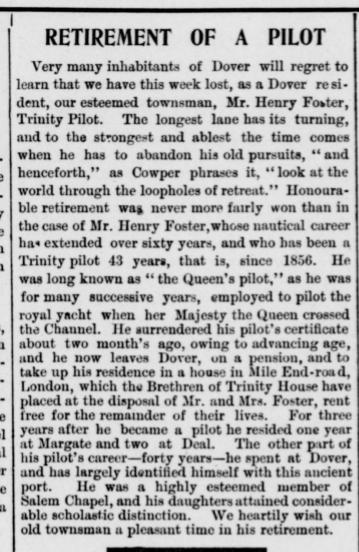
Dover Express 8 December 1899
At the age of seventy three Henry retired from the sea in 1899 and left Dover to take up residence in Trinity Grounds, 28, Mile End Road, the Trinity Pilots Alms House. This was reported in the Dover Express, where interestingly, his two daughters but none of his sons are mentioned.
Henry, like all Trinity Pilots, was self-employed. He would have paid into a sick and pension scheme run for and by Trinity Pilots. This enabled pilots to draw sick pay, a pension, and access to the Trinity Alms Houses as well as a pension for their widows.
In 1904 a newspaper article was published in the Morning Leader, briefly covering much of Henry’s seafaring life. Signed by G. W. It is written in such a way as to appear to have been based on an interview, possibly by the paper’s editor, G. W. Talbot. Along with the oft-repeated tales, the article states that between 1856 and 1899, he had piloted 1,400 boats from Dungeness to Gravesend and served on 20 ships before becoming a ‘Trinity House man.’ Henry admits to have, throughout his whole “… life’s work…”, only ever once felt truly anxious, and that was when he was piloting the royal yacht with Queen Victoria on board on an extremely foggy day. The article ends with Henry telling of how, when he was waiting at Dungeness for a ship, he told a fellow pilot the story of a noseless captain he had met at Rio Grande. When who should be on board the next ship to come in sight but that very same captain!
At some point, Henry and Mary moved from the Trinity Alms House of 28 Mile End Road; they lived there until around 1905 when they moved to 34 Stormont Road, Battersea. Just a few minutes’ walk from their daughter Christana and her family. Here they rented three rooms, sharing the house with Thomas Barnes, his wife Elizabeth and their three teenage children, who occupied four rooms.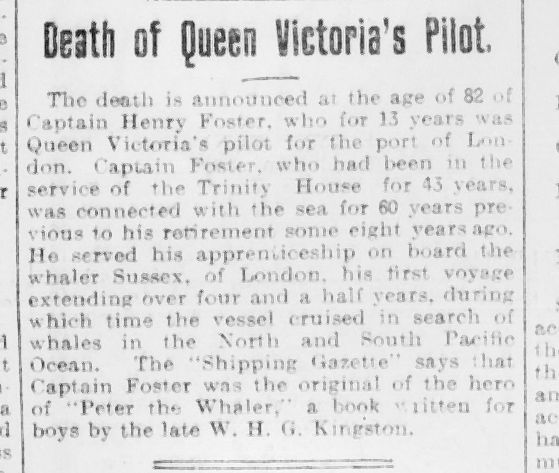
When Henry died there, on August 2 1908, he was primarily remembered as the Queens Pilot with his obituary giving a brief mention to his life at sea and his association with the character Peter in W H G Kingston’s book.
Mary survived her husband by five years; they had been married for fifty-six years. After his death she took in a lodger, a 54-year-old dressmaker who was born in Dover named Eliza Davis. It may be that they were old friends or simply acquaintances, as Eliza’s father was a master mariner sailing colliers. Until both her parents’ deaths, they had lived on Dover’s High Street.
It seems likely that Henry kept a journal, as ‘‘Reminicenses…’ is far too detailed to be written purely from memory. The Strand Magazine article, written by Alfred T Story in 1896 suggests that Henry lent W H G Kingston “…his journal…to draw from as he liked…” Could this have been a ‘journal’ or a copy of ‘Recollections of a South Sea Whaler’
We know that the final entries are based in 1873, but we don’t know for certain when either our first chapter or the full copy edition held by Dartmouth College in the USA were written. We assume our chapter was an abandoned second effort.
Perhaps the publication of ‘Recollections of a South Sea Whaler’ encouraged Henry to write and illustrate ‘Reminicenses of a Sailor’s Life.’
Whatever the circumstances for Henry writing ‘Reminicenses:…’, we are very grateful to Sally Bundy for giving us the ledger containing the first chapter, as, without that, we would not have found out about and been able to share the story of this remarkable man, Henry Foster.