Follow us on Facebook @FHofDW
Henry Foster
Reminicenses of a Sailors Life
Part 7
Boatswain on Cross Channel Paddle Streamers
After discharging their cargo, they engaged a tug to tow them to Cardiff, which saved on the expense of ballast. From Cardiff, they set sail with salt for Lisbon, then back across the Atlantic to Rio Grande. With no hides available there to bring home to England, they took on a cargo of hair; though whether that was horse or human Henry does not say, both were imported into Britain at the time. The lighter cargo meant for a faster home voyage, during which time Henry made up his mind to leave the Sussex Lass, wanting to become a pilot.
Once the cargo was discharged in Plymouth, he headed home, taking the Dublin Packet ship, Foyle, for London, from where he made his way home to Deal. After being listed as a candidate for the Cinque Ports Pilots, he spent some time with his family and, no doubt, his future wife Mary Clark.
Not wanting to be out of work, he returned to London where he took a berth as a boatswain on the Greenwich-built ‘City of Paris’ paddle steamer. The steamer was built to serve the London to Boulogne route carrying passengers and goods and was used to carry goods for the Great Exhibition of 1851. As the exhibition was held between May and October and Henry joined the steamer in February, remaining with her until October, it is quite possible he was boatswain at the time, though he makes no mention of it.
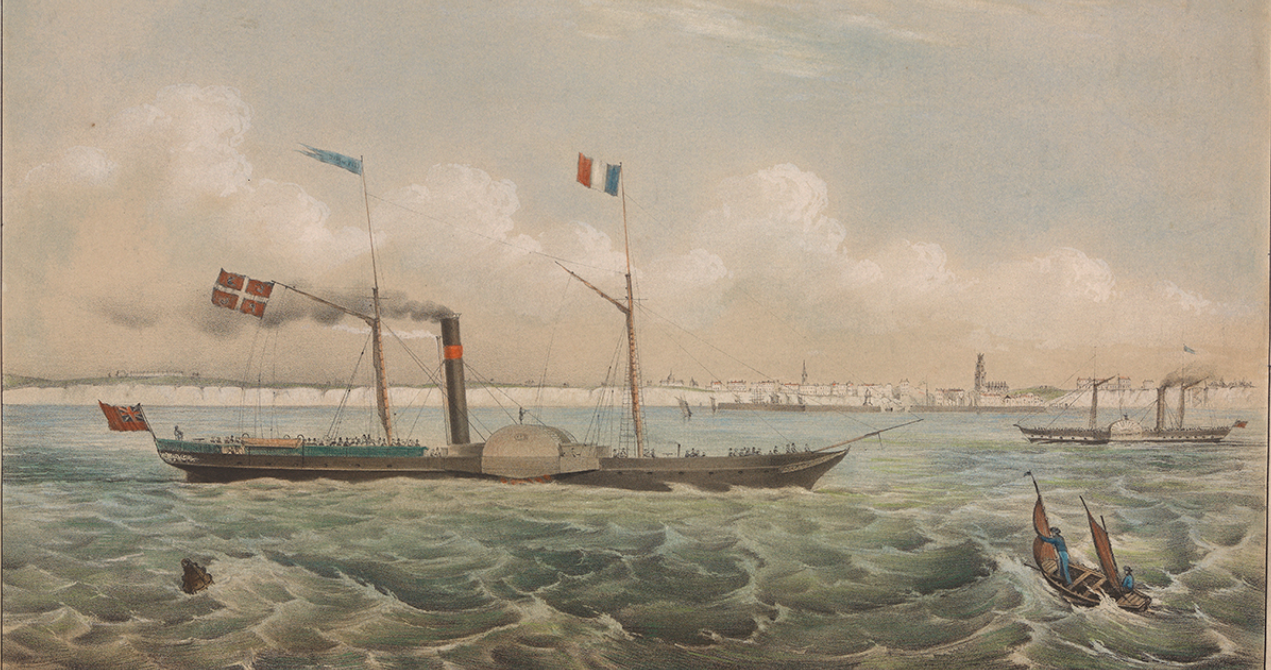
City of Paris from a print
The City of Paris made two voyages a week with four different lots of cargo as well as passengers being loaded and unloaded; “…it involved a great deal of work…” The Captain was, Henry writes, “…a grumbling old fellow, whose chief accomplishments were wearing a gold band, and getting drunk…and the biggest dolt at handling a steamer…” Despite this, he was very popular, which Henry puts down to landsmen who were taken in by his boasting.
Hearing that there was an opportunity to become a Cinque Ports Pilot, Henry, on October 13th, proceeded to Dover, but he did not get called for an examination. Feeling disappointed, he went home to Deal. A year later, in 1852, the Duke of Wellington expressed his desire for all remaining candidates on the list to be placed on the Trinity list. Hearing of this much later, Henry writes, “…had I been aware of this I could have been made Pilot 4 years before…” There is no actual evidence to prove the Duke actually expressed this desire, but he, as Lord Warden, had taken personal control of the Cinque Ports Pilots and resisted changes to their organisation. His death, in 1852, allowed the government to put the Cinque Port Pilots under the control of Trinity House.
Not wanting to be idle, Henry travelled back up to London but found his position on City of Paris taken by another. He soon found a berth on the City of Boulogne, another paddle steamer of the same company. He remained with this vessel until April 1852, when Captain George French of the Sussex Lass contacted him to ask if he could recommend a mate to him. Henry immediately offered his own services, but in the same letter he wrote, “…I should get married first…”
Although he did feel that his “…prospects of keeping a wife were not very splendid…”
and he thought he “…might never get a pilot’s licence, so determined to get a master of a ship as soon as possible…” He could not, he said, afford a splendid wedding but had at least saved a little from his wages.
At this point in ‘Reminicenses…’ Henry dedicates almost two pages to the topics of saving and avoiding debt, and on what the scriptures say about such matters. From Romans 13:8 he quotes, ‘Owe no man anything’.
Marriage and Schooner Dispatch
On 9 August 1852, at Eythorne Chapel, Henry married the young woman whom he had determined to marry when first he set on her. He does not say anything about the wedding or the family that gathered, or even if there was a celebration afterwards, only remarking, “…just married or spliced as the nautical phrase goes; well, I went down to Rye wife & all & joined the ship the next day…”
This ship was a schooner named ‘Dispatch’ and once fitted out the Captain, Richard Bament, gave Henry part of his pay to navigate the vessel and set out for Llanelli in Wales. Arriving there a week later Henry had an attack of cholera and, possibly due to the onset of low blood pressure “…fell down on deck…” Luckily he soon recovered.
On arriving in London Dispatch was chartered to take eight passengers and a steam engine to Fayal in Portugal. Henry lists the passengers as two labourers and their wives, a Portuguese gentleman, an engineer, presumably for the steam engine, the Consul at Fayal, who was the American Consular General, Charles William Dabney, and his sister.
As the Dispatch wasn’t designed for passengers, a rough cabin in the hold was hastily built for the male passengers, Henry and the Captain, so that the ladies could occupy the cabin used by Henry and the Captain.
Arriving in Fayal Harbour Henry was greeted by the familiar sight and aroma of a whale being boiled out. Also in the harbour was the Eliza Cornish which had been seized by Chilean convicts in the Straits of Magellan in April. After her recapture she was brought into Fayal rather than an English port as she was so badly damaged. Her remaining cargo including silver and gold was then offloaded and returned to England and the ship was later condemned.
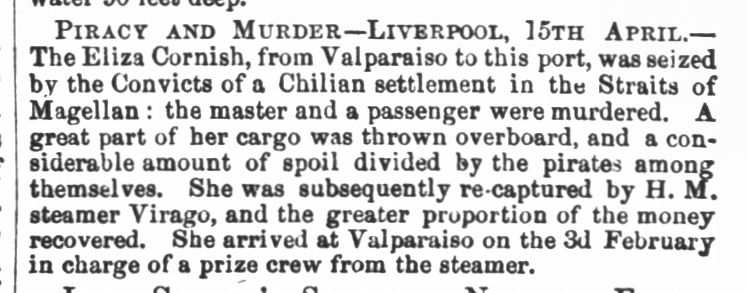
Glasgow Chronicle 21 April 1852
After offloading their cargo, Dispatch headed back to London from where Henry, as mate, made further voyages to Shields, St. Michaels, Hull and Rye, followed by several more to French ports and to Spain. Heading home from Malaga with a cargo of raisins and figs, they had atrocious weather and for twenty-five days the ship’s pump was in continuous use. By the time they had reached Liverpool, the storm had carried away the bulwarks, the wheel and the mate’s cabin skylight. Henry was in the cabin at the time trying to put on dry clothes as he’d “…been wet through for a week…” at which point the skylight was ripped off and the cabin filled with water. Henry dived under the table until the initial force of water and debris had subsided. With the water being too deep to open the door, he found the hatch and managed to open it, sending the water into the hold. Rushing up onto the deck in nothing but his ‘drawers’, he found the Captain washed over the side hanging onto a stanchion and another man holding fast onto what was left of the wheel, with others generally hanging on to what they could for dear life. As the storm calmed slightly, they began to put to rights what could be done, rigging sails and covering over the cabin roof to stop more water from flooding the cabin. The pump was once again called into action and, after four hours, much of the water had been ‘sucked out’. The Captain was so ‘knocked up’ that he took to his wet bed until they finally reached Liverpool.
Henry was determined to have a good night’s sleep in a dry bed and slept right through into the next day. Once the cargo had been offloaded, Henry writes: “…I went and got passed as Master under the local board, which I did without any difficulty…” The examiner of navigation was John Thomas Towson, who was the author of ‘Tables To Facilitate The Practice Of Great Circle Sailing…’. As Henry specifically mentions this, it must have been useful, if not of interest, to him.
Mate on the West Indiaman, Jamaica
John Thomas Towson then offered Henry the position of Chief Officer of a newly built steamer. The discovery of gold at Lewis Ponds Creek, New South Wales, in 1851, made by Gosport-born Edward Hammond Hargraves, had sparked the Australian Gold Rush, and prospectors from right across the world headed for Australia.
Despite the £20-a-month wages, Henry declined this position as he could not take his much-loved and long-awaited wife with him. Arriving in London, he “…shipped on board Henry Ellis, an Australian clipper ship, as chief mate bound for Melbourne for three years…” However, after Henry’s offer to go out for no wages, provided he could take Mary with him, was declined, he left the ship.
Never out of work for long, he found a mate’s position on the Jamaica, a Bristol-built West Indiaman which had been trading constantly to Antigua for thirty years. Typically, Henry gives a description of his new captain, Joseph Sowell, whom he says was the “…biggest old fidget that I had ever to do with…” and, as such, he “…was determined to put up with any amount of humbug rather than not have a berth…”
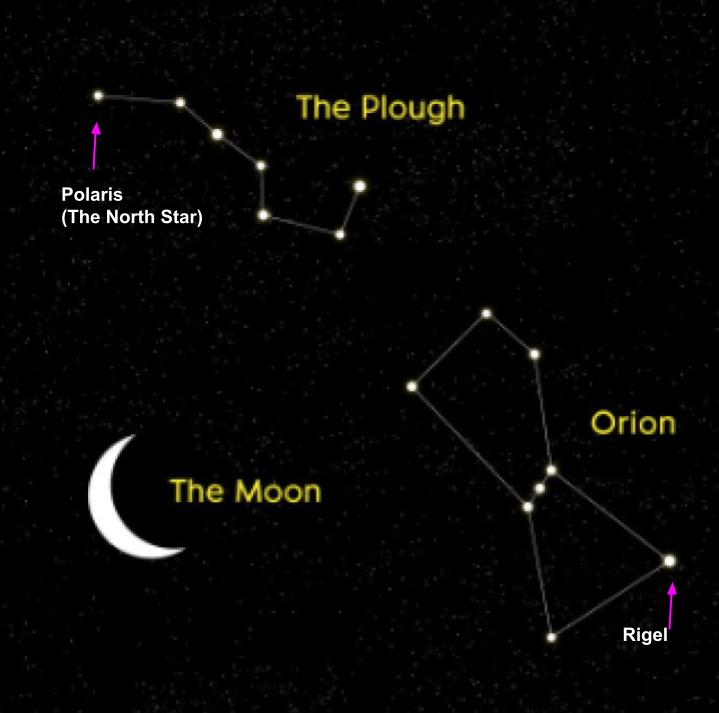 The first voyage was a “…teazer and no mistake…” It was by then December, and in the Channel they hit gales. Not sure if they could weather the storm and reach the Scilly Isles, Henry approached the Captain, who was ill in bed at the time, and offered to run the ship into Falmouth if the storm continued. After hesitating for some time, Captain Sowell asked, “…how will you find your position?…” Henry, being a competent navigator, had been watching the stars and replied, “…by the star Rigel, which I can see occasionally…” Captain Sowell was totally astonished and would not put any confidence in the stars at the best of times. Henry, though, showed him his observations, which were ‘Long. by Rigel (chronometer) & Lat. by Polaris’. This gave the Lizard NNE 24 miles. He must have relented as, the coordinates proving correct, Henry had them safe in Falmouth by midnight. The incident proved to Captain Sowell that he could have confidence in Henry’s knowledge and seamanship. Three weeks later, Jamaica arrived in Antigua.
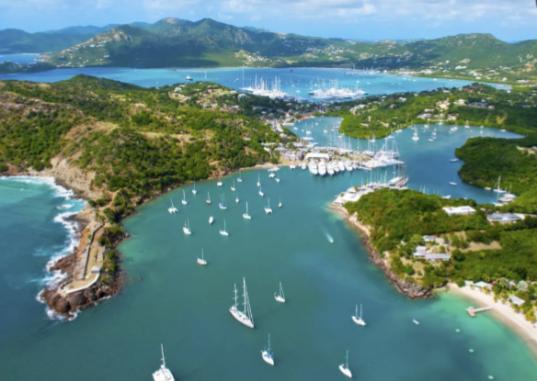
English Harbour Antigua
Here the arrival of a black Antiguan pilot amused Henry, whom he described as shipping alongside the Jamaica in his pilot’s boat which were “… called ‘Bermudian’s’ from the Bermuda Islands…” Ropes were thrown down to him and he “…immediately jumped overboard telling his boy to shove off and run after the ship…” Reaching the ropes, he climbed up onboard; his clothing was “…all rags and tatters, but the rags were snow white…” in sharp contrast to his black skin. Taking his straw hat off, which had somehow remained on his head, he asked the Captain for a ‘Dose of Salts.’ Henry took this to mean rum, but Captain Sowell literally interpreted this and ordered him a strong dose of Epsom salts. He was not phased at all by this offering and simply stirred the drink with his finger and downed it in one. The resulting effects Henry described as “…being uglier than was by nature…”
The pilot gave the order to “…fill the main-yard…” and they headed into English Harbour, one of Lord Nelson’s favourites in the area.
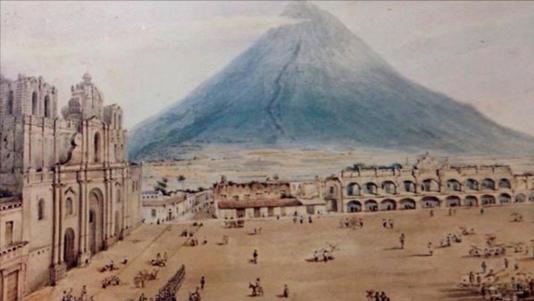
George Ackerman; Regina Wagner, Public domain, via Wikimedia Commons Antiguaguate 1827
The harbour Henry writes had a “…splendid dock-yard with every appliance for repairing ships, splendid stone quays …” most of which along with the Cathedral were nearly destroyed in an earthquake in 1833.
While walking around St. John’s City, Captain Sowell led Henry to a point he called Ship’s Stem, from which Sandy Island could be seen. With its few trees, the island was some 5 miles from the point. Captain Sowell told Henry of the Wesleyan Missionaries and their wives who were wrecked on the island. After several days, the surviving men tried to swim to St. John’s but were attacked and eaten by the sharks that infested that area of water. Mrs Jones, the only survivor, was taken off the island by a passing vessel. By then, she was suffering from hunger and exposure. This event had even reached Deal, as Henry remembered being told of it when he was a boy.
The story of the sharks seems to have been added to this story, which appeared in the British newspapers following Mrs Jones’s rescue. The true events were even more tragic. The missionaries were returning from a synod and were on board the mail boat Maria when it was wrecked on February 28, 1826. Those that drowned were Rev. William White with Mrs White and three children and an unnamed servant; Rev. Thomas Truscott and his wife with one child; Rev. Daniel Hillier; and Rev. William Oke.
The Evening Mail reporter, in April 1826, told of how Mrs Dorothy Jones, who was the sole survivor, had her infant child swept out of her arms and then later how her husband, Rev. Thomas Jones, had died in her arms.
They remained in St. John’s for six more weeks, during which time Henry only saw the Captain once; communications and orders between them were carried out by notes handed to Henry every morning which he tried to carry out to the best of his abilities. But Henry was obviously not satisfied and was determined on a Master’s position.
Henry writes of St. John’s of the sugar being brought on board and “…secured by Blacks and a black cooper who was also employed for the molasses, which casks are stowed empty, and filled with a hose from the deck…” He also writes that poultry and fresh pork were cheaply purchased here and the best green turtle could be bought for 3d a pound. Pineapples too were plentiful and that fish called snappers were easily caught in wicker cages or fish-pots. Snapper was also the name of the small-rigged schooner boat that they used to fetch their cargo; it could carry about twelve hogsheads of sugar at a time.
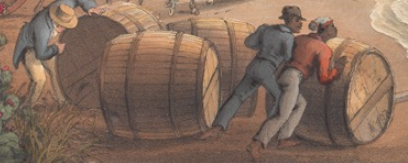
Section of Carting and putting Sugar-Hogsheads on board (1823) William A. V. Clark (English, 19th Century)
Snapper was left in St. John’s and the rest of the cargo was bought from other parts of Antigua and brought out to Jamaica “…by small sloops manned by blacks…” Antigua had abolished slavery in 1834, so it can be assumed that the men Henry refers to as ‘blacks’ were either former slaves or children of slaves.
In total, Henry made six voyages onboard Jamaica, sailing twice a year; after the second voyage, Henry began to expect that he would be given charge of the vessel. After the fourth voyage, Henry returned to Deal for two weeks. Every day he looked for a letter to arrive asking him to take charge. When a letter finally arrived, it was a request to return to London to commence loading as usual. “On arriving in London to his “…utter astonishment, I found a gentleman, Capt Culverwell, appointed to the command…” This was too much for Henry to take and not being able to keep quiet any longer, he told the new Captain in the presence of the old . “…the whole story from beginning to end…” Capt Culverwell said nothing when he had finished, but Captain Sowell looked very black in the face as Henry walked away down the quay. Here he got talking to the Captain of a vessel called Talavera, and his wife, who asked Henry what vessel he was on. When Henry told him, he replied “…What! Four voyages with old Sowell. I never knew a man to go second with him…” Henry was then offered a position on the Talavera, which he describes as a “…beautiful new clipper of about 700 tons…” The pay was better too, at £2 more than on Jamaica. However, Henry had a vague feeling he would not go to sea on this ship.
After about a week, Henry found himself walking by Jamaica when Captain Sowell spotted him and beckoned him onboard. “…I went onboard…” he said “…wondering whatever was the matter as he seemed half crazy…” He had that day been looking everywhere for Henry as Captain Culverwell was ill. Henry goes on to say that this was not exactly the case, as he was a man of independent means and, after hearing Henry’s story, told Captain Sowell he would not stand in Henry’s way and told him to give Henry the charge of Jamaica. Captain Culverwell was probably Timothy Thomas Head Culverwell.
Going home to Mary that night, he felt “…considerably elated…” and she could hardly believe this herself.
The next morning, at Mr Manning’s, the owner’s, office, who Henry describes as a perfect gentleman, asked him if he was acquainted with any of the merchants on Antigua. As Captain Sowell had not introduced him to any merchants at all Mr. Manning quite correctly pointed out that this would be a “…great disadvantage going there as an entire stranger…”
So it was suggested for this one voyage Henry should go out with Captain Sowell who would be “… given strict instructions to introduce me (Henry) to everybody I was likely to have to do business with…” For Henry, this voyage brought a considerable increase in pay which easily compensated for his initial disappointment of not being immediately made Master or Captain of Jamaica.
On arriving back in London from Antigua, Henry’s dream finally came true as his name was placed on the ship’s register as ‘Master’ of Jamaica.
One day while walking past the London dock entrance Henry was once again to cross paths with James Anderson. Apparently, James took some convincing that Henry was “…the boy Harry…” he had known on Sussex. Eventually suitably convinced he spent the following Sunday on board Jamaica where Henry introduced him to his wife. After this the men kept in touch becoming firm friends.
Master of Jamaica
Mary had not been well, though Henry does not say what ailed her. So, on the next voyage he took the opportunity of taking her with him which brought, he says, “…beneficial results, as she was never seasick…” Mary took an interest in the two young passengers, sons of Mr. Thibou, a merchant of Antigua. The Thibou’s were an old-established family on Antigua who, as well as being merchants and sitting on the governing bodies of the island, still owned sugar plantations. Frustratingly, Henry does not say which member of the family this was but, to show his appreciation for the attention given to his sons, this Mr. Thibou invited Henry and Mary to dine with his family and kindly announced that “…whenever they were on the island a place would always be laid for them…” This was convenient for them and other such invites from other merchants were also given. Henry’s honesty, geniality and kind nature now stood him in good stead, leading to him being able to secure a good cargo. He went out and met the planters who, like the merchants, were very hospitable but “…living considerably above their income…” Some of the planters kept harking back to the splendour they had lived in when slavery existed and did not now want to work or be satisfied with what was essential rather than living beyond their means. “…I offended a few of them …” writes Henry, who expressed his view that “…slavery now happily was done away at the emancipation…”
As was usual with Henry, he writes about the religions of the places he visited. In Antigua, he says that the Moravians far outnumber any other denominations. On one occasion he was invited to tea at the Wesleyan Mission and “…was struck with astonishment to see what they had to endure… There was an immense hall…” in which he observed “…children dressed as if going to a ball with a black servant to each…” The furniture, which included ottomans and “…a Piano at each end…was generally luxeriant…” Henry describes the hall as being canvassed, which perhaps refers to the use of mosquito nets made of Scottish Lawn or other lightweight materials that were commonly used during this period.
Henry was not impressed by what he saw. He wondered what the poor Christian people back in England would have felt if they knew their pennies, given “…from their penury…”, were being used “…to support the splendour (for it was that) thinking it was to keep the poor missionaries in comforts really necessary…” Despite these reservations, Henry did not want to detract from the good that had been done.
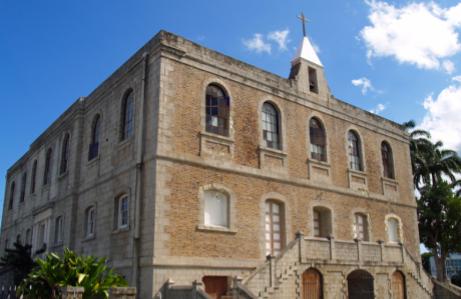
Ebenezer Chapel, St. Marys Street St. John’s Antigua
Henry gives us no clue as to which ‘Hall’ he is referring to. A likely place is the Ebenezer Chapel, built in 1839 on St. Mary’s Street in St. Johns which, after being damaged in an Earthquake in 1843, had recently been refurbished. As for the Wesleyan Ministers whose invitation he accepted there were, according to the 1851 Antigua Almanac, three on the island, John B Selley, Joshua Jordan and Theophelus Gregory so Henry could have had tea with any or all of them.
Of the Moravian Church elders Henry described as a ‘simple and godly body of men’ who did not waste a thing and had nothing that was not necessary “…the contrast was indeed great…” compared with the Wesleyans who did not have a Secretary to keep the accounts. All in all he felt them to be “…a good and consistent body of Christians…”
After spending one month on Antigua Henry and Mary set sail for home with eight passengers which included several children being sent to England to be educated. Heavy weather accompanied them most of the way home with many of the passengers being seasick. Mary though was unaffected and “…seemed to enjoy it…” On the nights when Henry could not leave the deck she would join him “…rigged up in oil skins & S. Wester amidst thunder, lightning rain & hail…”
Reaching home after thirty days at sea, on July 13 1856 Henry would later proudly write that he was now established. The money he earned as Master on that voyage was almost doubled due to the additional fees awarded to him from the £5 per head the owner received from the passengers. The owners were pleased Henry had just brought them the best freight and quickest voyage home. He no doubt would have continued to do well for his employers, but on arriving home he found that Trinity House had been asking for him, “…wishing him to come up for examination…” Henry hardly knew what to do for the best, having wanted both the position of Master and of Trinity Pilot for so long. But after finding that Mr. Bingham, the mate, had miscalculated the molasses cargo, leading to Henry, who trusted him, signing a bill of lading for “…7 puncheons of Molasses more than was on board…” Mr Bingham, at the time the error had been discovered, had already been paid off, leaving Henry to deal with the discrepancy. As Captain Sowell had employed Mr. Bingham in the first place, Henry blamed him for being tricked into the error or has he put it “…mulcted of £35…” Feeling angry, Henry gave up being Master of Jamaica.