Follow us on Facebook @FHofDW
Henry Foster
Reminicenses of a Sailors Life
Part 6
Mate on Anna & Sophia , Commodore & Sussex Lass
Henry soon found another mate’s position on a brigantine, Anna & Sophia, then lying in St Katharine’s Dock, but his “…stay on board did not last a week…” The outgoing mate told him that the master was ‘tyrannical’. This was Thomas Stephens, and Henry soon found him to be worse than he was portrayed and had been found guilty of a crime “…unfit for me to mention in these pages …” Needless to say Henry, who described him as a villain, did not sail with this man. Unfortunately, Henry gave no indication of what this ‘crime’ was, only saying “…I won’t waste any more paper on such a wretch…”
Despite being told by Thomas Stephens that if he could help it Henry would never find another berth of any kind, that very day he found a position on a brig called Laetitia, whose captain was named Scott and whose wife was sailing with him. No further information can be found about the vessel or Mr and Mrs Scott, but we know that Henry left them a week later despite their kind natures, in stark contrast to Captain Stephens.
James Greenaway approached Henry directly and offered him the position of mate onboard a ‘foreign-going’ barque named Commodore. This captain also only had coastal experience and, after much persuasion and with the agreement of Captain Scott, Henry took the position, one that he almost immediately regretted.
Captain Greenaway was refused the foreign freight, so had to continue with the coasting trade. The first trip with Henry onboard was to Guernsey for stone for London. Captain Greenaway seems to have been out of the same mould as Captain Nathaniel Hocker. “…I never could give satisfaction, so the less I say the better, but I was determined to stay until I could get a better berth…” After a few months Henry met with “…an old Gent Master…” named Captain George French. He had formerly been with Greenaway, so easily sympathised with him. Having gained the command of a schooner named Sussex Lass that was bound for Constantinople (Istanbul) and the Black Sea, he offered, and Henry gladly accepted, the mate’s position. So in August 1848, Henry made his way to Rye to join Sussex Lass, from where they proceeded to Cardiff to take on iron for Constantinople. Forty-four days later they arrived at St. George’s Island (Agios Georgios) where they weathered “…the heaviest squall … it lasted about half hour…” before heading up to the narrow straits of the Dardanelles, entering through the passage between the Turkish mainland and the island of Tenedos (Bozcaada). Henry reports that they had a good run through the straits, anchoring off Gallipoli before heading on through the Marmara Sea, which Henry says is remarkable for its few dangers and safe to navigate in all weathers.. Of Gallipoli he writes, “… it is a place of considerable trade as olive oil & other exports…”
As they approached Constantinople they took on board a Maltese Pilot who conducted them into the Golden Horn, the horn-shaped inlet of the Bosphorus Straits which connects the Marmara Sea with the Black Sea. The rules of pilotage and the harbour were “…simply abominable… there seems to be no order or anyone in the shape of a Harbour Master…” As such two vessels could lay claim to one berth for discharging their cargo with the result that the larger vessel would force its precedence. “… I could not help thinking what a splendid harbour this could be made, should any other nation gain possession of it…”
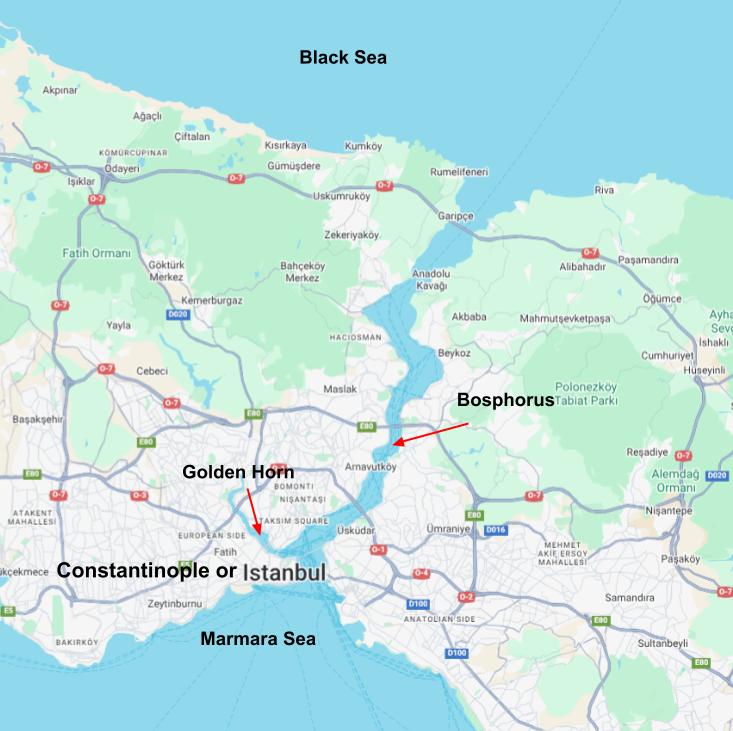
Before travelling up the Golden Horn Henry gave his impression of Constantinople “…or ancient Byzantinium…many who have visited it describe it to be one of the grandest sights in the World…” Henry was not that impressed, even though they arrived at the most favourable time and he describes how the “…rays of rising sun striking on the gilding of the minarets and domes of the mosque certainly gives it a most splendid appearance…” Once on land the illusion soon vanishes when walking through the streets and Bazaars. “…Such scenery is not to my taste , when I compare it and all other works of Man, they sink into insignificance when put alongside the Andes Mountains, or Mouna Roa in the Sandwich Islands….”
Once safely anchored in the harbour, Henry, ever the explorer, took a small boat as far as he could go up the Golden Horn, confessing that it was one of the prettiest places, with splendid palaces with marble steps descending right down to the water.”…the water alive with Kaiques cutting about in all directions giving life and animation to the scenery but as soon as one lands all the beauty vanishes…”

After discharging two-thirds of the cargo, they left the Golden Horn and proceeded on through the Bosphorus, into the Black Sea and on up to Galatzi on the River Danube. They had engaged a Greek pilot at Constantinople whom they obviously put their trust in. However, they soon found out this trust was misplaced. On entering the Sulina Branch of the Danube just north of Sulina itself, Sussex Lass ran aground on a sandbank. The ebb and flow of this stretch of river caused the build-up of sandbanks, or shoals, so the engagement of experienced pilots was a necessity; many ships’ captains preferred to use the local Sulina based, though uncertified, pilots rather than those based in Constantinople, as they knew the ever-changing conditions of the river. Eight years later work began to deal with the problem, but that was in the future and, unfortunately for the Sussex Lass, she was stuck on the bank in a position where the river would not rise enough to help get it off. After running out an anchor to the stern to keep from rotating on the bank, the crew started to move the remaining cargo out of the bows. The pilot was hoping to get his cousin, who lived in Sulina, to bring his boat to help lighten the Sussex Lass’s load; perhaps this had happened before! However, this was not to be and after a long night the crew, with the pilot determinedly not helping, had moved the cargo to a position that enabled the bow to be released from the bank before they, using the ship’s boats, could start to tow her off the bank. “…we had ten hours hard at it before we were entirely out of our difficulty…”
Once free of the bank it took them a week to reach Galatzi . This was achieved with the help of two or three Greek men, probably hired from Sulina, who would have been engaged for their knowledge and skill of tackingagainst the current of the river. Henry describes these ‘Greeks’ as “…the principle thing we had to contend with being the Greeks who were at the time a piratical lot…on the first night we entered the river they stole a new Ensign, and Hawser and the slightest provocation would draw their knives…” They even managed to quieten the Sussex Lass’s ‘excellent watchdog’ who lived on deck.
On arriving at Galatz, vessels would have had to moor on the opposite bank for twenty-four hours before approaching the quarantine enclosure. Once in the enclosure, cargoes were loaded and unloaded with the temporary Greek crew helping with this procedure.
Henry described Galatzi as one of the most uninteresting places he had ever been to. Due to strict quarantine rules, only the captains were allowed beyond the gates of the city wall. The wall was about three-quarters of a mile in length and separated the dock area from the city. Every few yards were portholes “…each having revolving cylinders open at both sides…” In this way, the quarantined men could purchase provisions by placing money inside the cylinder and, with luck, their purchases would be returned.
After the cargo of grain had been loaded, Sussex Lass proceeded to Tulcea. As they neared Tulcea, a sailing lighter was engaged to take some of their cargo, enabling them to pass through the shallow waters and avoid the sandbanks. This obviously added extra work and time, not to mention cost, to the voyage, but doing so was considered the most efficient and safest solution.
With the cargo loaded back on Sussex Lass, they proceeded out into the Black Sea, heading once again for the Bosphorus, but the winter weather soon caused them to look for a safe anchorage in the Gulf of Burgas where they “…found one of the best anchorages I ever was in…” wrote Henry, “…it was almost entirely landlocked water and smooth as in a dock…” Once safely anchored, Henry and the crew made an excursion six miles inland to the nearest village, where they bought “…provisions of every kind, and good wine could be had very cheap…” They hired a kind of dray to convey their provisions back to the shore. The shore party must have expected trouble, as Henry writes that they armed themselves with various kinds of axes, and one even carried a harpoon.
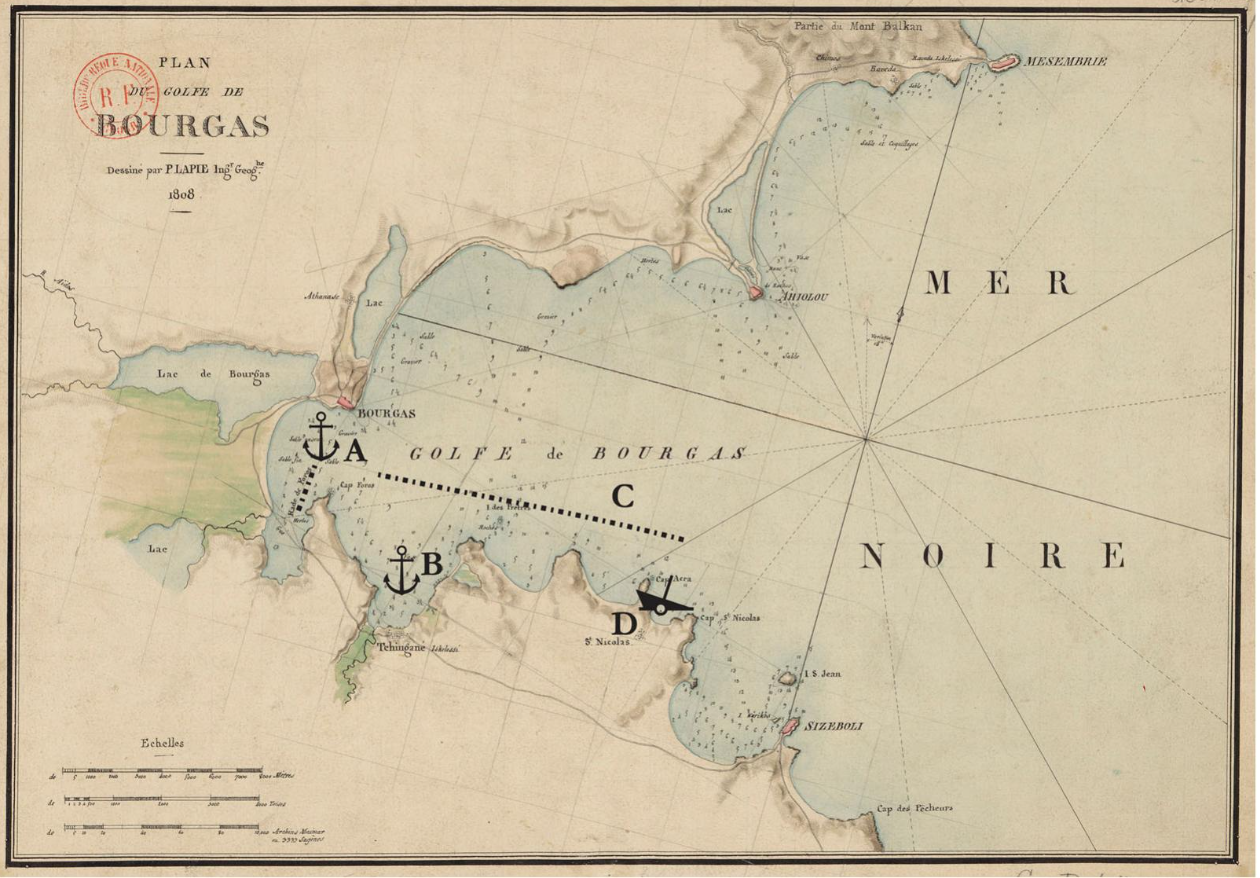
Gulf of Burgas
Once re-provisioned and with the weather easing, they continued towards the Bosphorus. Five miles from Constantinople, they called at Amoudki (possibly Arnavutköy) to take on water when a severe gale blew up. All hands were called on deck to try and steady the ship so the anchor could be safely released or ‘let go’. Henry had just cockbilled the anchor and, looking over the side and seeing that it was clear before letting it go, he saw a Kaique full of men drifting just where the anchor would have fallen.
The Sussex Lass stayed at Amoudki for about a week before getting underway again for their return journey. Sailing through a heavy gale, they reached Malta on Christmas Day 1848. Henry tells of being constantly wet and of having to clear the deck of the ‘muck’ after losing and replacing their jib-boom. The stormy weather continued and, on reaching the Isles of Scilly, they were very nearly wrecked; had it not been for the lookout, they would have been driven onto the rocks.
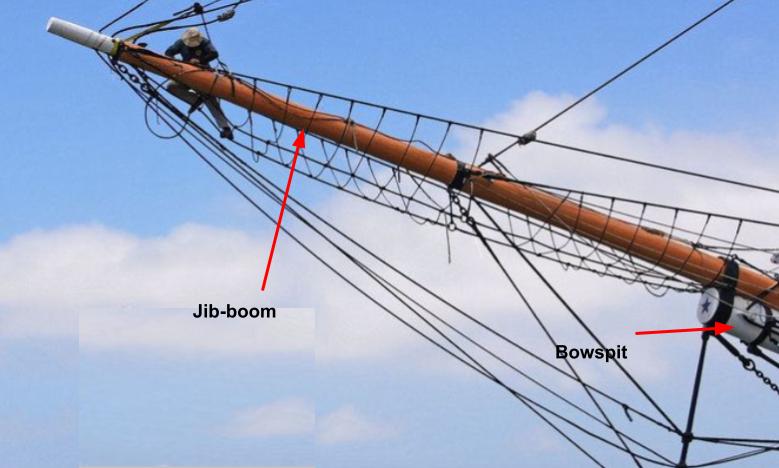
Jib-boom is a used to extend the length of a bowsprit on sailing ships.
On January 9, 1849, they anchored in St Sampson’s harbour, Guernsey, before heading for Falmouth where they received their next sailing orders. Knowing that Henry would be calling there, his family sent a letter to tell him that two of his sisters had married and were sailing the very next week to America. “…I begged hard for leave to go and see them, but it could not be…” heartbreakingly . “.. the younger of them I never saw again…”
Mary Ann & Amelia Foster The Congregational Chapel was rebuilt in the 1880s and is now the Landmark Centre. The sisters, Mary Ann and Amelia, had both married just two days after their brother’s ship had arrived in Falmouth, on January 24, 1849. They married their respective husbands, George Ekins and Edward Reynolds, in Deal’s old Congregational Chapel on Lower (High) Street. It was known locally that the couples were to emigrate and the Kentish Gazette reported that ‘A very large congregation attended to witness the ceremony. Great interest was excited, as the above (couples) intend, in a few days, emigrating to Illinois, United States.’ Travelling by steerage on board the Sir Robert Peel, the newlyweds left London on February 6 1849, arriving in New York on March 10. Why the apparent haste is not clear. Maybe they had friends or relatives in Peoria where they first settled; the town was certainly mentioned in the newspapers of the time, including ‘Emigrant’. Amelia, in early 1850, gave birth to a daughter who was named Emily. In that year’s census Edward’s employment was given as a pedlar, and living with them was Benjamin, Amelia and Mary Ann’s brother. Amelia, as Henry hinted at in ‘Reminicenses…’, sadly died in March 1852, possibly following complications after giving birth to her son Harry. Emily and Harry would remain close to their Uncle Benjamin, and Harry may well have worked for his uncle, as a printer, until his early death in 1883.
Mary Ann and George settled in Galesburg, Illinois, where they raised their family. George found employment initially as a tailor, later becoming an assessor, but it is not clear in what field of work that was.
Sussex Lass departed Falmouth on February 2, 1849, with orders that sent her to Westport in Ireland, of which Henry said, “…is provided with a natural harbour…the outer harbour of Westport would contain some thousands of ships at one time; it is one of the safest ports I ever was in…” He goes on to say that “…the inhabitants were half savage and that everything was cheap…” saying that he could buy made-to-measure Wellington boots for 14 shillings and knitted stockings at a shilling or 1s/3d per pair. As was Henry’s way, his mind turned to religion, remarking that he was astonished that the country was so “…overrun with popery and as full of superstition as the South Sea Islanders…” While in Westport, he visited the Protestant chapel where he found a congregation of about a dozen people.
One Sunday evening, all the crew went onshore leaving Henry and Captain French on board when he saw a young man “…ill treating an emaciated beggar on the quay (sic)…” when the beggar tried to make his escape by running up Sussex Lass’s gangplank with his tormentor following him. As the beggar reached the ship, Henry gave his “…pursuer such a swinging blow that he tumbled feet first between the ship and the quay…” Henry reached the quay just as the tormentor pulled himself out of the water and, before he had time to recover, Henry, very much against his nature, launched himself at the soaking man and “…gave him as good a pommelling as he ever had in his life…” Henry was so enraged by the treatment of the beggar that he could not stop beating the man for a while. When he did, the man left the quay like a wounded calf but soon came back with about fifty fishermen, prompting Henry and the captain, still alone on the Sussex Lass with the poor beggar, to try and pull in the gangplank. Unfortunately, they weren’t quick enough and a stone was thrown which hit the captain in the chest and another struck the main boom, leaving a notch in the wood. The arrival of the police saved them but nonetheless left Henry fearing to go onshore in daylight and writing, “…I have no doubt they would have killed us…” When he did venture onshore, it was at night and with a cudgel.
Departing Westport, for Cardiff, they were piloted out by the pilot’s fourteen-year-old son. Though Henry does not say who he was, he must have been fairly impressed to mention the fact.
Lisbon
Back in Cardiff they took on coal and set sail for Lisbon, a city which Henry describes as a magnificent place but, like many others, more imposing from a distance. Such were the quarantine restrictions they caused Henry to write “…quarantine regulations are absurdly ridiculous, as well as the Customs…” The merchant vessels were moored between four gunboats in a quadrangle from where, before any boat left for the shore, it had to report to the nearest gunboat to be searched. “…I have known them from stopping a boat for having a ¼ lb of soap…” Whether this was the action of a petty official or not is not clear, but Portuguese import duties at the time were, as Henry alluded to, complicated.
With the passing of quarantine, Sussex Lass was loaded with salt and wine by the merchant’s own men. To Henry’s surprise, when the first wine pipe, the large barrel or cask used for storing, transporting, or ageing wine was lowered into the hold, the man in charge called for a gimlet and spile, and drew off several gallons for the crew. Additionally, the merchant gave Henry a barrel which they enjoyed on the onward voyage to Rio Grande, Brazil.
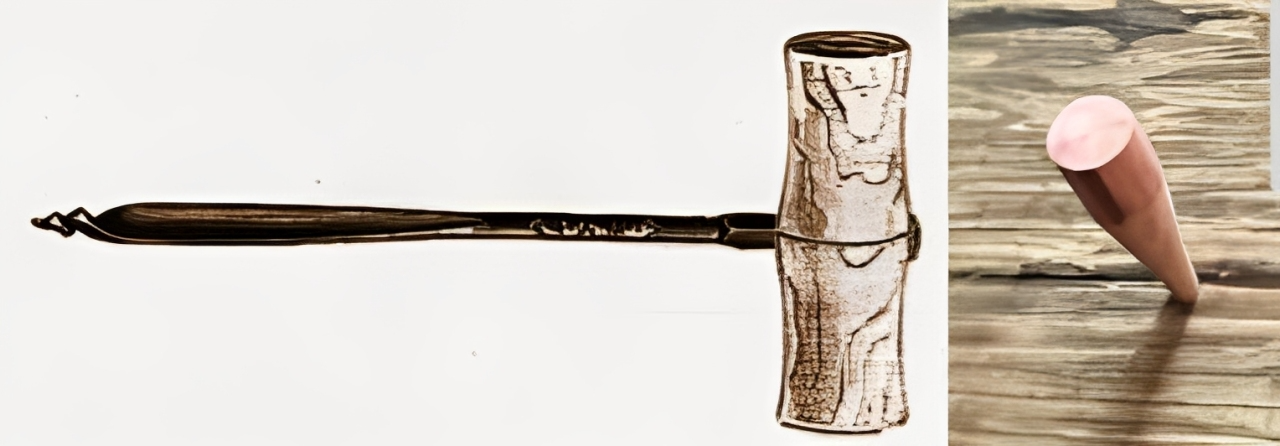
Gimlet and Spile
On reaching Rio Grande they came up against pilotage regulations which Henry describes as abominable. Pilots across the world were supposed to guide vessels safely through straits of water and into harbours. At Rio Grande Henry writes that “…they never board a ship until she is inside (the harbour) and out of danger…” Once in the harbour it is very secure as the anchor becomes embedded in the mud, meaning that it is in turn very hard to heave up. Due to the many Saints’ Days that were celebrated, it was hard to get the cargo discharged and another loaded. This was often only achieved by paying double the customs fees and hoping that the workers didn’t stop when they pleased.
“…Cattle is the principle production of this district, the bullock is killed for its hide which are then salted and stowed in the ship’s hold…” Henry found and enjoyed the best quarter of beef in the local market. He remarks upon the numerous horses saying “…though small, but will endure great fatigue…” On one occasion Henry hired one of these ‘small’ horses and rode 20 miles inland to a farm, travelling through hilly and grassy terrain and passing by herds of cattle that were left to roam free. At the farm he was given a demonstration of how they caught the cattle, rounding them up on horseback and using a lasso. It was not just the men who were skilled horsemen and cowhands, as the “…farmer’s wife, a little pretty creature with long black hair down to her waist, jumped on to a horse with no saddle, and caught a bullock in a few minutes…” Henry also admired the horses who, he says, “…seemed to take a pleasure…” in the work.
The scenery he describes as not having much variety, but he thought that if properly cultivated, anything could grow there. The rivers abounded with fish, principally mullet; water could be found anywhere close to shore by digging small holes and overnight they would fill with fresh water. The town, though, looked poverty-stricken and some of the streets were clogged with sand.
The loading and unloading of the ships was carried out by slaves and it was Henry’s task, once he had woken the crew, to fetch the slaves waiting on the shore. Of them he writes, “…they were a quiet looking lot of fellows and seemed very docile…” Slavery in Brazil was not abolished until 1888.
After six weeks in Rio Grande, they headed for home. With nothing but gales and wind all the way, they finally arrived in Bristol with their cargo of 5,573 ox horns and 14,000 salted ox hides, to find it was a day of thanksgiving. There had been a cholera outbreak in 1849 which “…decimated several towns in Cornwall…” It had abated by early November, so Queen Victoria ordered a day of thanksgiving to be held on Thursday 15 November, with the Archbishop of Canterbury prescribing a ’certain form of prayer’ to be used. Henry doesn’t say if the crew took part in any of the services or simply said prayers on board.
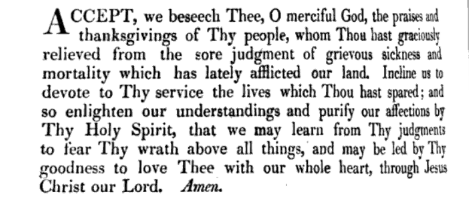
Authorised Thanksgiving Morning Prayer November 15 1849